In today's world, businesses are constantly faced with the challenge of doing more with less. Teams must be able to respond to customers more quickly, have information processed correctly, deal with increasing workloads, and keep an eye on costs while operating. But there are still numerous companies that are stuck in the cycle of repetitive manual work that takes up significant time and money from employees.
This is where an AI workflow automation service can go a long way. When AI is paired with workflow automation, businesses can automate repetitive tasks, minimize human error, boost productivity, and free employees to handle more valuable tasks.
Whether it's in customer support or sales, finance, HR, operations, or marketing, AI automation is transforming the way organizations are developing and implementing business processes. Partnering with an experienced AI development company can also guide businesses in determining the best processes that can be automated and the solutions that can be integrated into their current tech infrastructure.
What Is AI Workflow Automation?
AI Workflow Automation employs artificial intelligence to streamline and automate business workflows that were previously performed by humans. Unlike traditional automation, which often relies on fixed rules, AI-driven workflows have the ability to process data, recognize patterns, make decisions, and initiate actions in response to changes in context.
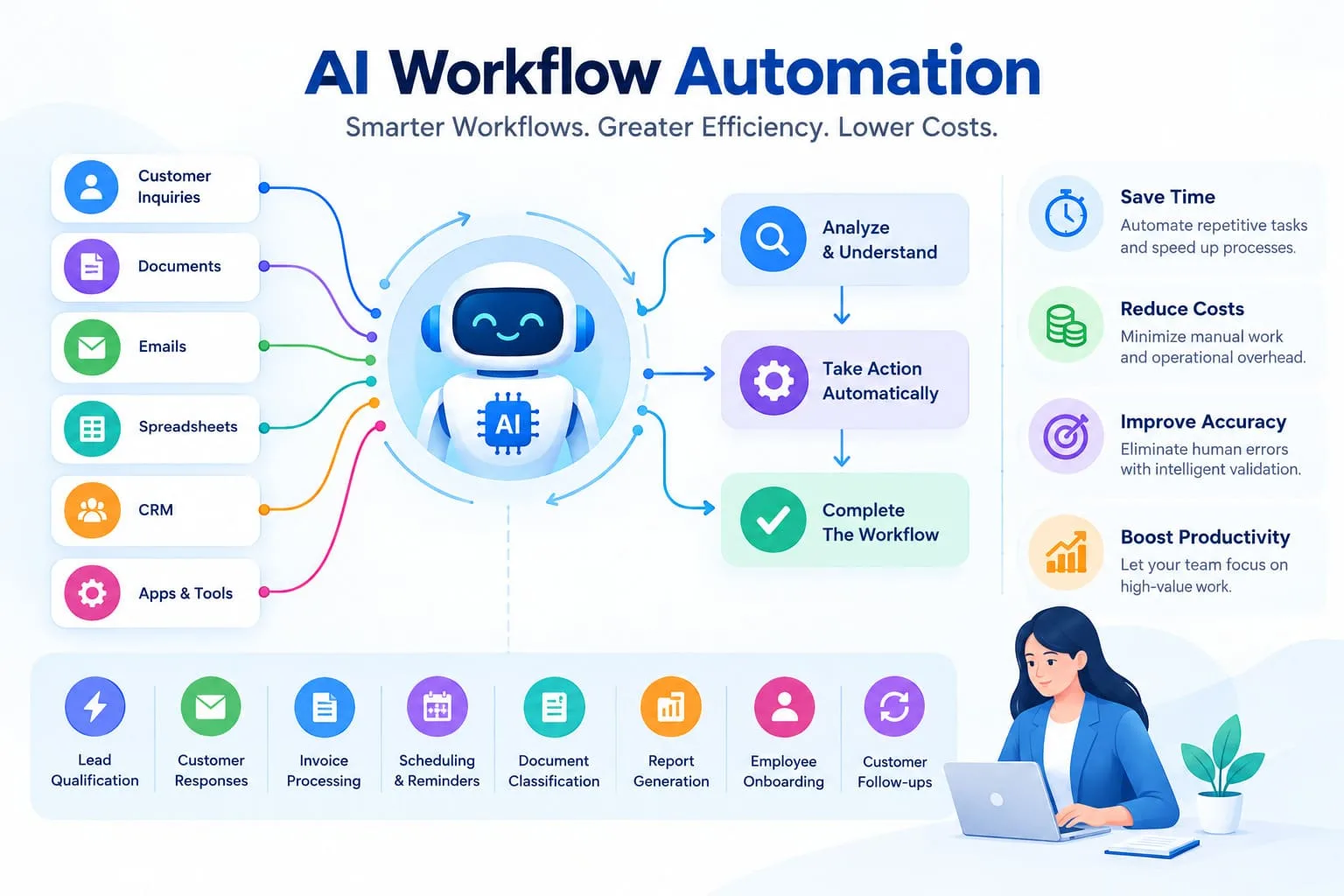
A typical workflow could automatically email a customer when a form is submitted. This workflow can be taken a step further by using AI to analyze the customer's message, determine intent, categorize the lead, update the CRM, assign the request to the correct person, and then create a tailored reply.
It is a blend of automation and intelligence that enables businesses to build workflows that are more efficient, agile, and can handle more complex tasks in the future.
How AI Workflow Automation Reduces Business Costs
Reducing costs is among the primary drivers behind workflow automation in businesses. Organizations can save employee time on repetitive tasks and redirect employees to tasks that directly drive growth by automating routine processes.
1. Saves on manual labor expenses.
An AI workflow automation service can automate repetitive tasks like data entry, document processing, email management, invoice processing, scheduling, and report creation. Businesses can save employee time and cut down on expenses by decreasing manual tasks. Automation is more effective than hiring people, allowing teams to devote their time to strategic, creative, and revenue-generating tasks.
2. Minimizes Human Errors
Manual methods can lead to data entry errors, lost emails, duplicate data entries, and wrong calculations. AI-driven workflows automate repetitive tasks and validate data before it moves on to the next step in the workflow. This will help to make the process more accurate, reduce costly errors, and save the employee time in correcting errors. Businesses can then get more predictable and consistent results.
3. Reduces Operational Overhead
A business may use several different platforms, such as CRMs, spreadsheets, accounting software, email solutions, and project management software. AI automation can tie such systems together and automatically transfer information. This will minimize repetitive administrative tasks, remove the need to handle unnecessary data, and keep employees from having to move back and forth between applications, ultimately increasing workflow efficiency and decreasing operational overhead.
4. Improves Resource Utilization
By automating tasks using AI, companies can make their resources work even more efficiently without hiring more people. Orders, inquiries, inventory, notifications, and reporting can be automated to manage bigger workloads. This enables workers to focus on more value-added tasks, while boosting productivity, scalability, and overall business performance.
How AI Automation Saves Valuable Time
Time is another major business resource. Every hour employees spend on repetitive work is an hour they cannot spend on strategy, innovation, customer relationships, or revenue-generating activities.
1. Automates Repetitive Tasks
Repetitive tasks, like lead qualification, replying to emails, invoice processing, data synchronization, scheduling, document classification, reporting, employee onboarding, and customer follow-ups, can be performed using AI workflow automation. By automating these tasks, employees save valuable time, manual involvement is minimized, and teams can dedicate their time to strategic and more impactful business activities.
2. Speeds Up Decision-Making
AI-powered workflows can process vast amounts of information, detect patterns, summarize documents, classify leads, and even provide valuable recommendations, all in a matter of moments. AI can automatically generate relevant insights, saving employees time on data collection and organization and helping managers make faster, more informed business decisions.
3. Enables 24/7 Workflow Execution
Unlike human teams, automated workflows can have no standard working hours, and work around the clock. AI can handle incoming customer questions, modify records, track important events, and send alerts at any time of the day. This enables businesses to provide support to their customers in various time zones, respond quickly to customer inquiries, and minimize the amount of manual monitoring.
Business Areas That Benefit From AI Workflow Automation
AI workflow automation can be applied across almost every department.
Sales and Lead Management.
Sales teams can automate lead capture, lead qualification updates to the customer relationship management system, follow‑up emails, and the assignment of leads. Artificial intelligence can analyze leads and help Sales representatives prioritize prospects using business criteria that are set in advance.
Customer Support
Customer support teams can use AI workflows to sort customer requests, give responses, send complex problems to human agents, and update support tickets automatically. This approach can cut response times while letting support representatives focus on issues that need judgment.
This can help to speed up the reply time but still permitting support agents to focus on issues needing human judgment.
Finance and Accounting
Finance teams can automate invoice processing, expense categorization, payment reminders, document extraction, and financial reporting. Artificial intelligence can pull data from documents. Move relevant information into accounting systems, cutting manual data entry.
Human Resources
Human resources departments can use automation for employee onboarding, interview scheduling, document collection, internal communications, and answering questions. Automating these HR tasks gives teams more time to focus on employee engagement and strategic workforce planning.
Marketing
Marketing teams can automate content workflows, lead nurturing, campaign reporting, customer segmentation, and social media processes. Artificial intelligence can also analyze customer data. Help marketing teams personalize communications based on customer behavior.
AI Automation vs. Traditional Automation
Traditional automation generally relies on fixed rules such as "if this happens, then do that." It works well for predictable and repetitive processes but can struggle when information is unstructured or conditions change.
AI automation adds intelligence to these workflows. AI can work with text, documents, customer messages, and other forms of information that require interpretation.
For example, traditional automation may send every customer inquiry to the same department. AI automation can analyze the inquiry and determine whether it relates to billing, technical support, sales, or another category before routing it appropriately.
This makes AI-powered automation particularly valuable for businesses dealing with large amounts of unstructured information.
How to Choose the Right AI Development Company
Successful automation is not about adding an AI tool to a process. Businesses must know which workflows should be automated, how systems should be connected, what data the AI will use, and where human oversight is required.
An experienced AI development company can examine business processes and spot opportunities for automation. It can also help with AI model integration, API connections, workflow design, data handling, testing, security, and continuous optimization.
Businesses should choose a development partner that understands both AI technologies and real-world business processes. The goal must be to build automation that delivers improvements, not simply to add technology for its own sake.
Conclusion
Businesses can benefit from an AI workflow automation service in several ways, including cost savings, time savings, increased accuracy, and streamlined processes. Whether it's in sales, customer service, finance, HR, or marketing, AI automation can automate repetitive tasks and free up time for employees to work on tasks that demand creativity, expertise, and human judgment.
But the adoption of these processes and technologies will require a proper selection of them for the successful implementation of the project. Additionally, by working with an experienced AI development company, businesses can create scalable workflows that seamlessly integrate AI with their current systems.
AI workflow automation is no longer just a productivity tool; it is becoming a necessity for businesses as they invest in intelligent technologies. As businesses increasingly embrace intelligent technologies, AI workflow automation is emerging as more than just a productivity tool; it is a must-have. It has become a viable approach to developing faster, slimmer, and more competitive companies.