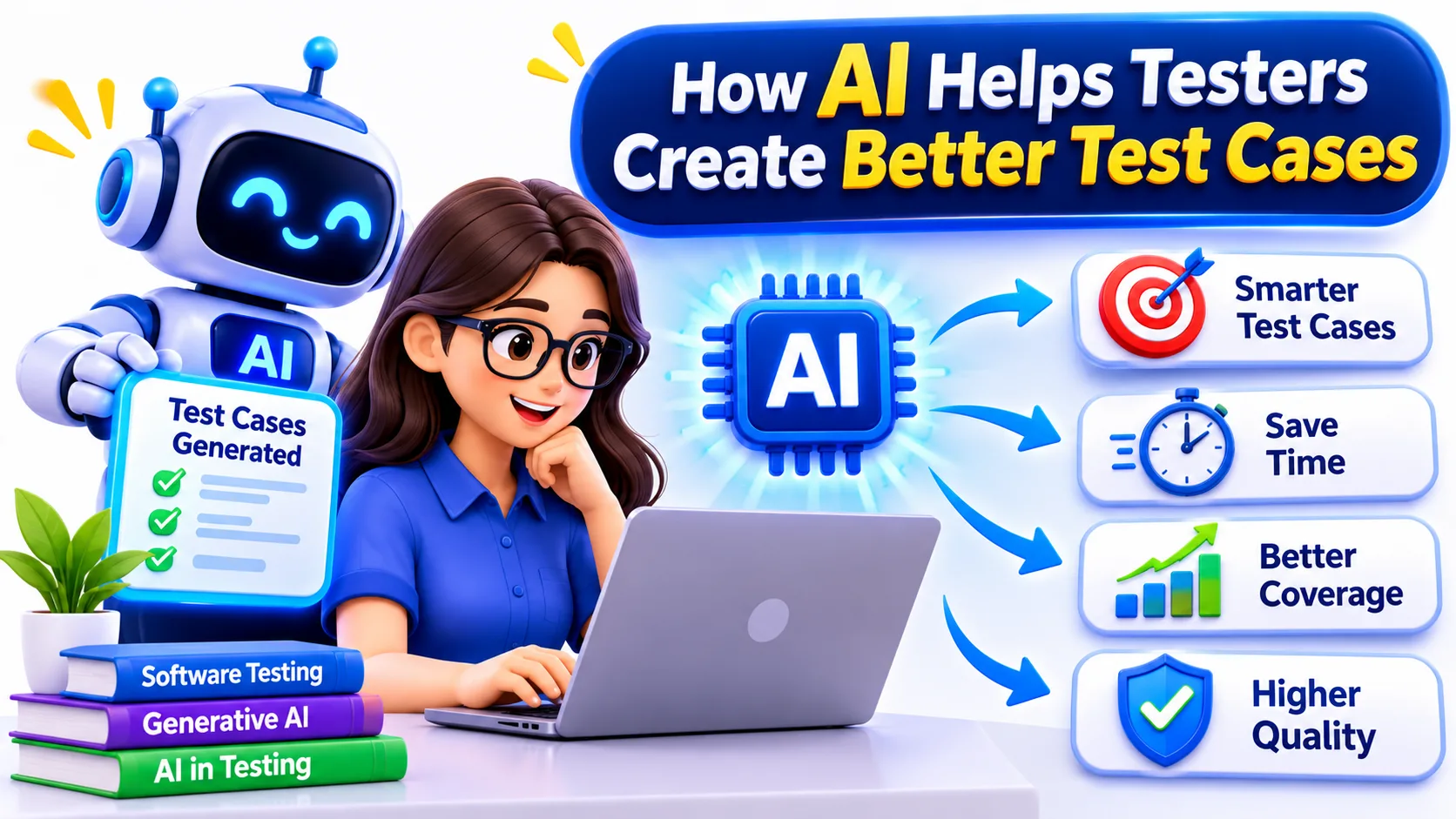
Writing test cases is one of the most important activities in software testing. Testers need to understand application requirements, identify possible user actions, and prepare steps to verify whether each feature works correctly. However, preparing test cases manually can take time, especially when an application has many features and business rules.
Artificial Intelligence (AI) is making this activity more efficient by helping testers prepare test ideas, identify possible scenarios, and organise testing information. Learning how to use AI in test case preparation is becoming a useful skill for people interested in modern quality assurance.
What Is AI-Based Test Case Generation?
AI-based test case generation uses artificial intelligence to suggest test scenarios or draft test cases based on information such as requirements, user stories, application details, or existing test documentation.
For example, a tester can provide a requirement describing a login page and ask an AI assistant to suggest positive and negative test scenarios.
The AI may suggest checking valid credentials, incorrect passwords, empty fields, password visibility, and account lockout conditions.
In Software Testing Training in India the tester can review these suggestions, correct them, and convert suitable scenarios into final test cases.
How AI Supports Test Case Preparation
1. Understanding Requirements
Testers can use AI to simplify lengthy requirements and identify important conditions. It can help summarise what a feature should do and highlight areas that may need further clarification.
However, unclear requirements should still be discussed with the business analyst or concerned team member.
2. Suggesting Test Scenarios
AI can generate possible scenarios based on a feature description. This helps testers explore different user actions and conditions.
For example, for a shopping cart, AI may suggest adding products, removing products, changing quantities, applying discounts, and checking the final price.
3. Creating Positive and Negative Test Cases
A complete test process should include successful and unsuccessful situations. AI can suggest both types of test cases.
For a registration page, positive scenarios may include entering valid details, while negative scenarios may include invalid email addresses, missing mandatory fields, and weak passwords.
4. Identifying Boundary Conditions
Boundary Value Analysis is a testing technique used to check values at the limits of an accepted range.
Suppose a form accepts an age between 18 and 60. AI can suggest checking values such as 17, 18, 19, 59, 60, and 61.
The tester should confirm that these values match the actual business requirement.
5. Improving Test Documentation
AI can help organise test cases into a structured format containing test case ID, description, preconditions, steps, test data, and expected result.
This can make documentation easier to prepare and review.
Practical Example: Creating Test Cases for a Password Reset Feature
Imagine an application allows users to reset their passwords through an email link.
A tester can describe the requirement to an AI assistant and request possible test scenarios.
The suggested scenarios may include:
- Enter a registered email address.
- Enter an unregistered email address.
- Submit the form without an email address.
- Open a valid password reset link.
- Open an expired reset link.
- Enter a new password that does not meet password rules.
- Enter two different passwords in the confirmation fields.
- Try to reuse an already-used reset link.
The tester must verify each scenario against the actual requirements and application behaviour before using it.
Limitations of AI-Generated Test Cases
AI can save preparation time, but its suggestions are not always correct. It may misunderstand business rules, miss important scenarios, or generate test cases that do not apply to the application.
It may also suggest many similar test cases without improving meaningful test coverage.
For this reason, testers should review every generated test case, verify expected results, check missing conditions, and remove irrelevant suggestions. Human knowledge and business understanding remain important.
Learn AI-Based Testing Through Practical Training
People interested in software testing should understand both traditional testing concepts and AI-assisted techniques. Software Testing Training Using AI can introduce learners to test case design, prompt writing, test data preparation, defect reporting, and practical AI applications.
A structured learning approach should begin with software testing fundamentals before moving to AI-assisted activities. This helps learners understand what needs to be tested and how to evaluate AI-generated suggestions.
At TechPratham, learners can develop software testing knowledge through instructor-led sessions, practical assignments, real-time project scenarios, and interview preparation.
Conclusion
AI can support testers in preparing test scenarios, identifying boundary conditions, and organising test documentation. It can make test case preparation more efficient when used with clear requirements and proper review.
For aspiring testers, learning how to combine software testing fundamentals with AI-assisted test design can help build relevant skills for modern QA work.