In today’s hyper‑connected world, a call‑center conversation is often the first—and sometimes only—direct touchpoint a customer has with a brand. A pleasant, consistent voice experience can turn a routine inquiry into a loyalty‑building moment, while a jarring or mismatched tone can do the opposite. Enter AI harmonizer technology: a suite of real‑time audio processors that align pitch, tone, and even accent to deliver a seamless, professional sound across every interaction.
From Static Scripts to Dynamic Voice Harmony
Traditional voice‑over studios have long relied on manual voice harmonization—the art of blending multiple vocal tracks so they sound natural together. In a call‑center setting, however, each agent’s voice is unique, varies throughout the day, and must adapt instantly to different customer profiles. Early attempts to standardize sound quality involved static equalizers and pre‑recorded prompts, which offered limited flexibility.
Modern AI harmonizers change the game by applying machine‑learning models directly to the live audio stream. These models analyze an agent’s speech in milliseconds, then adjust pitch, timbre, and resonance to match a predefined brand voice. The result is a uniform, soothing sound that feels both personal and polished—without forcing agents to “speak like a robot.”
Accent Changing Software: A New Layer of Inclusivity
One of the most striking advances is the integration of accent changing software within the AI harmonizer pipeline. Companies operating globally often face the challenge of serving customers whose native languages and dialects differ from those of the agents. Rather than hiring multilingual staff for every market, AI can now subtly modulate an agent’s accent to align with the listener’s expectations.
The technology works by training on large corpora of regional speech patterns, then applying a transformation that preserves the agent’s natural rhythm while shifting phonetic cues. The outcome? A conversation that feels native to the customer without compromising authenticity or comprehension. This not only improves satisfaction scores but also reduces the operational overhead of maintaining multiple language‑specific teams.
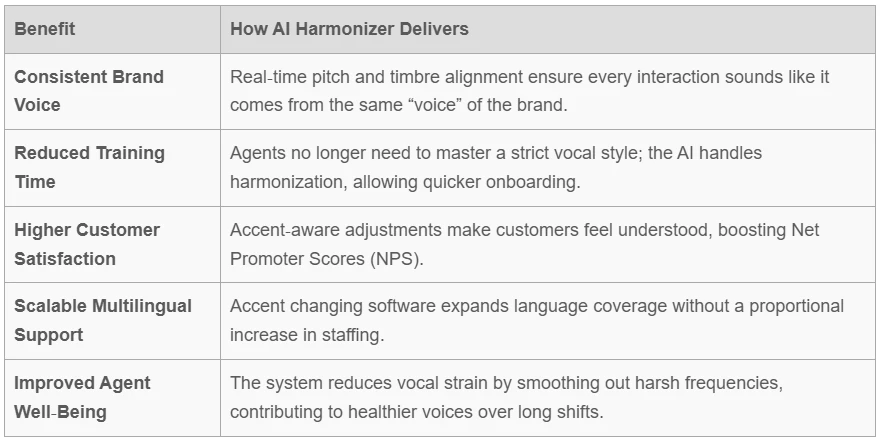
Real‑World Benefits for Call Centers
Looking Ahead: The Next Wave of Voice AI
The future will likely see AI harmonizers paired with sentiment analysis and adaptive dialogue systems. Imagine a call where the AI not only smooths the voice but also detects frustration, subtly softening the tone to de‑escalate tension—all in real time. As computational power continues to drop and edge‑processing becomes mainstream, these capabilities will become standard even in modest call‑center setups.
Takeaway
AI harmonizer tools are doing more than just polishing audio; they are redefining what voice harmonization means in the fast‑paced world of customer service. By combining sophisticated pitch correction with accent changing software, they deliver a consistent, culturally attuned, and agent‑friendly voice experience. For call centers looking to elevate their brand, invest in AI‑driven harmonization now—because the next conversation your customers have with you will be heard, not just listened to.