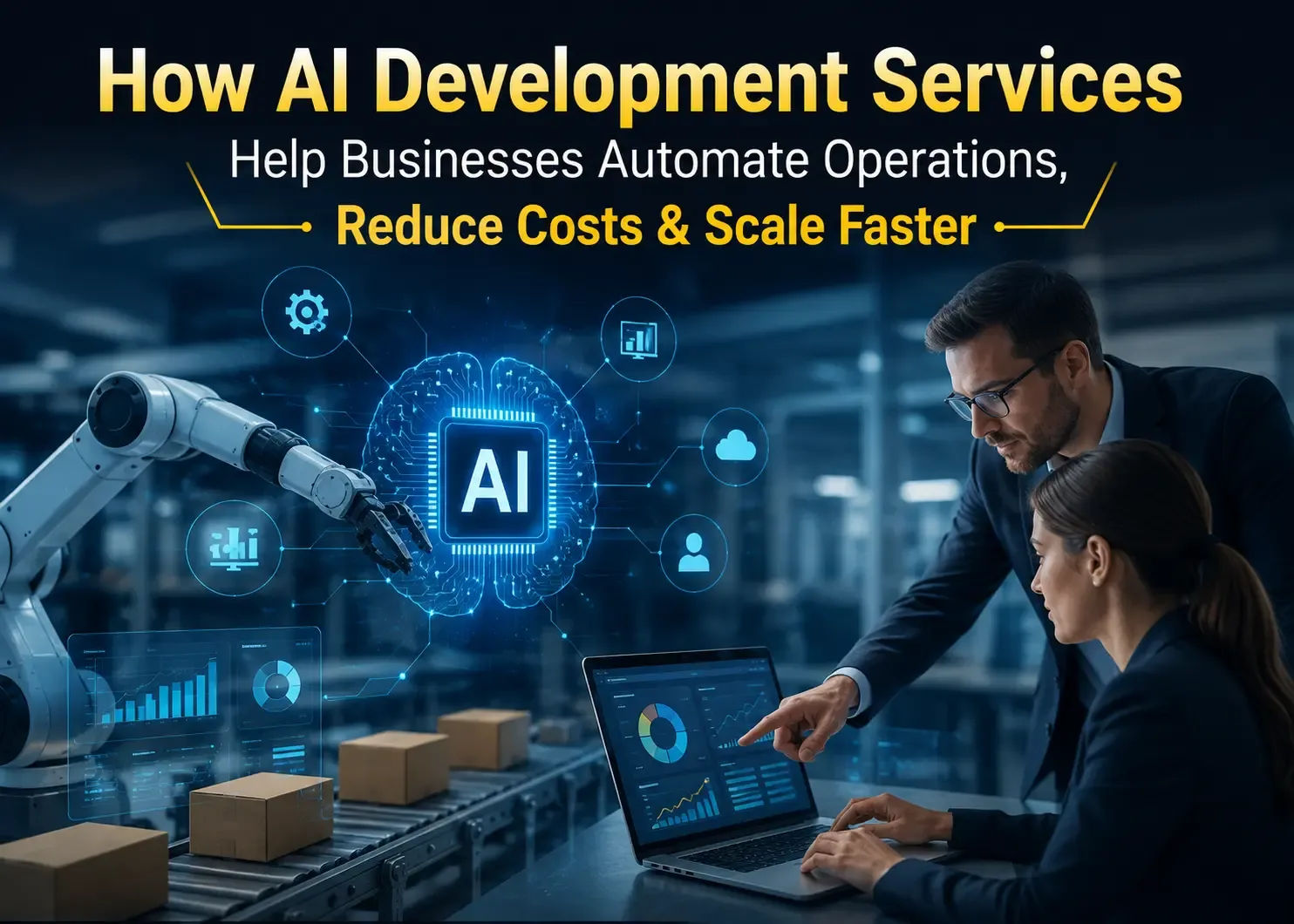
Artificial intelligence is becoming an important part of how modern businesses manage operations, serve customers, analyze information, and make decisions. What started as an experimental technology is now being integrated into everyday business processes, from customer support and document processing to forecasting, fraud detection, and workflow management.
Yet adopting AI successfully requires more than adding a chatbot or connecting an application to a large language model. Businesses need AI systems that understand their operational requirements, work with existing technology infrastructure, protect sensitive information, and produce measurable business value.
AI development services help organizations build these capabilities around their specific requirements. Instead of relying entirely on generic automation tools, businesses can develop intelligent applications that integrate with their existing workflows and continuously improve as operational requirements evolve.
Transforming Manual Processes Into Intelligent Workflows
A significant amount of operational effort in businesses still goes into repetitive activities. Employees may spend hours reviewing documents, entering information into systems, responding to common customer questions, categorizing requests, checking records, or preparing recurring reports.
AI can introduce intelligence into these workflows by combining technologies such as machine learning, natural language processing, computer vision, intelligent document processing, and workflow orchestration.
For example, an AI-powered document processing system can extract information from invoices, contracts, applications, and purchase orders before sending structured data to an ERP or accounting platform. Similarly, natural language processing can analyze incoming emails, identify their intent, and automatically route them to the appropriate department.
This creates a more efficient operating model in which software handles predictable activities while employees focus on tasks requiring judgment, creativity, negotiation, and domain expertise.
The most effective automation strategies do not attempt to automate everything. Instead, they identify repetitive, high-volume, rules-driven processes where AI can create measurable improvements without introducing unnecessary complexity.
Building AI Systems Around Business-Specific Requirements
Generic AI tools can be useful for experimentation, but enterprise environments often have requirements that off-the-shelf solutions cannot completely address. Businesses may need AI applications connected to proprietary databases, internal knowledge repositories, CRM platforms, ERP systems, APIs, analytics environments, or industry-specific applications.
An AI Development Company can help organizations design these systems around their existing technology ecosystem rather than forcing business processes into a predefined product.
This can involve developing custom machine learning models, integrating foundation models, creating retrieval-augmented generation systems, building recommendation engines, developing intelligent assistants, or embedding predictive capabilities directly into business applications.
Custom development also provides greater control over how AI interacts with organizational data. Access permissions, authentication mechanisms, encryption, logging, model evaluation, and human approval workflows can be incorporated into the architecture.
This becomes particularly important when AI applications handle confidential customer information, financial records, intellectual property, employee data, or other sensitive business information.
Reducing Operational Costs Without Sacrificing Quality
The cost benefits of AI are not limited to reducing the amount of manual work. Intelligent automation can also reduce errors, shorten processing cycles, improve resource utilization, and prevent operational bottlenecks.
Consider a customer-service operation handling thousands of requests. Employees may spend considerable time answering routine questions before reaching more complicated cases. An AI assistant can handle common requests, retrieve relevant information, summarize conversations, and escalate unusual cases to human representatives.
The result is not simply fewer manual interactions. Customer-service teams can spend more of their available capacity on complex issues where human intervention has greater value.
AI can contribute to operational efficiency through:
- Automating repetitive data-processing activities
- Reducing manual entry and reconciliation errors
- Accelerating document review and classification
- Improving employee productivity through intelligent assistants
- Detecting anomalies before they become expensive problems
- Optimizing resource allocation across operational teams
- Supporting faster customer-response processes
However, organizations should calculate AI's total cost of ownership before implementation. Cloud infrastructure, model inference, data preparation, API usage, monitoring, security, integration, and ongoing model maintenance all influence the economics of an AI system.
A successful AI strategy therefore focuses on sustainable efficiency rather than automation for its own sake.
Making Business Decisions More Data-Driven
AI can also improve operations by turning large volumes of business data into actionable intelligence. Traditional reporting generally explains what has already happened. AI-powered analytics can help businesses identify patterns, estimate future outcomes, and recommend potential actions.
Predictive models can be applied to areas such as customer churn, demand forecasting, inventory planning, fraud detection, equipment maintenance, and sales forecasting.
For instance, a manufacturer can combine machine telemetry, maintenance history, production data, and operational conditions to identify signals associated with equipment failure. Maintenance teams can then investigate potential problems before they result in significant downtime.
In retail, AI can analyze purchasing behavior, product demand, inventory levels, seasonality, and other variables to support more accurate replenishment decisions.
Generative AI introduces another useful capability: natural-language interaction with enterprise information. Through retrieval-augmented generation, an AI application can retrieve information from approved internal sources and provide contextual answers instead of requiring employees to search through multiple documents and systems manually.
The quality of these systems depends heavily on the underlying data. Poorly structured, outdated, duplicated, or inaccessible data can undermine even sophisticated AI models.
Scaling Operations Without Scaling Complexity
Business growth usually increases operational complexity. More customers create more support requests. More transactions generate larger datasets. Expanding into new markets introduces additional workflows, languages, regulations, and customer expectations.
Traditional processes often require businesses to increase headcount and operational resources at a similar pace. AI can provide an alternative by allowing certain processes to handle increasing workloads without requiring a proportional increase in manual effort.
An AI-enabled customer-support system, for example, can process and classify large numbers of interactions simultaneously. An intelligent document-processing platform can handle additional documents without requiring employees to manually review every record. Automated analytics can continuously process incoming data and surface relevant changes to decision-makers.
This does not mean AI eliminates the need for people as a business grows. Instead, it changes where human capacity is required.
Employees can move from repetitive execution toward exception handling, strategic planning, customer relationships, quality assurance, and higher-value decision-making.
Integrating AI With Existing Enterprise Technology
One of the biggest challenges in enterprise AI adoption is integration. Businesses rarely operate on a single application. Their technology environment may include CRM systems, ERP platforms, databases, cloud services, data warehouses, customer portals, payment systems, communication tools, and legacy applications.
AI needs to operate within this environment rather than becoming another isolated application.
API integrations, event-driven architecture, microservices, middleware, data pipelines, and cloud infrastructure can connect AI capabilities with existing systems. This allows an AI model to retrieve information, perform analysis, trigger workflows, or return recommendations within established business processes.
For example, an AI sales assistant could retrieve customer information from a CRM, summarize previous interactions, identify potential opportunities, and provide recommendations to a sales representative without requiring the employee to switch between several applications.
Good integration architecture also makes AI systems easier to maintain and scale as business requirements change.
Maintaining Security, Governance and Human Oversight
AI adoption introduces risks that businesses need to address from the beginning. Sensitive data may pass through models, generated responses may contain inaccuracies, and automated decisions can create operational or compliance issues if they are not properly controlled.
Organizations should establish governance mechanisms covering data access, model evaluation, security, monitoring, audit trails, and human intervention.
Human oversight remains particularly important for high-impact decisions. AI can provide recommendations, identify patterns, and automate routine actions, but organizations should define situations where human approval is mandatory.
Model monitoring is equally important. AI systems can experience performance degradation when the underlying data changes. Regular evaluation helps identify issues such as model drift, inaccurate outputs, unexpected behavior, or declining prediction quality.
A responsible AI architecture therefore treats security and governance as core engineering requirements rather than features added after deployment.
Creating a Scalable Foundation for Future Growth
The long-term value of AI development comes from building capabilities that can evolve with the organization. A narrowly designed automation may solve one operational problem, but a well-architected AI platform can support multiple use cases over time.
Businesses can begin with a specific process where the value is relatively easy to measure and then expand into adjacent workflows. This approach reduces implementation risk while allowing teams to learn how AI performs within their operational environment.
The strongest AI initiatives combine business objectives with technical feasibility. Organizations should identify the processes creating the greatest friction, establish measurable performance indicators, evaluate data readiness, and determine where automation genuinely improves the existing workflow.
AI is ultimately not a replacement for sound business processes. It is an enabling layer that can make those processes faster, more intelligent, and more scalable.
Conclusion
AI development services can help businesses move beyond basic automation toward intelligent operational systems. By combining AI with existing applications, enterprise data, workflow automation, predictive analytics, and appropriate governance, organizations can reduce repetitive work while improving responsiveness and decision-making.
The greatest opportunity lies in using AI where it solves a clearly defined business problem. Companies that approach AI as an engineering and operational transformation initiative—not simply as a new software feature—are better positioned to build systems that deliver sustainable efficiency and support growth without allowing operational complexity to increase at the same rate as the business.