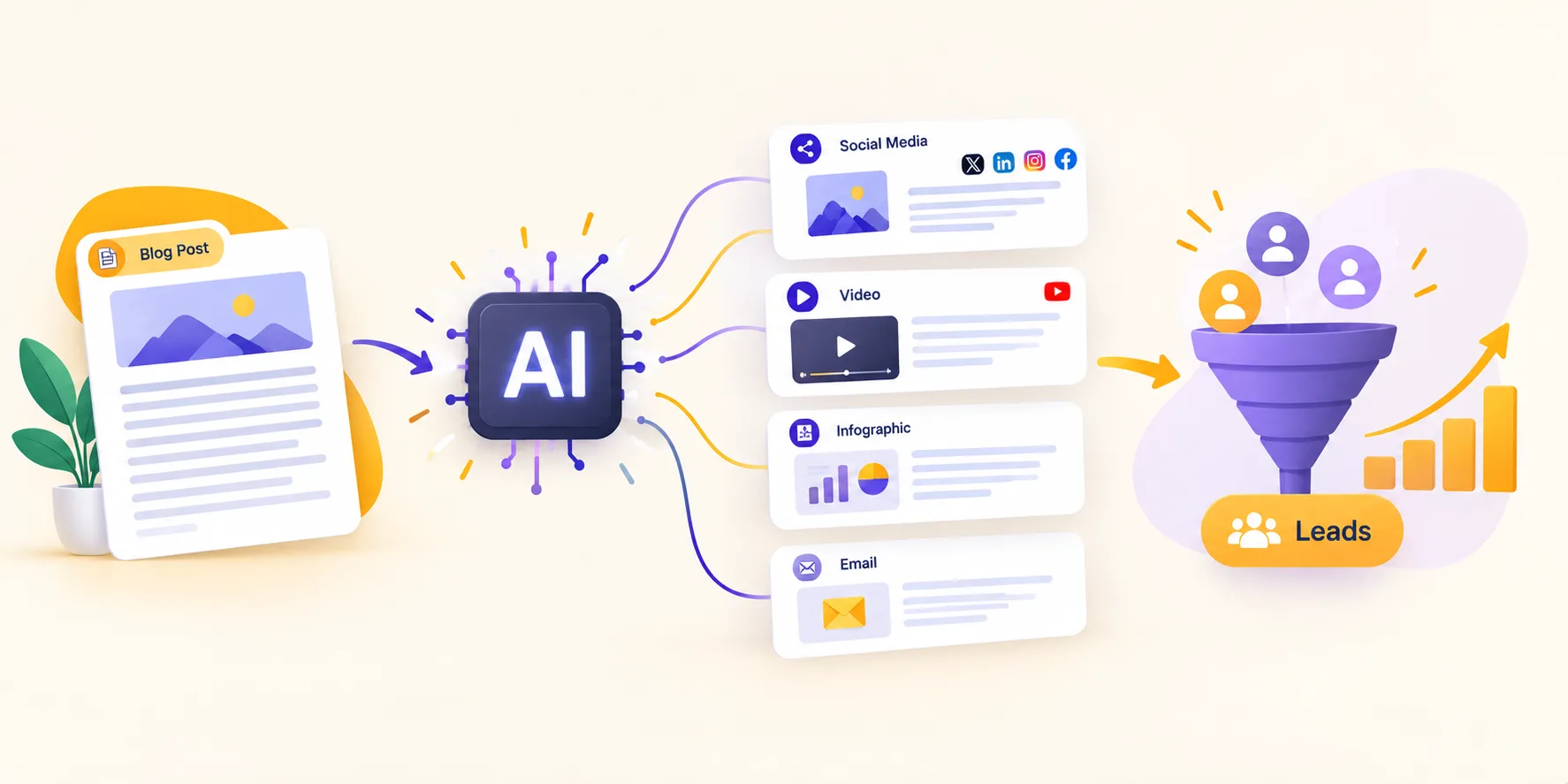
Many businesses have useful content sitting in their archives. Blog posts, webinars, customer interviews, research reports, and product demonstrations may contain valuable ideas, but each asset often reaches only a small part of its potential audience. Creating fresh content for every channel takes time, so marketing teams may struggle to maintain a consistent publishing schedule while supporting lead generation.
This is where AI content repurposing strategies can help. AI tools can identify key ideas, organize information, suggest new formats, and speed up the early stages of content production. Instead of starting from scratch every time, marketers can turn one strong source into several assets designed for different audiences and channels. The real value comes from combining that speed with human judgment, a clear distribution plan, and a focus on business results.
Why Does Content Marketing Become Difficult to Scale?
Publishing more content sounds simple until the production process becomes a bottleneck.
A single campaign might require a blog post, LinkedIn updates, email copy, a short video, sales material, and supporting visuals. Each asset needs to fit its channel and audience. Simply copying the same message everywhere rarely works.
Marketing teams also face a second problem: valuable content gets overlooked after publication. A detailed webinar may contain enough material for several articles, while an original research report may support a series of social posts and visual explainers.
Without a repeatable process, teams either create everything separately or leave these opportunities unused.
How Can AI Turn One Content Asset Into Multiple Pieces?
AI can help break a substantial piece of content into smaller ideas that suit different formats.
For example, a 45-minute webinar might contain a customer challenge, three practical recommendations, a useful industry statistic, and a discussion of common mistakes. AI can help identify these sections and suggest ways to develop them into individual assets.
One webinar could become:
- A detailed blog covering the main discussion
- Several LinkedIn posts focused on individual insights
- Short video clips featuring useful explanations
- An email summarizing the strongest takeaways
- An infographic presenting key statistics
- A downloadable guide combining related recommendations
Each asset should serve a specific purpose rather than repeat the original material word for word.
AI makes the initial breakdown faster, but the marketing team still needs to decide which ideas deserve further development and which formats make the most sense.
Which Content Should Businesses Repurpose First?
The best starting point is usually content that has already demonstrated value.
Instead of reviewing an entire content library without direction, marketers can prioritize assets using performance data and business relevance.
Look for content that attracts qualified organic traffic, generates leads, earns backlinks, receives meaningful engagement, or helps sales teams answer common customer questions.
A blog with steady traffic may be a good candidate for a short video series. A webinar that attracts decision-makers could support a downloadable eBook. A customer interview might provide material for a case study, a social campaign, and a sales presentation.
AI can help categorize existing assets by topic, format, audience, and potential reuse. Performance data should guide the decision, rather than assuming that every published asset deserves to be repurposed.
How Can AI Content Repurposing Strategies Support Lead Generation?
Repurposing becomes more valuable when the new assets help prospects move from learning about a problem to evaluating a solution.
Different formats can serve different stages of that process. An educational post may introduce a challenge, a detailed guide can explain possible approaches, and a customer story can demonstrate how a business addressed a similar issue.
For example, a B2B company publishing an article about improving sales efficiency could use AI to identify related questions and supporting ideas. The team might then create a checklist for sales managers, a short video explaining a common problem, and an email that directs interested readers to a more detailed resource.
Each asset creates another opportunity to reach the right audience. However, publishing more formats does not automatically produce more leads. The content must address a genuine need, reach relevant people, and offer a useful next step.
Can AI Help Match Content to Different Audiences?
The same topic can matter to several people for different reasons.
A marketing leader may want to understand campaign performance, while a sales manager may care about lead quality and a business executive may focus on revenue impact. A single article might touch on all three concerns without fully addressing any one of them.
AI can help identify these differences and suggest ways to adapt existing ideas for each audience.
For example, a long article about marketing automation could support:
- A strategy-focused post for marketing leaders
- A process guide for marketing operations teams
- A business case explaining the potential value to executives
The underlying facts should remain consistent, but the examples, emphasis, and calls to action can change.
Human review is important here. Audience adaptation should make the message more relevant, not introduce unsupported claims or create several nearly identical assets with different headlines.
How Can AI Speed Up Content Production Without Making Everything Sound the Same?
One risk of using AI is that every repurposed asset starts to sound alike.
A blog summary becomes a social post, the social post becomes an email, and the email becomes a video script with almost no meaningful change. The result may increase publishing volume without giving audiences a reason to engage with each format.
A better workflow gives every asset a distinct role.
A social post might lead with a surprising observation. A video could demonstrate a process. An eBook might bring several related ideas together into a practical framework. An email could focus on one specific problem and direct readers to the most relevant resource.
AI can help create initial drafts and explore different angles, but editors should refine the message, remove repetition, verify facts, and ensure that each asset feels appropriate to its channel.
Where Does Human Review Matter Most?
AI can reorganize information quickly, but it does not automatically understand every business context or verify every statement.
It may miss an important qualification, misinterpret a technical point, repeat outdated information, or produce a confident summary that changes the original meaning.
Human review should focus on areas where those errors would matter most:
- Accuracy: Are facts, statistics, and claims correct?
- Context: Does the new asset preserve the original meaning?
- Audience fit: Does it address the reader's actual needs?
- Originality: Does it add a useful angle instead of repeating existing content?
- Brand voice: Does it sound consistent with the company's communication style?
- Commercial relevance: Does it support a real audience need or business goal?
The objective is not to remove people from content production. It is to spend less time on repetitive tasks and more time on decisions that require expertise.
How Can Businesses Build a Repeatable AI Repurposing Workflow?
A reliable workflow helps teams use AI consistently without turning content production into an uncontrolled stream of drafts.
A practical process can follow six steps.
1. Select the source asset. Choose a blog, webinar, report, interview, or other resource with clear value.
2. Extract the main ideas. Use AI to identify key points, supporting evidence, examples, questions, and potential content angles.
3. Choose the right formats. Match each idea to a format that suits its purpose, such as a video for demonstration or an infographic for comparison.
4. Create channel-specific drafts. Ask AI to adapt the material to the audience, platform, length, and intended action.
5. Review and refine. Check accuracy, originality, readability, brand voice, and relevance before publishing.
6. Distribute and measure. Publish each asset through suitable channels and track its contribution to engagement, qualified traffic, and leads.
The workflow should also include a record of which source assets have already been reused. This helps teams avoid repeatedly publishing the same ideas while overlooking other valuable material.
How Should Businesses Measure the Results?
Content volume is easy to count, but it does not show whether the strategy is working.
Businesses should evaluate repurposed content against the goal of each asset.
GoalUseful metricsReach new audiencesImpressions, reach, referral trafficImprove engagementVideo completion, clicks, meaningful interactionsAttract relevant visitorsOrganic sessions, engaged sessions, target-audience trafficGenerate leadsForm submissions, qualified leads, conversion rateSupport salesContent-assisted conversions, sales feedback, influenced opportunitiesImprove efficiencyProduction time, cost per asset, output per source assetAttribution deserves attention. A prospect may read a blog, watch a video, and download an eBook before submitting a form. Looking only at the last interaction can hide the contribution of earlier content.
Comparing results across formats can also show which source assets are worth repurposing again and which approaches need improvement.
What Mistakes Can Reduce the Value of AI Repurposing?
AI can speed up content production, but a weak process can multiply existing problems.
Common mistakes include repurposing every asset without checking its value, publishing drafts without fact-checking, using the same message across all channels, and measuring success only by the number of pieces produced.
Another problem is creating content without a clear next step. A collection of social posts may attract attention, but if it does not connect to a useful resource or relevant page, its contribution to lead generation may remain limited.
Businesses should also review older material before reuse. Statistics, product information, regulations, and industry guidance may have changed since the original content was published.
A smaller number of accurate, relevant assets is often more valuable than a large volume of repetitive content.
When Should a Business Use AI for Content Repurposing?
AI is particularly useful when a business has a substantial content library, publishes across several channels, or needs to make better use of webinars, research, interviews, and long-form articles.
It can reduce the time spent extracting ideas, creating first drafts, adapting formats, and organizing production. It is less useful when the source material is inaccurate, the audience is poorly defined, or the team has no plan for distributing and measuring the finished assets.
The strongest approach starts with a clear content objective and uses AI where it can remove repetitive work. People remain responsible for the strategy, factual accuracy, creative decisions, and final quality.
For businesses working with Tangence, AI-assisted content repurposing can become part of a broader content marketing process that connects source material, channel-specific assets, and lead generation goals.
The Real Value Is Getting More From Every Strong Idea
Scaling content marketing does not always require producing more original material. Sometimes, the better opportunity is to make existing knowledge useful in more places.
With the right process, one strong asset can support several formats, address different buyer questions, and reach people who might never have seen the original. AI helps teams move through that process faster, while thoughtful editing and distribution ensure that the new assets still offer real value.
The measure of success is not how many pieces AI can generate. It is whether those pieces help the right people understand a problem, trust the information, and take a meaningful next step.