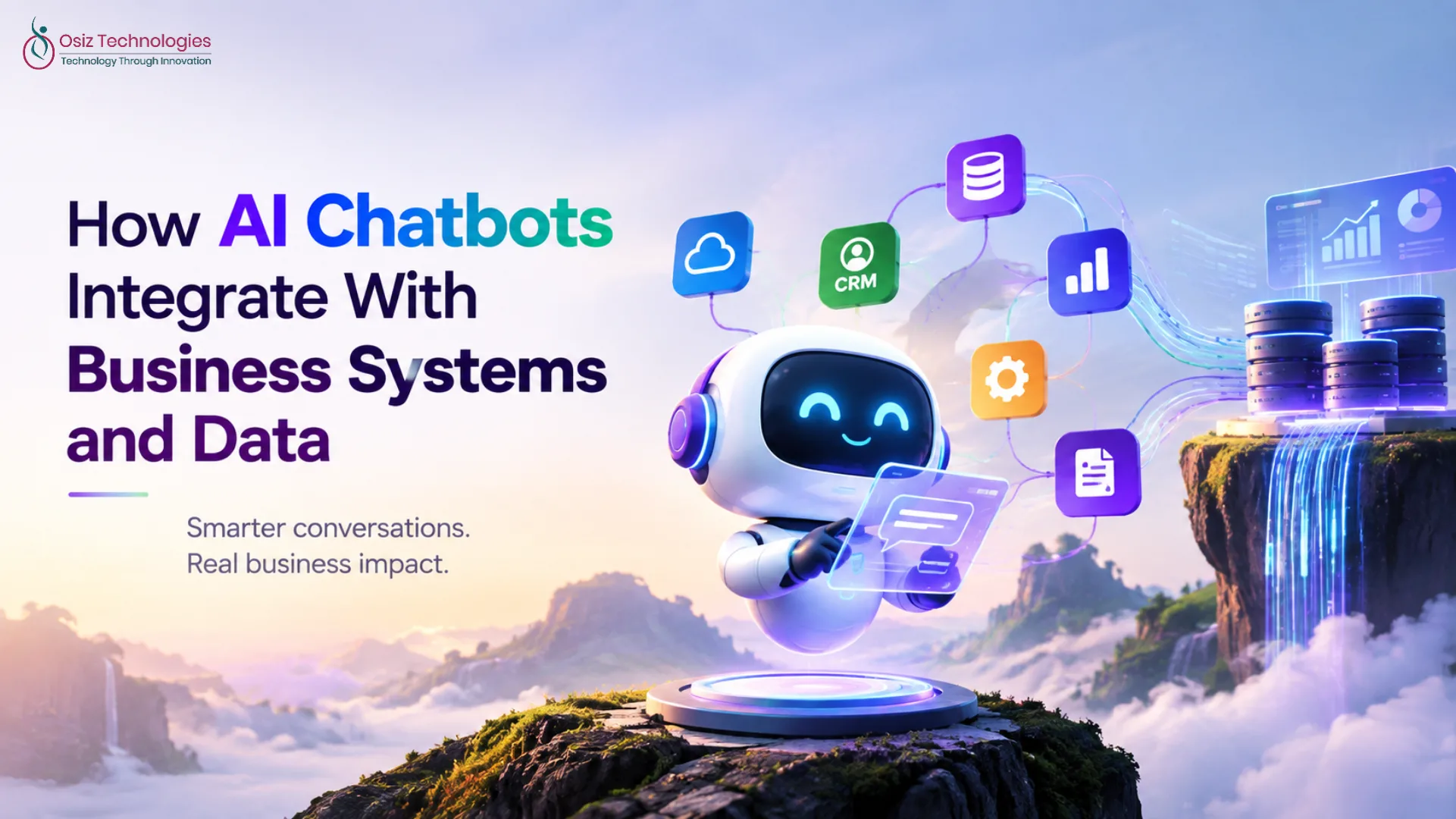
Modern businesses rely on multiple systems to manage customer information, sales, support, operations, and internal knowledge. AI chatbots become significantly more useful when they can connect with these existing systems and access relevant business data. Instead of operating as standalone conversational tools, integrated AI chatbots can retrieve information, update records, trigger actions, and support employees or customers across different workflows. AI Chatbot Development focuses on connecting conversational intelligence with business applications to create more context-aware and useful interactions.
How AI Chatbots Connect With Business Systems
AI chatbots connect with business systems through integration layers that allow them to exchange information securely. APIs are commonly used to retrieve customer records, check order information, create support tickets, or update CRM data. Webhooks can also notify the chatbot when specific events occur within connected applications.
An integration layer determines what information the chatbot can access and which actions it can perform. For example, when a customer asks about an order, the chatbot can authenticate the request, retrieve the relevant order information from the business system, and provide the response without requiring an employee to manually search for the details.
Business Systems AI Chatbots Can Integrate With
CRM Systems
AI chatbots can connect with CRM platforms to retrieve customer profiles, update contact information, record conversations, and support lead qualification. Sales teams can use these integrations to capture information from chatbot conversations and maintain updated customer records.
ERP and Business Management Platforms
Integration with ERP and business management platforms allows chatbots to access operational information such as inventory, orders, invoices, product details, and business processes. This can help employees and customers obtain relevant information without navigating multiple systems.
Help Desk and Customer Support Systems
AI chatbots can connect with help desk platforms to create support tickets, retrieve ticket status, categorize customer requests, and provide updates. Complex issues can also be transferred to human support agents with relevant conversation context.
Marketing and Sales Platforms
Marketing and sales integrations allow chatbots to capture leads, collect customer preferences, qualify prospects, and trigger follow-up activities. Information gathered during conversations can be transferred to connected sales and marketing systems for further engagement.
How AI Chatbots Access and Use Business Data
Structured and Unstructured Data
Business information exists in different formats. Structured data may include customer records, product catalogs, transaction details, and database entries, while unstructured data can include documents, policies, emails, FAQs, and knowledge articles. AI chatbots can be designed to work with both types of information to provide more complete responses.
Real-Time Data Retrieval
Real-time retrieval allows a chatbot to access current information instead of relying only on previously stored responses. For example, a chatbot can retrieve the latest order status, inventory availability, appointment information, or customer account details when responding to a query.
Knowledge Bases and Internal Documents
AI chatbots can connect to knowledge bases and internal documents to answer questions based on company-specific information. This enables employees or customers to interact with organizational knowledge through natural language rather than manually searching through multiple documents.
How AI Chatbot Integrations Automate Business Workflows
Customer Support Automation
Integrated chatbots can answer common questions, retrieve account information, check ticket status, and initiate support processes. When human intervention is required, the chatbot can pass relevant context to the support team.
Lead Qualification and Sales Automation
Chatbots can ask qualification questions, identify customer requirements, collect contact information, and categorize prospects. The resulting information can then be transferred to CRM and sales systems for follow-up.
Data Entry and Task Automation
Instead of requiring employees to manually enter information, chatbots can collect data through conversations and transfer it to connected systems. They can also trigger predefined actions such as creating records, submitting requests, or updating workflow statuses.
Technologies Used to Integrate AI Chatbots With Business Systems
APIs and Webhooks
APIs enable chatbots to communicate with external applications and retrieve or modify data. Webhooks support event-driven communication by sending information when specific actions occur in connected systems.
RAG and Knowledge Retrieval
Retrieval-Augmented Generation (RAG) allows AI chatbots to retrieve relevant information from approved data sources before generating responses. This helps ground responses in business-specific knowledge and reduces reliance on generic model knowledge.
Authentication and Access Control
Authentication and access controls determine who can access specific information and perform particular actions. Secure integration requires appropriate permissions, encryption, identity verification, and controlled access to sensitive business data.
Benefits of Integrating AI Chatbots With Business Data
Connecting AI chatbots with business systems creates more contextual and actionable conversations. Businesses can provide faster access to information, automate repetitive tasks, reduce manual data entry, improve customer support, and give employees a unified conversational interface for accessing multiple systems. Integration also allows organizations to extend chatbot capabilities as their applications, data sources, and workflows evolve.
Why Choose Osiz Technologies for AI Chatbot Development?
Osiz Technologies is an AI Chatbot Development Company that develops intelligent chatbot solutions connected with business applications, databases, APIs, knowledge bases, and enterprise workflows. Our approach focuses on building chatbots around specific business requirements rather than deploying isolated conversational interfaces. From CRM and ERP integration to RAG-based knowledge retrieval, workflow automation, and secure system connectivity, Osiz Technologies develops AI chatbots designed to work with existing business ecosystems.