Enterprise workflow automation is becoming more autonomous as businesses move beyond rule-based automation toward AI agents that can understand tasks, access business data, make decisions, and execute actions. Unlike traditional automation that follows predefined steps, AI agents can respond to changing conditions and coordinate multiple activities within a workflow. AI agent development enables enterprises to automate processes that require context, reasoning, system interaction, and limited human intervention. This makes AI agents particularly valuable for organizations managing complex, high-volume workflows across multiple departments and business systems.
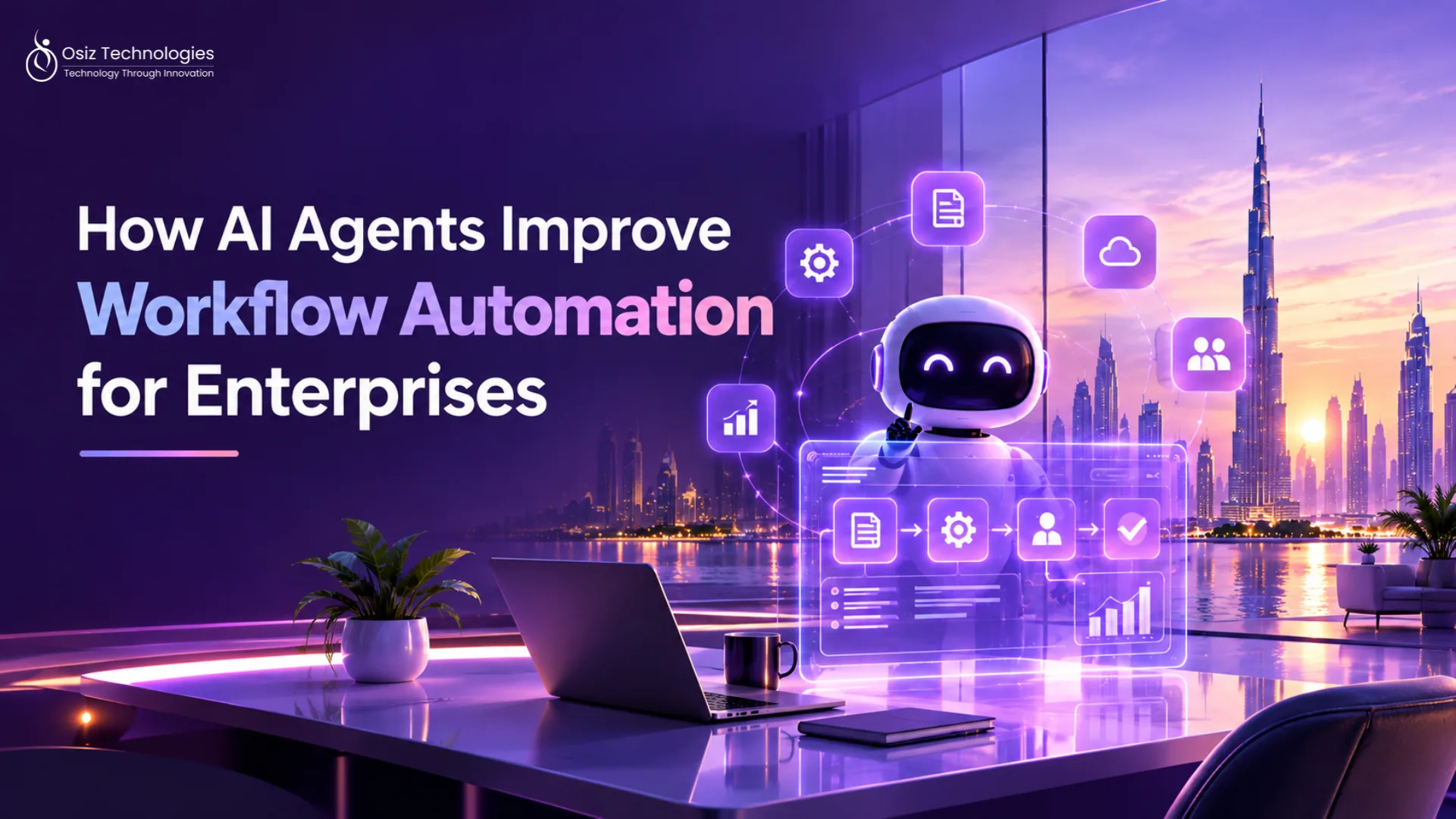
How AI Agents Improve Workflow Automation for Enterprises
AI agents improve enterprise workflow automation by taking responsibility for complete tasks rather than simply automating individual actions. An agent can receive a business request, understand the required objective, retrieve relevant information, perform the necessary actions across connected systems, and return the outcome.
For example, instead of automatically forwarding a new lead to a sales representative, an AI agent can qualify the lead, review customer information, update the CRM, determine the appropriate follow-up action, and notify the sales team. This reduces manual handoffs and allows workflows to move forward with less human intervention.
AI agents can also manage multi-step processes and respond to exceptions. When information is missing or a workflow condition changes, the agent can evaluate the situation and determine the next appropriate action based on business rules, available data, and defined objectives.
AI Agent Capabilities for Enterprise Workflow Automation
The effectiveness of AI-agent-powered automation comes from capabilities that traditional workflow automation typically lacks. AI agents can understand natural-language requests, interpret business context, retrieve information from enterprise systems, and execute actions across connected applications.
They can also make decisions within predefined boundaries, monitor workflow progress, identify issues, and escalate situations that require human judgment. With access to feedback and business rules, agents can continuously improve how they handle recurring workflow scenarios. These capabilities allow enterprises to automate workflows that involve multiple systems, changing inputs, and decision-based processes rather than only predictable, repetitive tasks.
Enterprise Workflows AI Agents Can Automate
Sales and Customer Support
In sales, AI agents can qualify incoming leads, update CRM records, identify follow-up opportunities, schedule interactions, and assist sales teams with relevant customer information. In customer support, agents can understand customer requests, retrieve account or product information, resolve common issues, update support tickets, and escalate complex cases to human agents.
Finance, HR, and IT Operations
Finance teams can use AI agents for invoice processing, payment-related workflows, document verification, and financial data handling. HR workflows can include employee onboarding, document collection, internal requests, and policy-related assistance. In IT operations, AI agents can handle service requests, troubleshoot common issues, create tickets, monitor workflows, and route incidents to the appropriate teams.
Business Benefits of AI Agent-Powered Workflow Automation
AI agent-powered workflow automation can improve enterprise operations by reducing repetitive manual work, shortening process completion times, and minimizing errors caused by manual data handling. Employees can spend more time on activities that require expertise, communication, and strategic judgment while AI agents handle routine workflow execution.
The benefits can extend across the organization as well. Faster task execution can improve response times, automated coordination can reduce workflow bottlenecks, and continuous agent operation can support processes beyond traditional working hours. When deployed with appropriate security, monitoring, and human oversight, AI agents can also provide a scalable foundation for automating increasingly complex enterprise processes.
Why Choose Osiz Technologies for AI Agent Development?
Osiz is an AI Agent Development Company that builds intelligent AI agents for enterprise workflows, business applications, and operational processes. Our approach focuses on understanding the workflow first, identifying where autonomous execution creates measurable value, and developing agents that can interact with the systems and data businesses already use.
From AI agent architecture and custom agent development to enterprise integrations and workflow automation, Osiz Technologies can develop solutions tailored to specific business requirements. The goal is not simply to add AI to an existing process, but to create AI agents capable of understanding tasks, taking appropriate actions, and moving enterprise workflows forward with greater autonomy.