Introduction
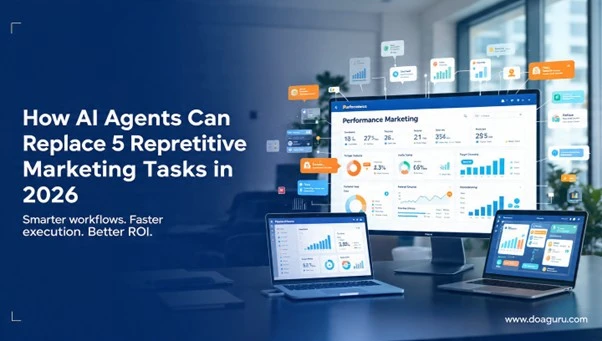
Marketing teams spend a staggering amount of time on work that produces very little original thinking. Scheduling posts, writing templated follow-up emails, pulling weekly performance reports, resizing graphics for different platforms, and responding to standard customer queries, these are the tasks that consume hours every week and return results that a well-configured AI agent can produce in minutes.
This is not about replacing marketers. It is about redirecting human attention toward work that actually requires judgment: building relationships, crafting brand narratives, closing deals, and interpreting data with context. In 2026, the businesses that understand this distinction are the ones pulling ahead. The ones that do not are going to keep paying skilled people to do the work of a scheduled script.
At DOAGuru Infosystems, recognised as the best digital marketing company in Jabalpur, we have spent considerable time studying which marketing tasks are genuinely suitable for AI automation and which still need a human hand. Here are five where AI agents are already delivering real results.
1. Social Media Scheduling and First-Draft Content Generation
Most businesses post on social media because they know they should, not because they have a clear strategy behind every piece of content. The result is inconsistent posting, last-minute scrambles, and content that looks rushed because it was.
AI agents can now manage the entire first-draft pipeline. Tools like Jasper, Buffer AI, and even custom GPT-based workflows can take a content calendar, a brand voice document, and a set of topic pillars, then generate a week's worth of post drafts, captions, and hashtag sets automatically. A human then reviews, refines, and approves. The time savings are significant -- what used to take a content executive a full day now takes two to three hours.
The key is training the agent on your specific brand voice from the start. Generic AI output sounds generic. A well-fed agent, given real examples of your best-performing content and a clear brief on tone, can produce drafts that need only minor edits before going live.
2. Performance Reporting and Weekly Analytics Summaries
Every marketing manager has sat through the experience of spending three hours on a Friday pulling numbers from Google Analytics, Meta Business Suite, and a CRM, then formatting everything into a report that the client or director reads in four minutes. This is one of the clearest cases for AI automation.
AI agents connected to your analytics platforms via API can generate structured weekly or monthly reports automatically. They can flag anomalies, highlight which campaigns performed above benchmark, and even include brief interpretive notes based on patterns in the data. Tools like Polymer, Narrative BI, and custom Zapier or Make.com workflows with GPT integrations can handle this end to end.
The human role shifts from data collector to data interpreter. You spend your time understanding what the numbers mean for strategy, not formatting spreadsheets.
3. Email Drip Campaign Personalisation
Standard email drip campaigns send the same message to everyone at the same interval. In 2026, that approach is falling behind. Audiences expect some level of relevance -- they notice when a follow-up email has nothing to do with what they actually clicked on or enquired about.
AI agents can personalise drip sequences dynamically. Based on which pages a lead visited, which emails they opened, and what they downloaded, the agent adjusts the sequence in real time. The next email they receive is contextually relevant to their last action, not just the next item in a fixed queue. Platforms like HubSpot, ActiveCampaign, and Klaviyo now have this functionality built in, and for businesses running custom stacks, API-based AI agents can plug into almost any CRM.
The impact on conversion rates is measurable. Contextually relevant emails consistently outperform generic sequences across industries.
4. Ad Copy Variations and A/B Testing Briefs
Running paid advertising without testing multiple copy variations is a common mistake. Most teams avoid it not because they disagree with the principle but because writing ten variations of a headline and five versions of body copy for every campaign is genuinely time-consuming work.
AI agents can generate these variations at scale. Given a campaign objective, a target audience profile, a product description, and a list of key messages, an agent can produce dozens of ad copy combinations in minutes. The marketing team then selects the most promising ones, sets up the A/B test, and monitors results. This is a legitimate time saver that also tends to improve test diversity -- humans often unconsciously iterate too narrowly within a familiar structure.
For businesses working with the best graphics design company in Jabalpur to produce their ad visuals, pairing strong AI-generated copy variations with well-designed creatives significantly improves the overall quality of paid campaigns.
5. Customer Query Triage and First-Response Drafting
Not every customer message needs a senior team member's immediate attention. A large portion of inbound queries are variations of the same questions: pricing, timelines, service scope, portfolio requests, and revision policies. AI agents, trained on a business's FAQ base and configured with appropriate guardrails, can handle first-response drafts or even full responses for standard queries.
This is particularly useful for digital agencies, education institutions, healthcare providers, and e-commerce businesses that receive high volumes of similar enquiries. The agent flags anything outside its training scope for human review, ensuring that complex or sensitive queries always reach the right person.
Used well, this approach reduces response times from hours to minutes and frees your team to focus on queries that genuinely require their expertise.
What This Means for Your Business
The businesses getting the most out of AI agent automation are not the ones using the most tools. They are the ones that have taken time to map their workflows, identify which tasks are truly repetitive, and then configure AI carefully within those specific areas.
Getting this right requires both strategic thinking and technical execution. At DOAGuru Infosystems, we work with businesses across Jabalpur and beyond to build AI-assisted marketing workflows that are practical, measurable, and genuinely useful. We do not recommend tools for their own sake. We recommend what works for your specific situation.
If your team is spending more time on tasks than on thinking, that is worth a conversation.