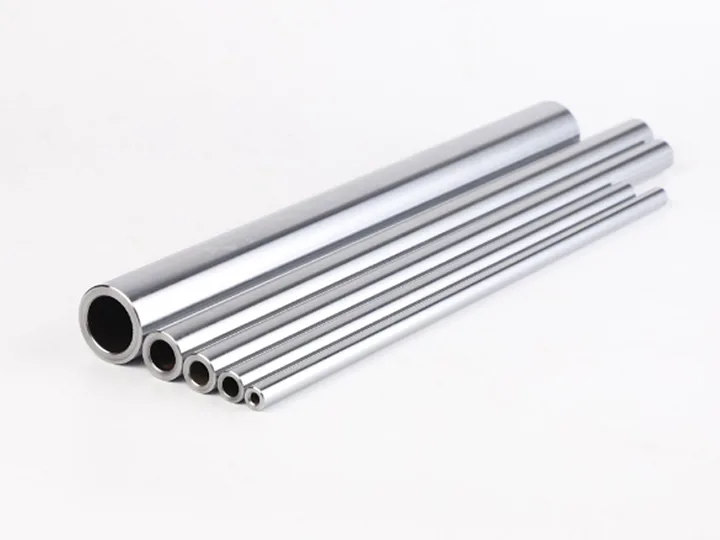
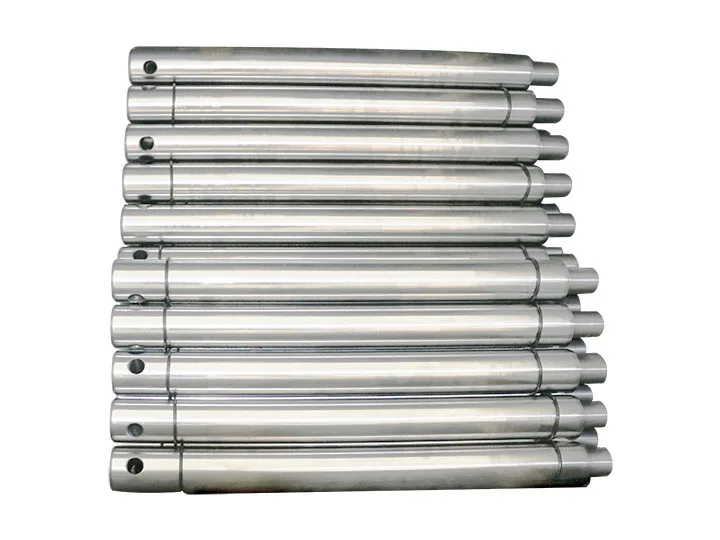
A hollow piston rod represents a significant engineering advancement over conventional solid rod designs, offering a unique combination of reduced weight, internal fluid routing capability, and enhanced structural efficiency that solid rods simply cannot match. In applications where reciprocating mass directly impacts system response time, energy consumption, and overall machine dynamics, the hollow piston rod has become the component of choice for designers seeking to optimize performance. From high-speed automation equipment to large-bore hydraulic cylinders in heavy machinery, hollow piston rods provide solutions that solid alternatives cannot deliver.
Wuxi Xinluo Hydraulic Machinery Co., Ltd. has developed deep expertise in manufacturing hollow piston rods, supplying precision hollow shaft components to customers across industrial automation, construction equipment, and pneumatic system sectors throughout their 15 years of operation.
What Is a Hollow Piston Rod?
A hollow piston rod is a tubular, cylindrical shaft with a central bore running through its length, designed to serve the same fundamental function as a solid piston rod — transmitting force between a piston and an external load — while offering additional capabilities that arise from its hollow geometry.
Fundamental Design Concept
The hollow piston rod eliminates the solid core material from the center of a conventional rod, replacing it with a controlled internal diameter. This design decision is not merely about weight reduction. The tubular cross-section fundamentally changes the mechanical behavior of the component:
Moment of Inertia: For a given outer diameter, a hollow rod retains nearly the same bending stiffness as a solid rod, because bending resistance is primarily governed by the outer material distribution. The material removed from the center contributes minimally to bending stiffness.
Weight Reduction: By removing the low-stress core material, weight reductions of 30–60% are achievable depending on the wall thickness ratio, dramatically reducing the reciprocating mass in cylinder applications.
Internal Passage: The bore can serve as a fluid conduit, allowing hydraulic oil or compressed air to pass through the rod itself, enabling compact cylinder designs with integrated oil routing.
Hollow Piston Rod vs. Solid Piston Rod
The key distinctions between hollow and solid piston rod designs include:
Mass: A hollow rod with an inner-to-outer diameter ratio of 0.6 weighs approximately 64% less than a solid rod of the same outer diameter.
Buckling Behavior: While the critical buckling load is reduced compared to a solid rod of the same diameter, proper wall thickness design ensures adequate safety margins for most applications.
Manufacturing Complexity: Hollow rods require additional processing steps — tube forming, internal surface finishing, and end closure machining — making them more complex to produce than solid rods.
Application Fit: Solid rods remain preferred for short-stroke, high-buckling applications, while hollow rods excel in long-stroke, high-speed, or weight-sensitive applications.
Key Features and Specifications
Material Grades for Hollow Construction
Hollow piston rods are manufactured from seamless steel tubes or forged hollow billets, with material selection driven by the operating pressure and service conditions:
35# Steel (GB/T 699 / AISI 1035)
Medium carbon steel with good formability and machinability. After normalizing or quenching and tempering, it provides adequate strength for pneumatic and moderate-pressure hydraulic applications. Its lower carbon content offers better weldability, making it suitable for applications requiring welded end fittings.
45# Steel (GB/T 699 / AISI 1045)
The most commonly used material for hydraulic-grade hollow piston rods. With approximately 0.45% carbon content, it achieves core hardness of 25–32 HRC after quenching and tempering, providing an optimal combination of strength, toughness, and fatigue resistance. 45# steel seamless tubes are widely available and offer excellent cost-performance characteristics.
CK45 (EN 10083-2)
The European equivalent of 45# steel, specified by many OEM customers in European and export markets. CK45 seamless tubes provide consistent mechanical properties and excellent machinability for precision hollow rod manufacturing.
Dimensional Specifications
Standard hollow piston rod outer diameters range from 12 mm to 200 mm, with wall thicknesses typically ranging from 3 mm to 25 mm depending on the diameter and pressure rating. The inner bore diameter is controlled to ensure uniform wall thickness, which is critical for balanced mechanical properties and consistent surface treatment results.
Surface Requirements
Like solid piston rods, hollow piston rods require precision external surface finishing with roughness values of Ra 0.2–0.4 μm and hard chrome plating with thickness of 20–50 μm. The inner bore surface may also require finishing depending on its function — if used as a fluid passage, the internal surface must be smooth enough to prevent turbulence and contamination generation.
Pressure Rating Considerations
The wall thickness of a hollow piston rod must be designed to withstand both the axial compressive loads and any internal pressure if the bore is used as a fluid passage. For internal pressure containment, the wall thickness is calculated using the thick-walled cylinder formula, with appropriate safety factors applied based on the operating conditions.
Manufacturing Process
Seamless Tube Preparation
The manufacturing of hollow piston rods begins with the procurement of high-quality seamless steel tubes. Wuxi Xinluo Hydraulic sources seamless tubes manufactured to precise specifications, with verified chemical composition and mechanical properties. Each batch undergoes spectrometric analysis and ultrasonic flaw detection to identify any internal defects before processing.
Cold Drawing
For applications requiring tighter dimensional tolerances and improved surface quality, the seamless tubes undergo cold drawing through precision dies. This process reduces the outer diameter and wall thickness to the specified dimensions while improving the material's mechanical properties through strain hardening. Cold drawing also produces a superior surface finish that reduces the material removal required in subsequent grinding operations.
Heat Treatment
Hollow piston rods made from 45# steel or CK45 undergo quenching and tempering to achieve the required core hardness and mechanical properties. The heat treatment process for hollow components requires careful control of heating and cooling rates to ensure uniform properties throughout the wall thickness and prevent distortion. Wuxi Xinluo Hydraulic employs specialized fixturing and controlled atmosphere furnaces to maintain dimensional stability during heat treatment.
External Precision Grinding
After heat treatment, the external surface is ground to the specified diameter tolerance and surface finish using centerless grinding machines. The grinding process is carefully controlled to maintain wall thickness uniformity and geometric accuracy.
Chrome Plating
The external surface receives a hard chrome plating layer identical in specification to solid piston rods. For hollow rods with internal fluid passages, the internal bore may receive additional treatment — such as internal honing or a protective coating — depending on the application requirements.
End Machining and Threading
The final manufacturing operations include machining the rod ends to the required configuration — typically internal or external threads for piston attachment, and snap ring grooves, clevis pins, or other connection features. Wuxi Xinluo Hydraulic uses CNC lathes to ensure precise thread geometry and concentricity with the bore.
Applications and Industries
High-Speed Automation Systems
In automated manufacturing lines, the reduced reciprocating mass of hollow piston rods directly translates to faster cycle times, lower energy consumption, and reduced vibration. Pneumatic cylinders with hollow rods can achieve significantly higher speeds than equivalent solid-rod configurations.
Large-Bore Hydraulic Cylinders
For hydraulic cylinders with bore diameters exceeding 200 mm, the weight savings of a hollow rod become substantial. Construction equipment, marine cranes, and industrial presses benefit from the reduced inertia, which improves control precision and reduces shock loads during rapid deceleration.
Internal Fluid Routing Applications
When the hollow bore is utilized as an internal oil passage, designers can create compact hydraulic cylinders that route pressurized fluid through the rod itself. This eliminates external hoses and fittings, reducing the machine's envelope and potential leak points.
Instrumentation and Testing Equipment
Material testing machines, simulation platforms, and precision positioning systems benefit from the weight reduction and stiffness characteristics of hollow piston rods. The lower moving mass enables more accurate force control and faster response times.
Agricultural and Forestry Equipment
Combine harvesters, tree harvesters, and other mobile agricultural equipment use hollow piston rods where weight reduction contributes to improved fuel efficiency and reduced ground pressure, while maintaining the strength needed for demanding field conditions.