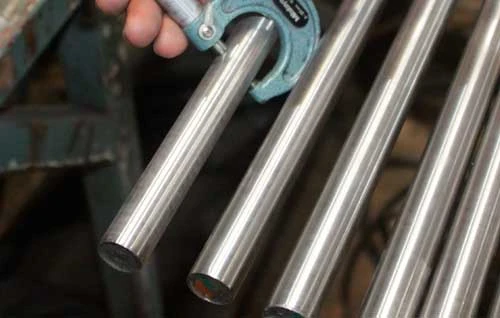
In high-temperature industrial set-ups, both corrosion resistance and mechanical strength are of paramount importance in order to guarantee the lasting performance of the equipment. Stainless Steel 347H Round Bar is a kind of austenitic stainless steel stabilized with niobium, which has been developed for working conditions, where the presence of elevated temperatures along with corrosive environments is the norm. Through increased creep and stress rupture properties, this stainless steel has become the first choice for making boilers, pressure vessels, heat exchangers, and other furnace components.
And diameters can be as small as 10 mm and as large as over 300 mm, making these bars become industrial workhorses that are supplied in hot-rolled, forged, or solution-annealed conditions. They are well know for meeting strict dimensional tolerances and their high-quality surface finishes weld well, paint well, clean well and even eat well if one were to drop a bit of candy on one. When it comes to selecting high-temperature stainless steel bars, procurement teams and engineers first look at the tensile strength, hardness, carbon content, and compliance with the ASTM A479 or A276 standards. Industrial kingdoms of Saudi Arabia such as Riyadh, Dammam, and Al Khobar regularly go to get essential production materials through reliable suppliers on B2B platforms like pipingmaterial.sa which also provides mill test reports, enables buyers to compare the technical specifications, and establish contact with genuine distributors for crucial high-temperature applications.
When working with continuous high temperatures, long-term service in the power generation, petrochemical, and chemical processing industries, Stainless Steel 321H Round Bar is the go-to material for its outstanding oxidation resistance, dimensional stability, and resistance to intergranular corrosion. Throughout the Jeddah area and its industrial suburbs, 321H bars are often implemented for producing heat exchangers, chemical processing equipment, and various other furnace components. Besides the fact that titanium-stabilized 321H material has the remarkable capability not only of maintaining but even improving its strength in high-temperature environments it also exhibits excellent performance in reducing and oxidizing atmospheres. Neither does it lose tensile strength even after long-term use and thus promises reliability for the power generation, petrochemical, and chemical processing industries.