
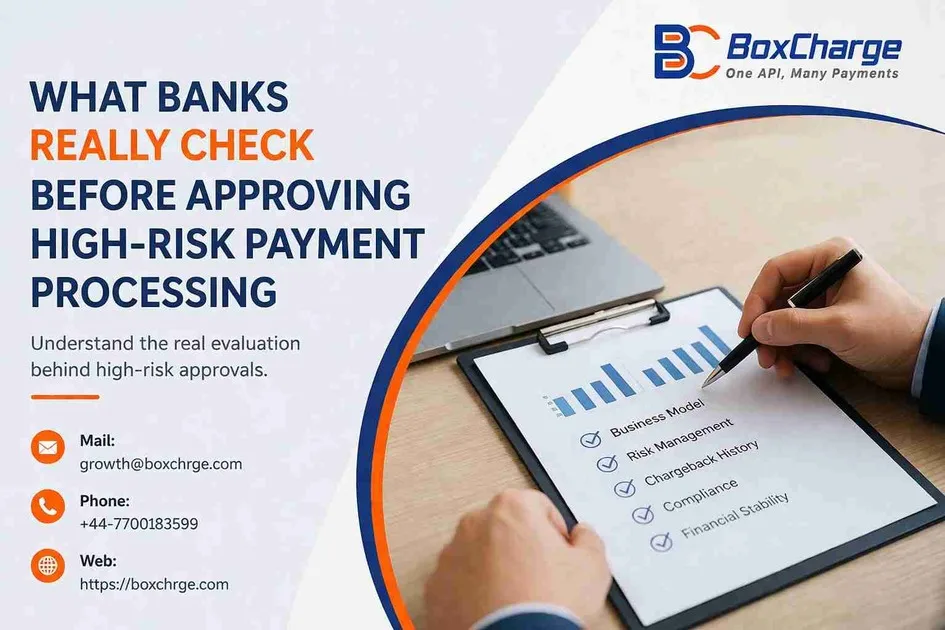
Most high-risk merchants think approval comes down to paperwork.
It doesn’t.
By the time your application reaches a bank or acquirer, a decision is already forming in the background. Not based on what you wrote—but on how your business is expected to behave once transactions start flowing.
Because in high-risk payment processing, approval isn’t a formality. It’s a calculated risk decision.
If you operate in sectors like iGaming, streaming, forex, or subscription services across markets like Germany, the UK, or wider Europe, you’ve probably already seen how unpredictable approvals can feel.
They aren’t random.
They’re pattern-driven.
Why High-Risk Payment Processing Gets Scrutinized So Heavily
Banks don’t reject high-risk merchants simply because of the industry.
They reject uncertainty.
High-risk environments naturally involve:
- Higher dispute exposure
- cross-border transaction complexity
- regulatory pressure across the EU and UK
- inconsistent user behavior
Banks don’t fear high-risk industries—they fear unpredictable ones.
That’s why getting approved for a high-risk payment gateway depends less on what you sell and more on how predictable your operation looks under pressure.
1. Business Model Clarity (How Your Revenue Actually Works)
Banks want to understand:
- How do you make money
- How users are billed
- What happens after the first transaction
Many merchants don’t get rejected—they get filtered out early because their model looks unclear.
👉 A payment gateway provider prefers predictable, structured businesses—not uncertain ones.
2. Chargeback Risk and Behavioral Patterns
Chargebacks are not just a number—they’re a pattern.
In industries like streaming and subscriptions, disputes often come from:
- forgotten renewals
- unclear billing descriptors
- delayed support
👉 If your chargeback management is reactive, banks increase your risk score immediately.
3. Geographic Exposure and Transaction Consistency
Banks evaluate:
- where your users come from
- How transactions behave across regions
- currency consistency
👉 Strong global payment processing ensures smoother approvals across markets like Germany and the UK.
4. Fraud Controls and Risk Infrastructure
Banks assume fraud will happen.
What matters is how you handle it.
A proper secure payment gateway should include:
- fraud detection
- transaction monitoring
- behavioral tracking
Weak controls = higher rejection probability.
5. Technical Setup and Payment Gateway API Performance
Your infrastructure speaks before your application does.
If your payment gateway API:
- fails transactions
- lacks retry logic
- creates friction
…it signals instability.
And instability is what banks avoid.
6. Financial Signals and Scaling Behavior
Banks look at:
- expected volume
- transaction size
- refund ratios
If your growth outpaces your infrastructure, your high-risk payment solutions won’t hold—and banks know that.
7. Compliance and Regulatory Alignment in Europe
In regions like Germany and the UK:
- KYC and AML checks are mandatory
- Regulatory alignment is critical
👉 Every payment gateway provider operates within strict compliance frameworks.
What Most Merchants Get Wrong
Most assume:
“Approval means I’m safe.”
Not true.
Banks continuously monitor:
- transaction behavior
- disputes
- approval trends
And restrictions often happen quietly.
How to Improve Approval Chances—and Stay Approved
To build long-term stability:
- Choose a high-risk payment gateway provider
- Implement strong chargeback management
- Maintain consistent global payment processing
- Use a secure payment gateway
- Optimize your payment gateway API
Because small issues compound quickly in high-risk payment processing.
Where the Right Setup Changes Everything
When your system fits your model:
- approvals stabilize
- transactions succeed more consistently
- disputes reduce
- scaling becomes smoother
That’s the impact of choosing the right high-risk payment gateway.
Final Thought
Banks don’t approve businesses based on promises.
They approve based on patterns.
If your business shows clarity and control, approvals follow.
If not, you won’t always get rejected—you’ll simply never get fully approved.
In high-risk payment processing, approval isn’t a milestone—it’s a stress test.