
High-risk payment processing is a specialized payment service designed for businesses that may face higher levels of chargebacks, fraud, regulatory requirements, or financial risk. These businesses may have difficulty obtaining standard merchant accounts from traditional payment providers.
A high-risk merchant account allows eligible businesses to accept credit cards, debit cards, and other payment methods while operating under risk-management terms established by the payment provider or acquiring bank.
Being classified as high risk does not mean a business is illegal or unreliable. It generally means the business presents a higher potential financial or operational risk based on its industry, transaction history, business model, or customer base.
Why Is a Business Considered High Risk?
Payment providers evaluate several factors when determining whether a business is high risk.
Common factors include:
- High chargeback rates
- Recurring or subscription payments
- Large transaction values
- International transactions
- Long fulfillment periods
- Limited processing history
- Regulated industries
- Previous merchant-account issues
- Higher fraud exposure
Industries such as iGaming, adult businesses, forex, cryptocurrency, travel, digital goods, nutraceuticals, and subscription services may receive additional underwriting because of their risk characteristics.
However, classification varies between providers. One payment processor may consider a business high risk while another may be willing to support it under different conditions.
How Does High-Risk Payment Processing Work?
The basic transaction process is similar to standard card processing:
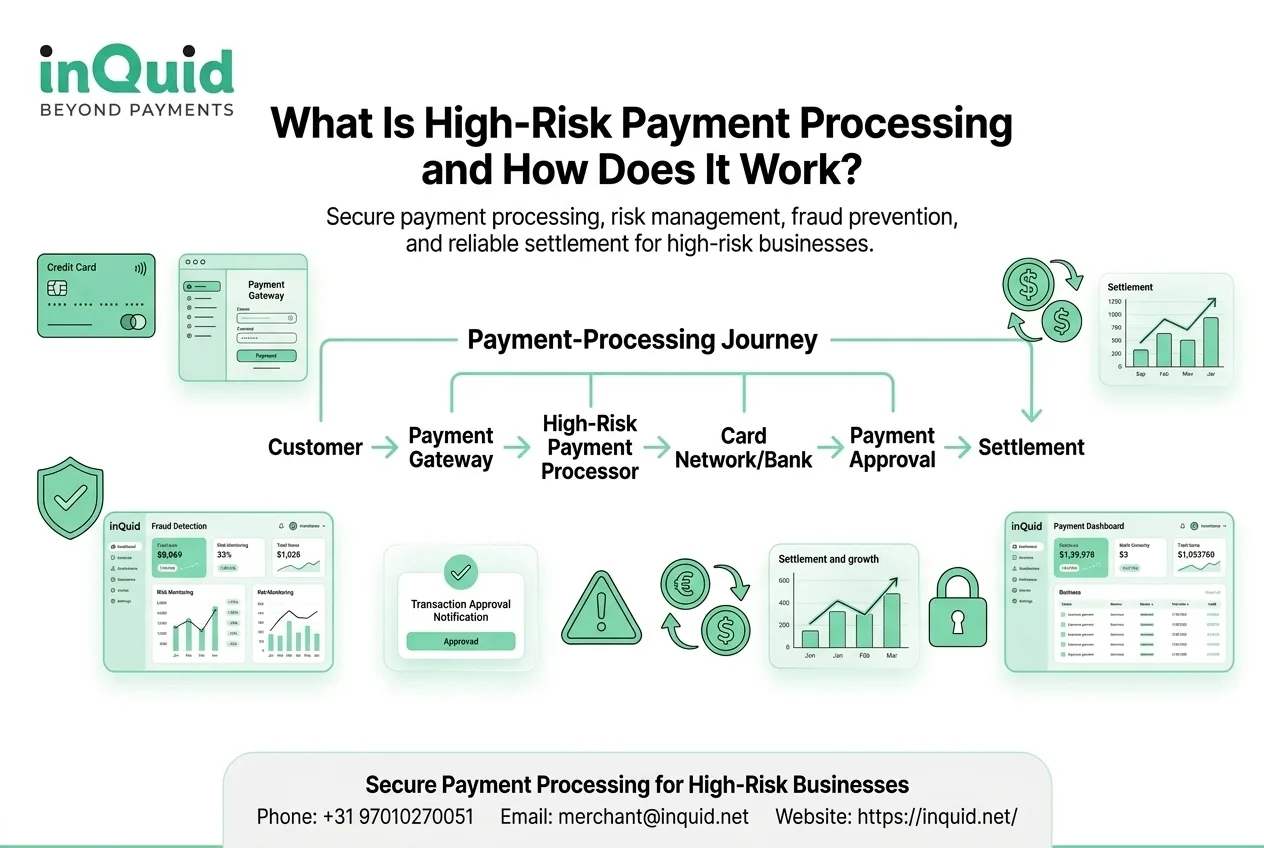
Customer → Payment Gateway → Payment Processor → Card Network → Issuing Bank → Approval → Settlement
When a customer makes a payment, the payment gateway securely sends the transaction information to the relevant processing infrastructure. The transaction is then authorized by the customer's bank.
For high-risk merchants, additional controls may be applied to manage payment risk. These can include:
- Fraud screening
- 3D Secure authentication
- Transaction monitoring
- Address verification
- CVV verification
- Velocity controls
- Chargeback monitoring
After successful authorization, funds are settled according to the merchant agreement.
What Is a High-Risk Merchant Account?
A high-risk merchant account is a specialized account that enables an eligible business to accept card payments despite having a higher-risk business profile.
Compared with standard merchant accounts, high-risk accounts may involve:
- Higher processing fees
- Rolling reserves
- Additional underwriting
- Processing limits
- Enhanced transaction monitoring
- More documentation
The exact terms depend on the merchant's industry, processing volume, transaction history, geography, and overall risk profile.
What Is a Rolling Reserve?
A rolling reserve is a percentage of processed funds temporarily held by the payment provider to protect against future chargebacks, refunds, or other financial liabilities.
For example, if a provider requires a reserve, a portion of each settlement may be retained for an agreed period before being released.
Businesses should understand the reserve percentage, release period, and conditions before accepting a high-risk payment-processing agreement.
How Do High-Risk Businesses Reduce Chargebacks?
Chargeback management is an important part of high-risk credit card processing.
Businesses can reduce unnecessary disputes by:
- Clearly describing products and services
- Using recognizable billing descriptors
- Providing transparent pricing
- Making cancellation procedures easy to understand
- Maintaining clear refund policies
- Using fraud-prevention tools
- Monitoring unusual transactions
- Responding quickly to customer disputes
A lower and more controlled chargeback rate can also help demonstrate responsible payment management over time.
How to Choose a High-Risk Payment Processor
Choosing the right high-risk payment processor requires more than comparing transaction fees.
Businesses should evaluate:
- Industry Support
Confirm that the provider supports your specific business model and products or services.
- Payment Methods
Check whether you need credit cards, debit cards, digital wallets, bank payments, recurring billing, or alternative payment methods.
- International Processing
If you serve customers internationally, review supported countries, currencies, settlement options, and cross-border processing capabilities.
- Security
Look for appropriate fraud prevention, transaction monitoring, tokenization, authentication, and payment-security controls.
- Settlement Terms
Understand settlement schedules, reserves, processing limits, refunds, and chargeback procedures before onboarding.
High-Risk Payment Processing vs. Standard Processing
The biggest difference is the level of risk management surrounding the merchant account.
Standard merchants may receive simpler underwriting and lower processing costs. High-risk merchants typically undergo more detailed review and may receive customized pricing, reserves, monitoring requirements, or processing conditions.
This additional structure helps payment providers manage the greater potential exposure associated with certain business models.
Benefits of High-Risk Payment Processing
For eligible businesses, specialized payment processing can provide several advantages:
- Access to card payment acceptance
- Support for complex business models
- International payment capabilities
- Multi-currency processing
- Fraud and chargeback management
- Scalable payment infrastructure
- Payment gateway integration
For businesses that have been declined by traditional providers, a specialized high-risk merchant account provider may offer a more appropriate processing arrangement.
Frequently Asked Questions
- Does high risk mean my business is illegal?
No. High-risk is generally a payment and underwriting classification. Legitimate businesses can be classified as high risk because of their industry, transaction profile, chargeback exposure, or other factors.
- Are high-risk merchant accounts more expensive?
They can be. Higher processing fees, reserves, and additional account costs may apply depending on the provider and merchant profile.
- Can a high-risk business accept international payments?
Yes, depending on the provider, acquiring arrangement, supported countries, currencies, and merchant's underwriting approval.
- Can a new business get high-risk payment processing?
Potentially. New businesses may undergo more detailed underwriting because they have limited processing history. Providers may request business documents, financial information, website details, product information, and projected transaction volumes.
- How long does high-risk merchant-account approval take?
There is no standard timeframe. Approval depends on the provider, acquiring bank, business model, documentation, and complexity of the merchant's risk profile.
Final Thoughts
High-risk payment processing gives eligible businesses access to specialized payment infrastructure when standard processing may not be suitable.
The right solution should provide more than payment acceptance. Businesses should consider security, chargeback management, payment gateway integration, settlement terms, international processing, pricing, reserves, and scalability.
Before choosing a high-risk payment processor, review the complete agreement and make sure the processing terms match your actual business model and expected transaction activity.