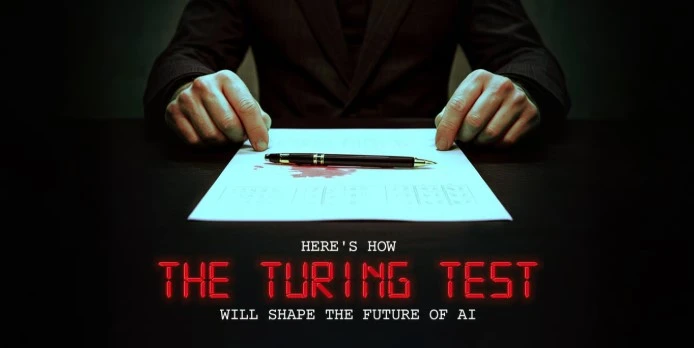
The 2009 movie Exam cleverly parallels the Turing Test by putting human behavior under extreme pressure, just as the Turing Test challenges machines to mimic humans convincingly. The Turing Test, proposed by Alan Turing in 1950, remains a foundational idea for evaluating artificial intelligence. Its goal is simple: if a machine can converse so naturally that a human judge can’t distinguish it from a real person, it passes.
Turing’s thought experiment inspired decades of AI development—from early programs like ELIZA to modern chatbots and virtual assistants. Despite its influence, the Turing Test has limits: it only measures how well machines imitate conversation, not true intelligence, reasoning, or ethical behavior. Outcomes can also vary depending on the judge’s bias or the machine’s clever tricks.
Still, the Turing Test continues to shape AI research today. It’s used to refine virtual assistants, power CAPTCHAs that keep bots away, and drive realistic behaviors in games. Its principles help developers push AI toward more human-like interaction and problem-solving. Looking ahead, the Turing Test may evolve to evaluate emotional understanding, ethical choices, and contextual awareness—skills crucial for AI in fields like healthcare, education, and disaster response.
Ultimately, the test’s legacy is bigger than fooling humans—it r