
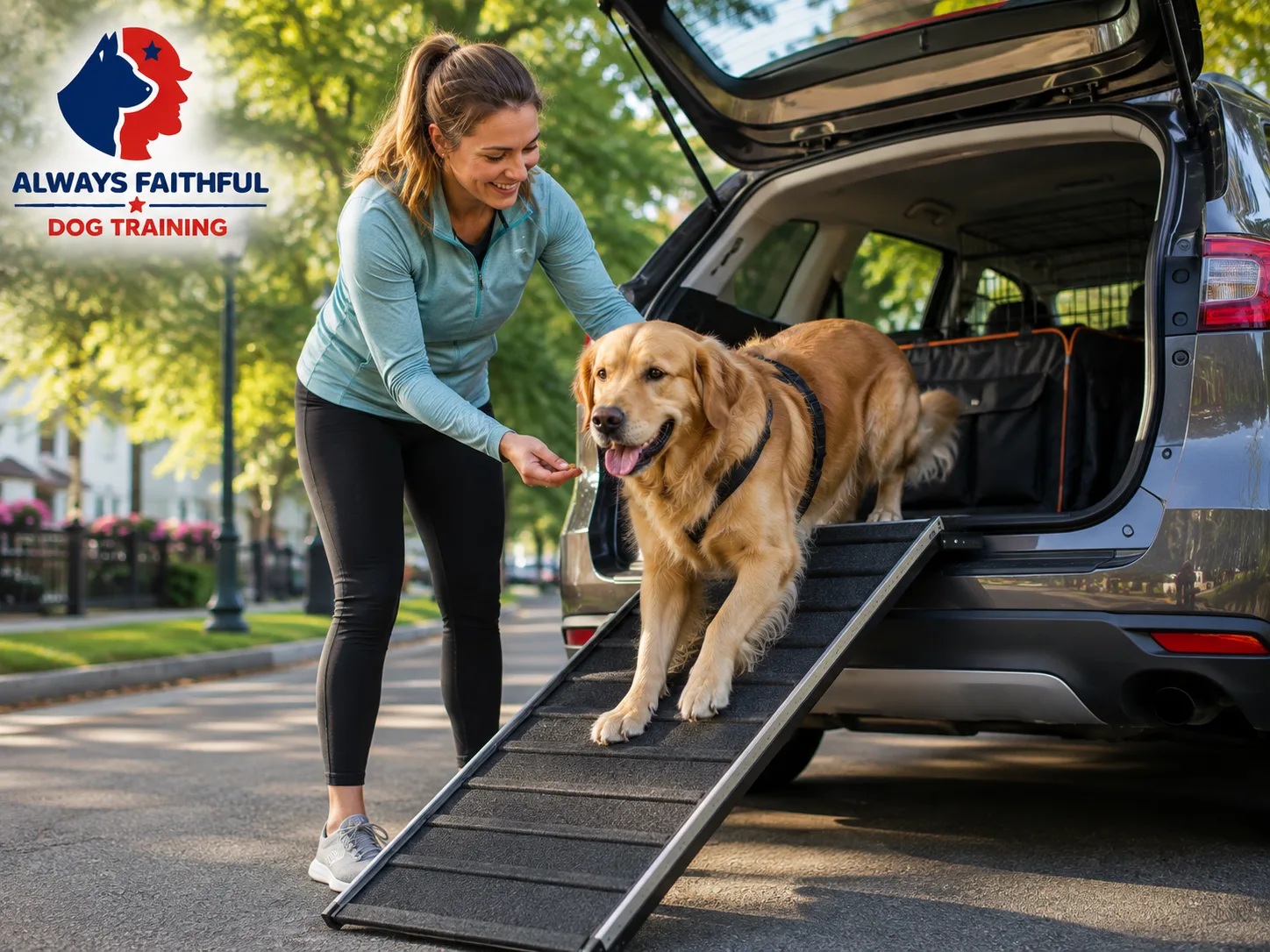
Dog training can prepare dogs for many ordinary situations that they encounter around the home, including navigating stairs. Some dogs confidently run up and down steps, while others hesitate, freeze, pull backward, or become nervous when faced with a staircase. Stairs can feel unfamiliar because they change the dog's footing, balance, height, and visual perspective at the same time. Teaching a dog to approach and use stairs calmly can build confidence while also helping owners establish safer movement patterns around the house.
Why Stairs Can Feel Uncomfortable to Dogs
A staircase is different from walking across a flat floor. Each step changes the position of the dog's body and requires adjustments in balance.
Open-backed stairs can be especially confusing because the dog may be able to see through the gaps between steps. Smooth surfaces can create another concern if the dog's paws do not feel secure.
Some dogs may also hesitate because they had little exposure to stairs during their early development. Others may have experienced a slip and subsequently become cautious.
Understanding the reason for hesitation helps owners avoid assuming that the dog is simply refusing to cooperate.
Let the Dog Investigate the Staircase
The first stage does not necessarily need to involve climbing. Allowing a dog to calmly investigate a staircase can make the environment less unfamiliar.
The dog can observe the steps, smell the surrounding area, and become accustomed to the sounds associated with people moving up and down.
Owners should avoid immediately pulling a hesitant dog toward the stairs. Giving the dog an opportunity to process the environment can prevent the staircase from becoming associated with pressure.
Begin With a Single Step
When a dog is uncertain about stairs, starting with the entire staircase can create too much difficulty.
A single low step or the first portion of a staircase provides a simpler learning opportunity. The dog can practice placing its paws accurately before being expected to navigate multiple levels.
Once the dog demonstrates comfort with one step, another can gradually be added. This allows the physical challenge to increase in manageable stages.
Consider the Surface
The condition of the steps can influence how comfortable a dog feels. Hardwood, tile, polished stone, and other smooth surfaces may provide less traction than carpeted stairs.
If a dog repeatedly slips, the problem may not be a lack of training. The environment itself may need attention.
Owners should check whether the steps are secure, clean, and appropriate for the dog's size and physical abilities. A safe training environment makes it easier for the dog to concentrate on learning rather than worrying about losing balance.
Teach Controlled Movement
Some dogs have the opposite problem: they are not afraid of stairs at all and move too quickly.
Racing down steps can increase the chance of slipping or colliding with someone. A dog that has learned to move at a controlled pace may be easier to manage in a busy household.
Owners can focus on calm movement rather than speed. The objective is to help the dog understand that stairs require attention and deliberate foot placement.
Going Up and Going Down Are Different Skills
Dogs may find one direction easier than the other. Climbing upward requires pushing the body forward and upward, while descending requires greater attention to balance and paw placement.
A dog that confidently climbs may still hesitate when coming down.
For this reason, owners should practice both directions separately. Success in one direction should not automatically be treated as proof that the dog is equally comfortable in the other.
Avoid Pulling a Nervous Dog
Using a leash to drag a hesitant dog up or down stairs can increase tension. The dog may begin associating the staircase with physical pressure instead of learning to navigate it confidently.
A better approach is to reduce the difficulty and allow the dog to progress gradually.
If the dog repeatedly freezes or tries to escape, owners should pause and consider whether the staircase, surface, environment, or physical condition is contributing to the problem.
Use the Same Technique Consistently
Dog Training learn more easily when the people around them communicate the same expectations.
If one family member allows the dog to race up and down the stairs while another expects slow movement, the dog receives conflicting information.
Everyone in the household should understand the desired behavior. Consistency is particularly important when children are present because children may unintentionally encourage dogs to chase or race on stairs.
Practice During Calm Periods
Busy household activity can make stair training harder. People carrying objects, children running through the area, or other pets moving around can create distractions.
Initial practice is usually easier when the environment is relatively quiet.
Once the dog becomes comfortable, controlled distractions can gradually be introduced. This helps the dog learn that the skill still applies when ordinary household activity is taking place.
Pay Attention to Physical Limitations
Not every stair problem is behavioral. Pain, stiffness, weakness, vision problems, or other physical limitations can affect how a dog approaches steps.
A dog that previously used stairs normally but suddenly begins avoiding them deserves closer attention.
Owners should not assume that sudden hesitation is a training issue. If there are signs of discomfort, limping, weakness, or a significant change in mobility, veterinary advice is appropriate.
When Professional Training Can Help
For people searching Dog training Near me, professional assistance can be useful when a dog's reaction to stairs is persistent, difficult to interpret, or connected to broader confidence problems.
A trainer can observe the dog's movement and identify where the difficulty begins. The training process can then be adjusted according to the dog's behavior rather than forcing the same exercise on every dog.
Professional guidance can also be valuable when owners need help teaching controlled movement in homes with multiple floors.
Help Puppies Build Positive Experiences
Puppies do not automatically understand every household feature. A staircase can be introduced as another part of their environment, provided the physical setup is appropriate for their age and development.
Early experiences should remain controlled rather than overwhelming. Puppies should not be encouraged to repeatedly race up and down long staircases simply because they appear enthusiastic.
The focus should be familiarity, careful movement, and appropriate supervision.
Practice in Different Environments
A dog that learns to use one staircase may still hesitate when encountering a completely different design.
Indoor wooden stairs, outdoor concrete steps, narrow staircases, and unfamiliar building entrances can all feel different.
After the dog develops confidence at home, exposure to other safe stair environments can help generalize the skill. Each new environment should be introduced gradually instead of assuming the dog will immediately understand it.
Keep Safety More Important Than Speed
Stair training should never become a race. Dogs should have enough space to move without being crowded by people or other animals.
Owners should also avoid allowing dogs to carry oversized objects on stairs if the object interferes with their vision or balance.
Simple management choices can prevent accidents while the dog is still developing reliable habits.
Make Stair Skills Part of Normal Life
Once the dog understands how to navigate stairs calmly, occasional practice can maintain the behavior. Owners do not need to turn every trip upstairs into a formal training session.
Normal daily movement can provide enough repetition when the dog's habits are already established.
The important point is that calm, controlled stair use becomes an ordinary part of the dog's routine rather than a special event that only happens during training.
Final Thoughts
Learning to use stairs confidently is a practical life skill that can make everyday movement easier for both dogs and owners. The process works best when the environment is safe, the difficulty increases gradually, and the dog's individual comfort level is respected.
Owners researching Dog training Near me can look for guidance that addresses practical household behaviors rather than focusing only on basic commands. With thoughtful progression and regular practice, Dog training can help dogs develop better awareness, controlled movement, and confidence when navigating the different surfaces and levels they encounter in everyday life.