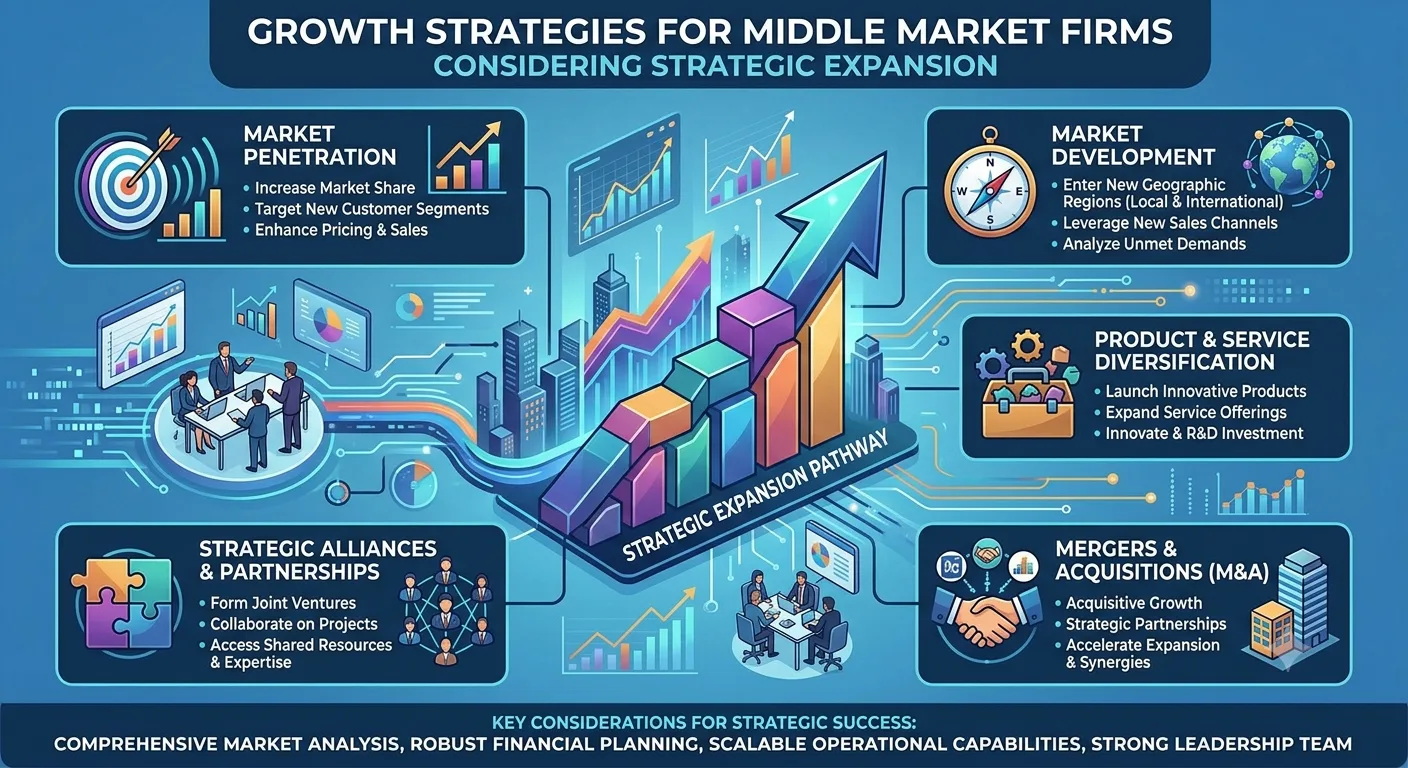
Growth is often a major priority for successful businesses. For companies that have established a strong market position, strategic expansion can create opportunities to increase revenue, reach new customers, and build long-term value.
However, expansion also brings challenges.
Entering new markets, launching products, acquiring businesses, or expanding operations requires careful planning. For Middle Market Firms, the right growth strategy depends on financial resources, market conditions, operational capabilities, and long-term objectives.
A thoughtful approach can help companies pursue growth while managing risk and maintaining the strength of their existing business.
Evaluate Your Current Position
Before beginning a major expansion, companies should understand their current position.
Business leaders should evaluate financial performance, customer demand, competitive advantages, operational capacity, and management resources.
Important questions include:
- Is the current business financially strong?
- Are existing operations scalable?
- Is there sufficient management capacity?
- What opportunities exist in the current market?
- What risks could affect expansion?
A clear understanding of the starting point can help leaders develop realistic growth plans.
Expand Into New Markets
Geographic expansion can provide new opportunities for Middle Market Firms.
A company with a successful product or service in one region may identify demand in other cities, states, or international markets.
However, expansion should be supported by market research.
Businesses should evaluate customer demand, local competition, regulations, pricing, and distribution requirements before entering a new market.
A phased approach may help reduce risk. Instead of making a large investment immediately, companies can test demand and gradually expand operations.
Develop New Products and Services
Product and service expansion can create additional revenue opportunities.
Existing customers may provide a natural market for complementary offerings.
For example, a company may introduce additional services that solve related customer problems or expand its product portfolio to serve new customer segments.
The best opportunities are often closely connected to the company's existing strengths.
Businesses should avoid expansion that creates unnecessary complexity or moves too far away from their core capabilities.
Consider Strategic Acquisitions
Acquisitions can provide a faster path to growth.
Instead of building new capabilities internally, a company can acquire an established business with customers, employees, technology, or market access.
Strategic acquisitions may help companies:
- Enter new markets
- Gain new customers
- Add complementary products
- Acquire technology
- Increase market share
- Improve operational scale
However, acquisitions require careful evaluation.
Companies should conduct thorough due diligence and ensure that the target business supports their long-term strategy.
A poorly aligned acquisition can create operational challenges and reduce the value of the transaction.
Build Strategic Partnerships
Not every growth opportunity requires an acquisition.
Strategic partnerships can allow businesses to access new markets, technologies, or customer groups without purchasing another company.
Partnerships may involve distribution agreements, technology relationships, joint ventures, or other collaborative arrangements.
For middle-market companies with limited resources, partnerships can provide flexibility while reducing the financial risk associated with a major expansion.
Invest in Technology and Efficiency
Technology can also support growth.
Automation, data analytics, cloud platforms, and digital tools can help companies improve efficiency and manage larger operations.
For Middle Market Firms, investing in scalable systems may be especially important before rapid expansion.
Outdated technology can create bottlenecks as a company grows.
Businesses should evaluate whether their financial systems, customer management tools, supply chain processes, and operational infrastructure can support future growth.
Strengthen the Management Team
Growth places additional demands on leadership.
A business that depends heavily on one owner may struggle to manage a larger and more complex organization.
Building a strong management team can improve decision-making and reduce operational risk.
Companies considering expansion should evaluate whether they have experienced leaders in areas such as finance, operations, sales, technology, and human resources.
Strong leadership can help ensure that growth initiatives are properly managed.
Maintain Financial Discipline
Growth often requires investment.
Businesses may need capital for hiring, technology, facilities, acquisitions, or marketing.
Before pursuing expansion, companies should understand the financial requirements and potential return on investment.
Maintaining financial discipline can help prevent a company from growing too quickly.
Leaders should establish clear budgets, performance targets, and milestones for major initiatives.
Conclusion
Strategic expansion can create significant opportunities for Middle Market Firms, but successful growth requires more than ambition.
Companies should begin with a clear understanding of their strengths, financial position, and long-term objectives. Whether the strategy involves geographic expansion, new products, acquisitions, partnerships, or technology investment, each decision should support the overall direction of the business.
The strongest growth strategies combine opportunity with discipline.
By carefully evaluating markets, strengthening operations, investing in leadership, and maintaining financial control, middle-market companies can pursue expansion while building sustainable long-term value.