Introduction
Businesses investing in digital advertising often face one important question: should they spend their budget on Google Ads or Meta Ads? Both platforms dominate the digital advertising landscape and offer powerful targeting capabilities, advanced analytics, and scalable advertising opportunities. However, the way these platforms operate is completely different, and understanding those differences is critical for maximizing return on investment (ROI).
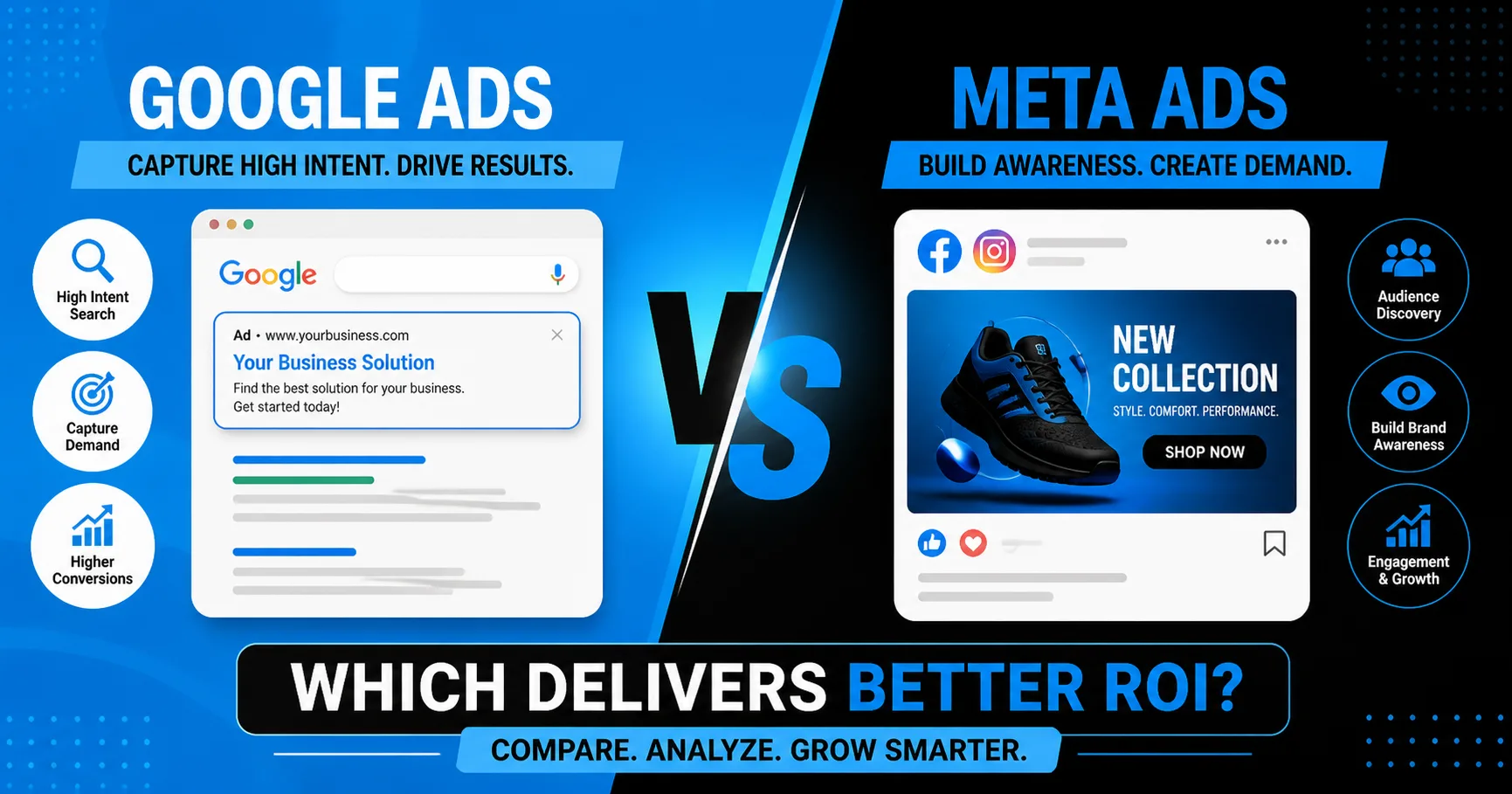
Google Ads focuses on capturing users with high purchase intent, while Meta Ads excel at audience discovery, brand awareness, and visual engagement. The debate around Google Ads vs Meta Ads continues because each platform performs differently depending on business goals, industry, audience behavior, and campaign strategy.
In this guide, we will explore how Google Ads and Meta Ads work, compare their strengths, analyze ROI potential, and help businesses decide which platform delivers better results.
Understanding Google Ads
Google Ads is a pay-per-click advertising platform that allows businesses to appear on Google Search, YouTube, Gmail, Google Maps, and millions of partner websites through the Google Display Network.
The biggest strength of Google Ads is user intent. People searching on Google are actively looking for products, services, or solutions. This means businesses can target users precisely when they are ready to take action.
Why Google Ads Generates Strong ROI
Google Ads often produces high conversion rates because users already have intent. For example, someone searching “best digital marketing agency near me” is likely closer to making a purchasing decision compared to someone casually browsing social media.
This makes Google Ads highly effective for service businesses, B2B companies, healthcare providers, law firms, educational institutions, and local businesses that depend on immediate lead generation.
Understanding Meta Ads
Meta Ads include advertising across Facebook, Instagram, Messenger, and Audience Network. Unlike Google Ads, Meta focuses on interest-based targeting rather than keyword intent.
Meta Ads are designed to help businesses discover new audiences and create demand through visual storytelling, engaging creatives, and audience segmentation.
Why Meta Ads Deliver Impressive Engagement
Meta platforms allow advertisers to target users based on interests, demographics, behaviors, purchasing habits, and online activity. This creates opportunities for brands to build awareness before users even realize they need a product or service.
Industries like fashion, beauty, fitness, travel, lifestyle, and eCommerce often achieve excellent ROI with Meta Ads because visually engaging products perform exceptionally well on Facebook and Instagram.
Google Ads vs Meta Ads — The Core Difference
The primary difference between Google Ads and Meta Ads lies in customer intent.
Google Ads capture existing demand. Users search because they already need something.
Meta Ads create demand. Users discover products while browsing social media content.
This distinction significantly affects ROI depending on the business type and marketing objective.
H3: Search Intent vs Audience Discovery
Google users are often closer to conversion because they actively search for solutions. Meta users may not initially intend to buy, but strong creatives and emotional marketing can influence purchasing decisions.
This is why Google Ads typically generate better direct-response conversions, while Meta Ads often excel in awareness and engagement campaigns.
Cost Comparison Between Google Ads and Meta Ads
Advertising costs vary greatly depending on competition, audience targeting, industry, and campaign optimization.
Google Ads generally have higher cost-per-click rates because advertisers compete for high-intent keywords. Meta Ads usually offer lower CPC and broader reach, especially for awareness campaigns.
Which Platform Is More Budget-Friendly?
Meta Ads are often more affordable for smaller businesses or startups with limited budgets. Businesses can generate significant reach and engagement without spending aggressively.
However, although Google Ads may cost more per click, the quality of leads is often stronger because users are already searching with intent to purchase.
Which Platform Delivers Better ROI for Lead Generation?
Lead generation performance depends heavily on industry and audience behavior.
Google Ads typically deliver stronger ROI for businesses offering urgent or solution-based services. For example, users searching for “emergency plumber,” “SEO agency,” or “best dentist near me” are highly likely to convert quickly.
Meta Ads for Lower Cost Leads
Meta Ads often generate lower-cost leads because users can submit forms directly within Facebook or Instagram without visiting external landing pages. However, lead quality can sometimes be weaker because user intent is lower.
Businesses should focus not only on cost-per-lead but also on lead quality and long-term customer value.
Which Platform Works Better for eCommerce?
For eCommerce brands, both platforms offer strong opportunities, but their roles differ.
Google Shopping Ads perform exceptionally well for high-intent product searches. Users searching for products already have buying intent, making conversions easier.
Meta Ads excel at impulse purchases and visually driven products. Fashion, cosmetics, home décor, fitness products, and accessories often achieve excellent engagement and sales through Instagram and Facebook campaigns.
Retargeting Improves ROI
Both Google and Meta offer retargeting capabilities that allow businesses to reconnect with users who previously visited their website.
Retargeting campaigns usually deliver higher conversion rates because users already recognize the brand.
Audience Targeting Capabilities
Google Ads target users primarily through keywords, search behavior, location, and purchase intent.
Meta Ads use interests, demographics, behaviors, and lookalike audiences for advanced audience targeting.
Which Platform Has Better Targeting?
Google Ads provide stronger intent targeting, while Meta Ads offer better behavioral and interest-based targeting.
Businesses focused on capturing immediate demand often prefer Google Ads, while brands looking to build awareness and community engagement usually benefit more from Meta Ads.
Creative Performance and User Engagement
Meta Ads rely heavily on visual content. Creative quality significantly affects performance on Facebook and Instagram.
Short-form videos, Reels, Stories, and carousel ads continue to dominate engagement trends across Meta platforms.
Google Ads Focus More on Intent Than Creativity
Although Google Display and YouTube campaigns benefit from strong creatives, Google Search Ads primarily rely on keyword relevance and intent rather than visual storytelling.
This makes Meta Ads more suitable for emotionally engaging campaigns and lifestyle branding.
AI and Automation in Advertising
Both Google and Meta are rapidly integrating AI-driven optimization into their advertising platforms.
Google uses machine learning through Performance Max campaigns and automated bidding strategies. Meta continues expanding AI-powered advertising tools like Advantage+ campaigns.
Automation Improves Campaign Performance
AI-powered optimization helps advertisers improve targeting, bidding, audience segmentation, and creative testing while reducing manual campaign management.
Businesses leveraging automation effectively often achieve stronger ROI and scalability.
Which Platform Is Better for Small Businesses?
Small businesses with limited budgets often start with Meta Ads because of lower advertising costs and broader audience reach.
However, local businesses offering high-intent services may achieve faster ROI through Google Search campaigns.
Choosing Based on Business Goals
Businesses focused on immediate conversions usually benefit from Google Ads.
Brands focused on awareness, engagement, and customer discovery often perform better with Meta Ads.
The ideal strategy depends on the customer journey and marketing objectives.
Why Combining Google Ads and Meta Ads Delivers the Best ROI
Many successful brands no longer choose between Google Ads and Meta Ads. Instead, they combine both platforms strategically to create a full-funnel marketing approach.
Meta Ads create awareness and introduce brands to new audiences.
Google Ads capture users later when they actively search for products or services.
Full-Funnel Advertising Strategy
A customer may first discover a brand through Instagram or Facebook content. Later, when they search for that product or company on Google, Google Ads help complete the conversion process.
This combination often produces significantly higher long-term ROI than relying on a single platform alone.
Final Verdict — Google Ads or Meta Ads?
There is no universal winner in the Google Ads vs Meta Ads debate because both platforms serve different purposes.
Google Ads usually deliver stronger ROI for high-intent lead generation, urgent services, and direct-response campaigns.
Meta Ads often produce better results for brand awareness, visual storytelling, audience engagement, and impulse-driven purchases.
The Smartest Approach for Maximum ROI
The businesses achieving the highest advertising returns in 2025 are not choosing one platform over the other. They are integrating both strategically.
Using Meta Ads to generate awareness and Google Ads to capture purchase intent creates a complete digital advertising ecosystem that improves customer acquisition, engagement, and long-term profitability.
Conclusion
Google Ads and Meta Ads are both powerful advertising platforms capable of delivering exceptional ROI when used correctly. The key is understanding how each platform aligns with your business goals, audience behavior, and marketing strategy.
Google Ads excel at capturing demand, while Meta Ads excel at creating demand. Businesses that understand this distinction can allocate budgets more effectively and optimize campaigns for better performance.
Instead of asking which platform is better overall, businesses should focus on which platform is better for their specific objectives. In many cases, the most profitable strategy is not Google Ads versus Meta Ads — it is Google Ads plus Meta Ads working together to drive sustainable digital growth.