
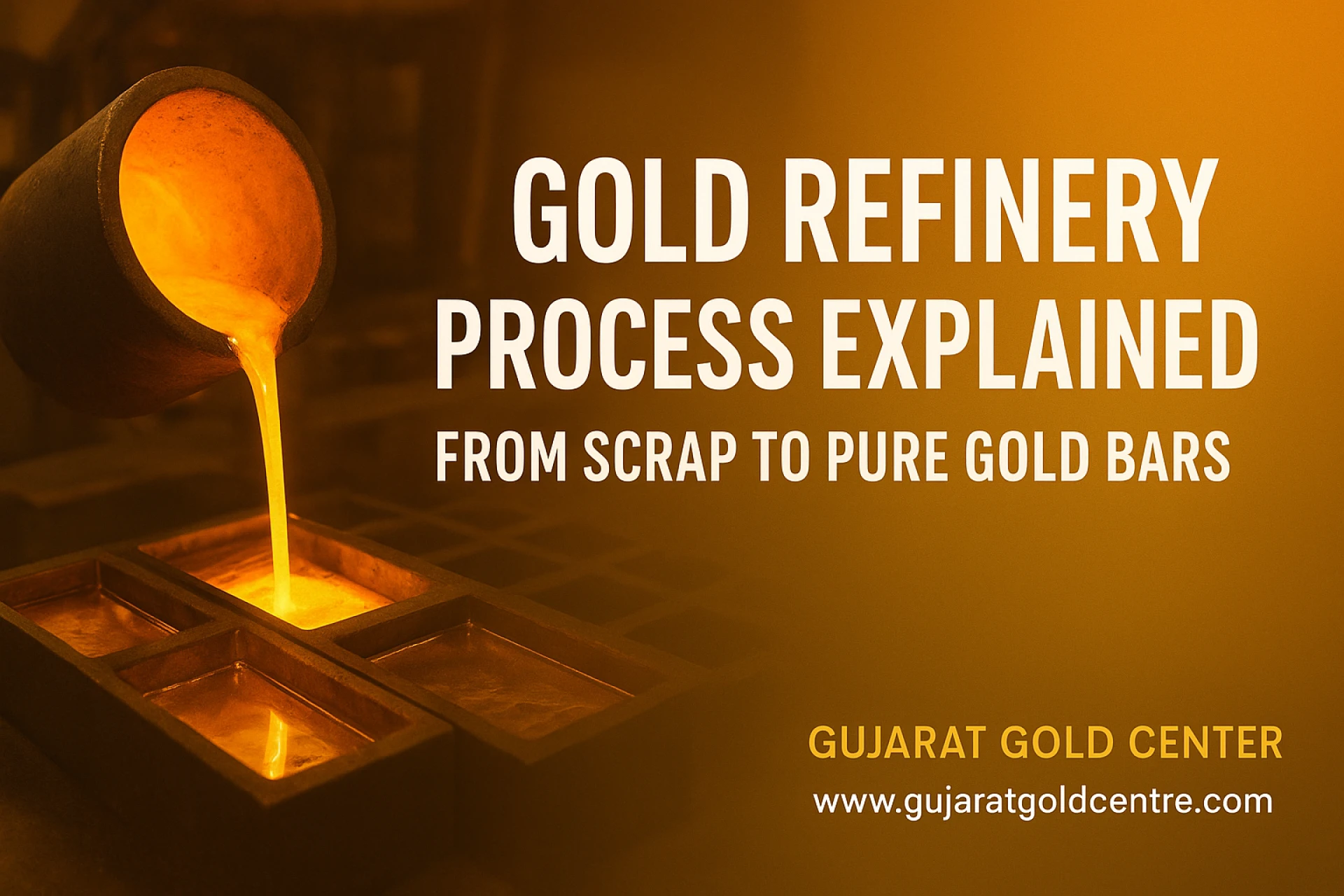
Gold refining is the invisible backbone of the jewelry and bullion industry. But how does scrap gold transform into shining 24-karat bars? In this guide, Gujarat Gold Centre (GGC) — a leading gold refinery in Ahmedabad — breaks down the gold refinery process step-by-step, explaining the science, technology, and purity standards that ensure every bar meets global benchmarks.
Understanding the Gold Refinery Process
Refining gold means removing impurities from raw or recycled material to achieve nearly 100% pure metal. In India’s gold refining industry, this process plays a critical role in sustaining both local jewelry manufacturing and international bullion trade.
At its core, the gold purification process involves melting, chemical treatment, and purity testing before casting into standard bars or granules.
Step-by-Step Journey: From Scrap to Pure Gold
1. Collection and Pre-Assessment
Scrap gold — from jewelry, coins, or industrial waste — is collected and tested for initial purity.
Refineries like GGC use advanced gold assay techniques (such as XRF analysis) to determine composition.
2. Melting the Scrap
The material is melted in a high-temperature refining furnace, ensuring uniformity. Flux is added to separate base metals and impurities.
3. Chemical Refining
Two primary refining methods are used:
- Aqua Regia Process: A blend of nitric and hydrochloric acids dissolves gold, leaving behind other metals.
- Electrolytic Refining: An electric current passes through a gold solution to deposit ultra-pure gold onto cathodes.
4. Precipitation & Filtration
Gold particles are precipitated, washed, and filtered to eliminate any residual chemicals.
5. Drying and Melting Again
The refined gold is remelted to remove microscopic impurities — resulting in gold that is up to 99.99% pure.
6. Casting Pure Gold Bars
Finally, molten gold is poured into molds to create bullion bars, granules, or sheets — ready for hallmarking and distribution.
The Science Behind Gold Refining: Aqua Regia & Electrolytic Methods
Both Aqua Regia and Electrolytic Refining are global standards in professional refineries:
- Aqua Regia is favored for small-scale refining due to efficiency and precision.
- Electrolytic Refining produces higher purity gold, ideal for investment-grade bullion.
- Modern refineries integrate both for optimal recovery and purity assurance.
Ensuring Purity: Assay and Testing Procedures
Every refined batch undergoes gold assay and hallmark certification:
- Fire Assay & XRF Testing verify purity levels.
- Hallmark Certification from BIS ensures consumer trust.
- At Gujarat Gold Centre, multi-layered testing guarantees that each bar meets 24-karat gold refining standards.
Why Choose a Certified Gold Refinery in Ahmedabad
Ahmedabad has become a refining hub due to its modern infrastructure and skilled expertise.
Gujarat Gold Centre (GGC) stands out as a trusted gold refinery company in India, offering:
- International-grade refining accuracy
- Transparent testing and reporting
- Fast turnaround for jewelers and traders
- Sustainable and ethical refining practices
Environmental and Ethical Refining Practices
Today’s gold refining goes beyond purity — it’s about responsibility.
GGC uses eco-friendly chemical handling, precious metal recovery systems, and recycling initiatives that minimize waste. By prioritizing sustainability, GGC ensures the refining process supports both the environment and industry ethics.
Conclusion: Partner with Gujarat Gold Centre for Trusted Refining Solutions
From scrap gold refining to bullion manufacturing, Gujarat Gold Centre ensures transparency, technology, and trust at every step.
Whether you’re a jeweler, investor, or trader, choose a partner that turns your gold into guaranteed purity — every single time.
Explore trusted refining with Gujarat Gold Centre — gold refinery in Ahmedabad