
Here's a humanized version. I've loosened the rhythm, cut the stock phrases ("Put simply," "The honest takeaway," "It is not X. It is Y."), added contractions, and kept all your facts, headings, the table and the CTA.
Go vs Rust for Backend Development: Where Each One Earns Its Complexity
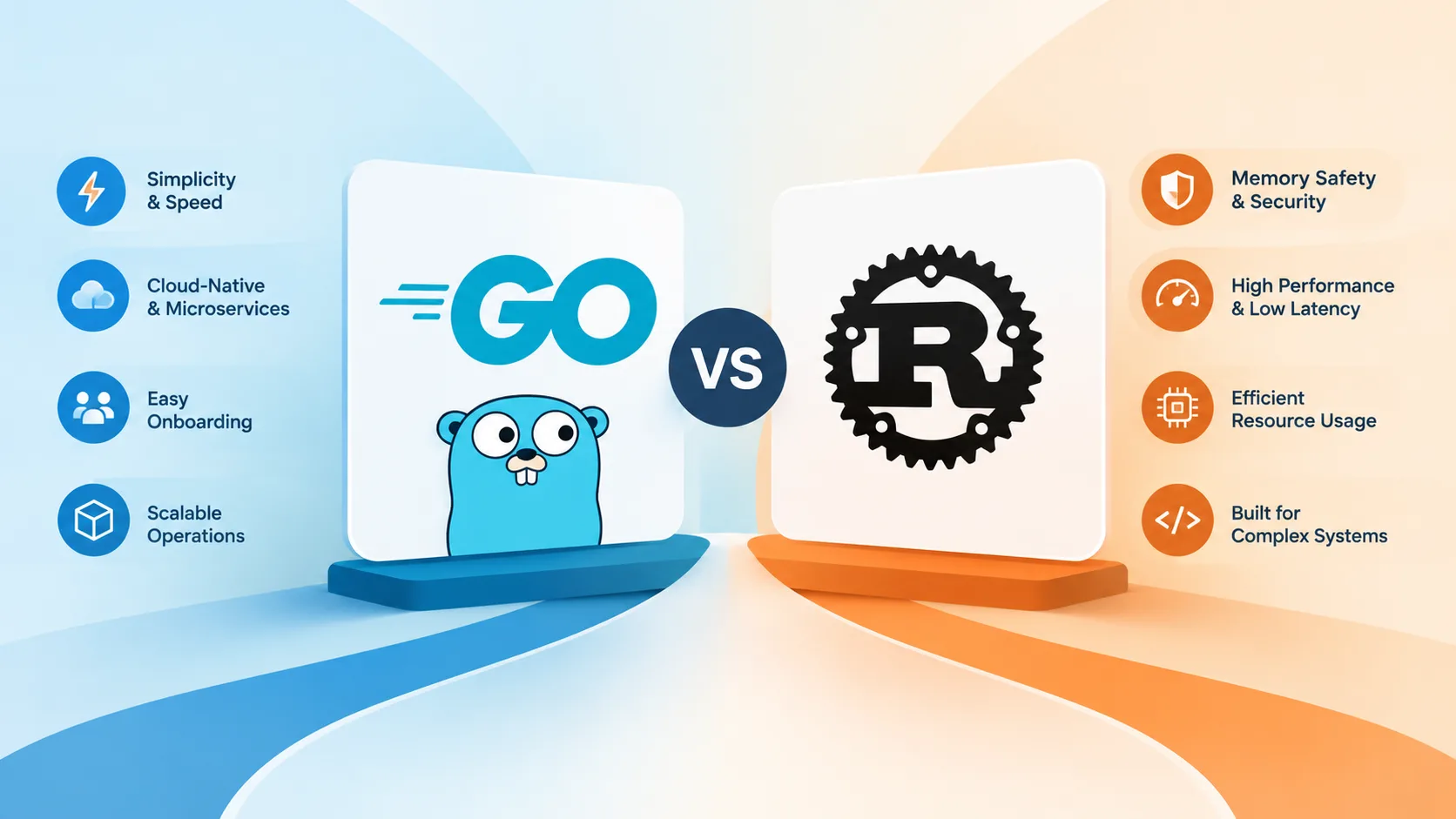
Sooner or later, every backend team comparing Go and Rust runs a benchmark. Rust wins. And then someone asks the obvious follow-up: if Rust is faster, why does so much of the cloud-native world still run on Go?
Because speed was never really the deciding factor. For most backend services, both languages are fast enough. What actually separates them is how they handle complexity. Go keeps the language small and lets the runtime deal with the messy parts. Rust hands those messy parts to you at compile time, and in exchange gives you code that behaves predictably once it's running.
You pay either way. You just pay in different places. This guide walks through where each language is worth what it costs, so you can choose based on the service you're actually building, not the language your team is most excited to try.
The short answer
Go is the right default for most business backends. Think REST and gRPC APIs, microservices, internal platforms, DevOps tooling, and anything where shipping quickly and onboarding new engineers matters more than shaving off the last few milliseconds.
Rust belongs on the hot paths. That means services with strict tail-latency targets, high-throughput data and network infrastructure, memory-constrained environments, and code where a memory bug would turn into a security incident.
Both make sense when one critical component needs Rust's guarantees and the rest of the system doesn't. In our experience, that's how most teams adopt Rust successfully.
Two languages, two places to put complexity
You can't remove complexity from a backend service. You can only decide where it lives.
Go pushes it to runtime. A garbage collector handles memory. Goroutines and channels make concurrency feel cheap and easy. You can read the whole language spec in an afternoon. The catch is that some problems only show up later: GC pauses under heavy allocation, data races the compiler won't flag, and nil pointer panics in production. Go gives you good tools to catch these (the race detector, profilers, solid code review), but ultimately you're relying on discipline rather than the compiler.
Rust pushes it to compile time. Its ownership and borrowing rules prove your code is memory safe and free of data races before it ever runs. There's no garbage collector, so latency stays predictable. The cost comes upfront: a steeper learning curve, slower builds, extra design time spent working with the borrow checker, and async code that can get complicated quickly.
One way to think about it: Go charges a small, ongoing fee in operations and vigilance. Rust charges a large one-time fee in learning and design. Which is cheaper for you depends on how long the service will live and how much it hurts when it fails.
Where Go makes the most sense
Go was built at Google for big teams writing networked services, and you can feel that in how it's designed. The simplicity isn't a gap in the feature list. It's the whole point.
CRUD APIs and microservices. Most backend work is I/O bound. Your code spends its time waiting on databases, caches and other services. Goroutines let you handle thousands of concurrent requests with code that still reads top to bottom, and the standard library comes with an HTTP server you can run in production.
Cloud-native and platform tooling. Kubernetes, Docker, Terraform and Prometheus are all written in Go. If your service lives in that world, you get mature client libraries and plenty of real-world examples to learn from.
Fast-moving product teams. Anyone comfortable with a C-style language can usually be productive in Go within a couple of weeks. Reviews move faster too, since there are only so many ways to write the same thing.
Simple deployment. Go builds a single static binary, and it builds it quickly. That means small containers, fast CI pipelines, easy cross-compilation and less operational overhead.
Services with moderate latency needs. Go's garbage collector is tuned for short pauses. If your API has a p99 target in the tens of milliseconds, GC is rarely what's slowing you down.
For services like these, Rust's guarantees solve problems you don't have, and its learning curve slows you down on the ones you do.
Where Rust is worth the extra effort
Rust's complexity pays off when surprises at runtime are expensive. These are the cases where teams consistently find it worth the investment.
Strict tail-latency targets. No garbage collector means no GC pauses. Discord's engineering team rewrote a busy Go service in Rust after GC spikes kept causing latency problems, and performance became much steadier afterward. If your SLA is written around p99.9, Rust takes an entire source of variance off the table.
Network and data infrastructure. Proxies, load balancers, message brokers, databases and stream processors exist to move bytes around. Cloudflare built Pingora, its HTTP proxy, in Rust so it could handle enormous traffic while using less CPU and memory.
Memory and cost constraints. Rust services often need a fraction of the memory a garbage-collected language would. At scale, that shows up on your cloud bill, and it makes Rust a natural fit for edge computing and embedded backends.
Security-critical code. Parsers, authentication layers and anything that touches untrusted input benefit from memory safety enforced at compile time. Memory safety bugs are behind many of the most serious vulnerabilities in systems software, and Rust's design rules out most of them.
CPU-heavy processing. Media encoding, compression, cryptography, search indexing and ML inference serving all benefit from zero-cost abstractions and precise control over how memory is laid out.
You'll notice a pattern here. Rust tends to win when a service runs hot, runs for a long time, and costs a lot when it breaks.
Performance: what the benchmarks don't tell you
Yes, Rust usually beats Go on raw throughput, and on CPU-bound work the gap can be significant. But benchmark charts leave out three things that matter a lot more in production.
The language probably isn't your bottleneck. If a request spends 40 ms waiting on Postgres and 2 ms running your code, cutting that 2 ms in half won't change much. Look at your queries, caching and network hops first.
Tail latency matters more than averages. Go and Rust often have similar median latency. The difference appears at p99 and above, where GC pauses and allocation pressure start to show. If your users only ever feel the median, Go is fine. If your contracts are written around the tail, Rust has the advantage.
Efficiency adds up at scale. Saving 30% on CPU and memory barely registers on three servers. On three hundred, it's real money. Run the numbers for your own fleet before deciding a rewrite will pay for itself.
So where does that leave you? Go is fast enough for the vast majority of backend services. Rust is worth it when performance is the product, not just a bonus.
Team, hiring and delivery speed
Picking a language is also a staffing decision, and this is where Go's simplicity really pays off.
Onboarding. Go engineers are usually productive within weeks. With Rust, it often takes a few months before developers stop fighting the borrow checker and start designing around it. Build that ramp-up into your roadmap from the start.
Hiring. There are more Go developers out there, especially in backend roles, so it's easier to hire Golang developers who can contribute from their first sprint. Rust regularly tops "most admired language" lists in developer surveys, so plenty of people want to work with it. Experienced production Rust engineers, though, are still hard to find and more expensive to hire.
Velocity over time. Go teams usually ship faster early on. Rust teams often catch up later, because whole categories of bugs never make it to production and refactoring feels safer when the compiler is checking your assumptions. For a short-lived MVP, Go's early speed wins. For a core service you'll maintain for five years, Rust's stability can close that gap.
Code review. Go code tends to look the same no matter who wrote it, which keeps reviews quick. Rust is more expressive, and that also means a codebase can drift in style unless the team agrees on strong conventions.
A quick decision framework
Use this table as a starting point. If most of your answers fall in one column, you probably have your answer.
FactorLean GoLean RustWorkload typeI/O bound (APIs, CRUD, orchestration)CPU bound or byte-heavy (proxies, parsing, encoding)Latency targetMedian and p99 in tens of msStrict p99.9 or microsecond budgetsTime to marketWeeks to first releaseMonths are acceptable for the gainTeam experienceMixed backgrounds, growing teamSystems experience or time to investInfrastructure costSmall to mid fleetLarge fleet where CPU and memory savings compoundFailure costBugs are recoverableMemory bugs mean security incidents or outagesService lifespanEvolving product, frequent rewritesLong-lived core componentEcosystemCloud-native, Kubernetes, DevOpsSystems, WebAssembly, embedded, edgeYou don't have to choose just one
For a lot of companies, the most practical answer is a polyglot setup: Go for most of the system, and Rust only for the handful of components that genuinely need it.
Here's how that usually plays out:
- Build the product in Go. APIs, business logic, workers and admin services all benefit from shipping quickly.
- Measure in production. Profile CPU, memory and tail latency to find the services that are actually expensive or unstable.
- Rewrite only the hot path in Rust. That might be a single gateway, one stage of a data pipeline or a parsing service, sitting behind a clean gRPC or HTTP contract.
- Keep the boundary clean. When services talk through well-defined interfaces, each team can work in whichever language suits its problem.
This keeps Rust's learning curve limited to a small team, keeps your hiring options open, and puts your performance investment exactly where the data says it belongs.
Final thoughts
Go and Rust aren't really competitors. They're tools built for different jobs. Go makes the common case easy: readable code, fast delivery and simple operations for the services most businesses rely on every day. Rust is worth its complexity in the rarer but critical cases where latency, memory, cost or safety are what the product is actually selling.
Start with Go. Switch to Rust when you can point to a specific problem its guarantees will fix. And if that problem only exists in one part of your system, use both.
Need help deciding, or building it? At Techiebutler, our dedicated engineering teams build backend services in Go and Rust for startups and growing companies.