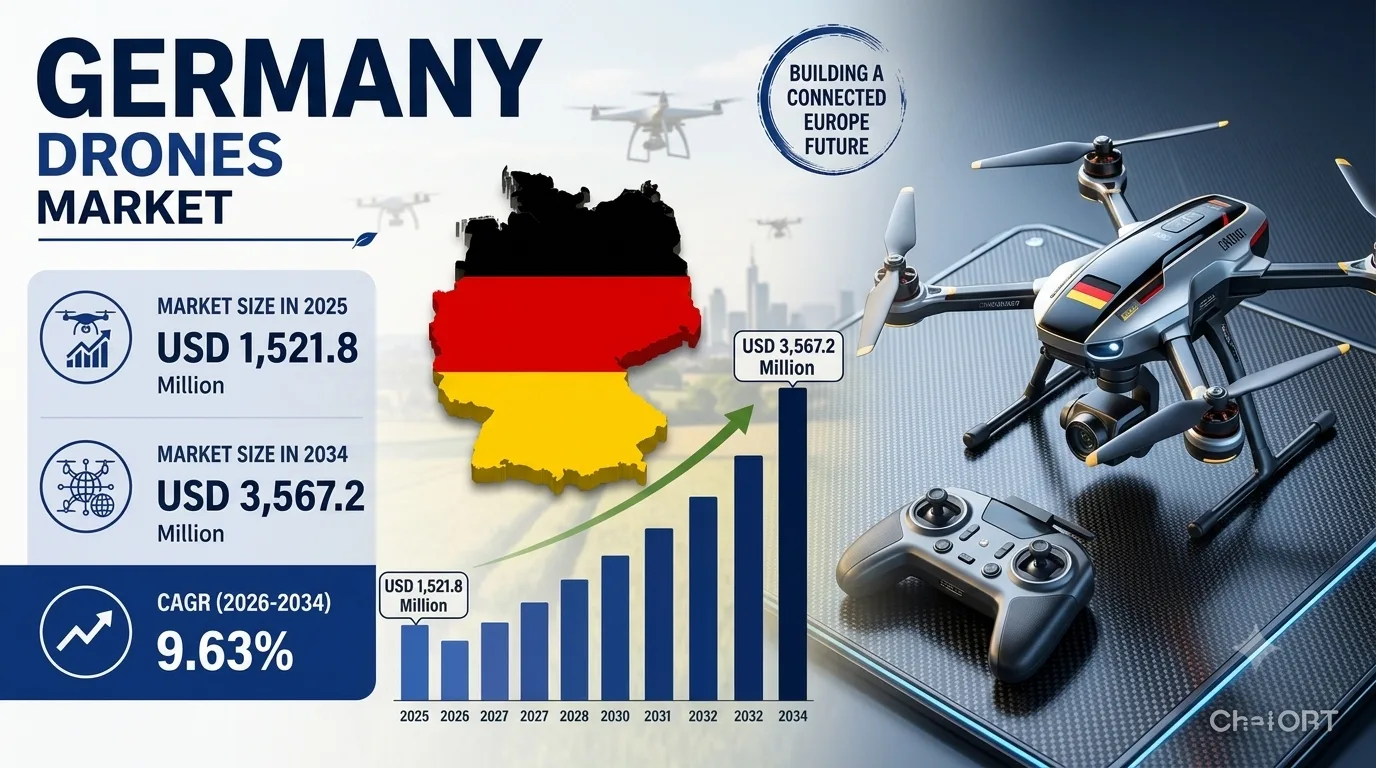
The Germany drones market size reached USD 1,521.8 Million in 2025. Looking forward, the market is projected to reach USD 3,567.2 Million by 2034, exhibiting a growth rate (CAGR) of 9.63% during 2026‑2034. The market is experiencing significant growth, driven by increased adoption across sectors like agriculture, logistics, and public safety. Technological advancements, such as improved navigation and AI integration, are also enhancing drone capabilities. The demand for drones in commercial applications, such as aerial photography and infrastructure inspection, is further contributing significantly to the Germany drones market share. Germany's strategic positioning as a hub for defense modernization and its participation in NATO's evolving defense frameworks are creating robust demand patterns for military and commercial drones across the country. This market is strategically important to Germany's economy as it directly supports the nation's defense, logistics, agriculture, and infrastructure sectors.
The Germany drones market is poised for sustained expansion, driven by advancements in military drone capabilities, technological innovations, and expanding commercial applications. With a projected CAGR of 9.63% through 2034, the market presents significant opportunities for established manufacturers and new entrants focused on AI-integrated, autonomous, and high-performance drone solutions.
GERMANY DRONES MARKET SUMMARY
- The Germany drones market encompasses a wide range of unmanned aerial vehicles designed for aerial surveillance, reconnaissance, delivery, mapping, and defense applications across the military, agriculture, logistics, and media sectors.
- The ecosystem includes hardware manufacturers, software developers, component suppliers (navigation systems, AI processors, battery systems), OEMs, aftermarket service providers, and end-use consumers.
- Major segments identified in the market include type (fixed wing, rotary wing, hybrid), component (hardware, software, accessories), payload (<25 kilograms, 25-170 kilograms, >170 kilograms), point of sale (original equipment manufacturers, aftermarket), and end-use industry (construction, agriculture, military and defense, law enforcement, logistics, media and entertainment, others).
- The military and defense segment is a dominant end-use category, driven by Germany's increased investment in sophisticated drone systems for reconnaissance, surveillance, and intelligence gathering.
- The market is characterized by rapid technological advancements, including AI integration, autonomous flight systems, improved battery performance, and enhanced payload capacities.
PORTER'S FIVE FORCES ANALYSIS – GERMANY DRONES MARKET
The competitive dynamics of the Germany drones market can be analyzed using Porter's Five Forces framework.
Porter's Five Forces Analysis – Germany Drones Market
- Competitive Rivalry: High, with intense competition between global defense contractors, specialized drone manufacturers, and emerging technology disruptors. Rivalry is driven by technological innovation, defense contracts, and strategic partnerships. Business implication: Companies must differentiate through AI integration, autonomous capabilities, and strong defense sector relationships to win contracts and maintain market position.
- Supplier Power (Component Providers): Moderate. Suppliers of critical components such as AI processors, navigation systems, and battery technology have increasing negotiating power due to specialized expertise and limited alternatives. Business implication: Drone manufacturers must develop strategic partnerships with key suppliers and invest in vertical integration to secure supply chains.
- Buyer Power (Government and Commercial Buyers): Increasing. Government defense agencies and commercial operators have growing bargaining power as sophisticated buyers demanding advanced capabilities, reliability, and cost-effectiveness. Business implication: Manufacturers must demonstrate proven track records, offer competitive pricing, and provide value-added services such as training and maintenance to attract buyers.
- Threat of Substitutes: Moderate. Alternative surveillance and delivery technologies (satellite systems, manned aircraft, ground-based systems) pose substitution threats for certain applications. Business implication: Drone manufacturers must articulate clear advantages in cost, flexibility, and operational efficiency relative to alternatives.
- Threat of New Entrants: Moderate. High barriers to entry exist for military-grade drone manufacturing (regulatory approvals, defense certifications, R&D investment), but lower barriers for commercial and consumer drone segments. Germany's growing market attracts new domestic and international entrants. Business implication: Established players should build defensible positions through technological leadership, patent portfolios, and strong government relationships.
Competitive Rivalry – Moderate to High (Healthy)
- Multi-tier competition spans global defense leaders (Airbus, Rheinmetall), specialized drone manufacturers (Stark, Alpine Eagle), and technology disruptors (Anduril Industries) – driving differentiation through product innovation, AI capabilities, and autonomous systems rather than destructive price competition.
- Airbus's partnership with Kratos Defense to deliver combat drones to the German Air Force by 2029, Anduril Industries and Rheinmetall's collaboration to develop Barracuda and Fury drones for European markets, and Stark's plans to launch a drone manufacturing plant in Swindon, UK, reflect active strategic repositioning that is strengthening the overall market ecosystem.
Request for Sample Report: https://www.imarcgroup.com/germany-drones-market/requestsample
MARKET GROWTH DRIVERS:
Several key factors are propelling the expansion of the Germany drones market. The advancements in military drone capabilities serve as a powerful demand driver for defense-grade drones. Germany is making significant progress in the development of military drone technology to enhance its defense capabilities and support NATO operations. The nation has ramped up investment in sophisticated drone systems for purposes such as reconnaissance, surveillance, and intelligence gathering. For instance, in July 2025, Airbus partnered with US-based Kratos Defense to deliver combat drones to the German Air Force by 2029. The XQ-58A Valkyrie, an unmanned combat aircraft, will feature Airbus' mission systems, enhancing Germany's aerial capabilities. These military drones are intended to deliver real-time data, which improves situational awareness and operational effectiveness. Additionally, technological innovations are supporting commercial drone adoption, with continuous research and development propelling significant advancements in battery performance, AI integration, and autonomous operations.
MARKET GROWTH DRIVERS:
The Germany drones market is also benefiting from accelerating technological innovations and evolving commercial demands. There is an accelerating shift toward AI-integrated and autonomous drone systems, as German industries and defense operators increasingly transition from conventional manned systems. AI integration is enhancing the decision-making capabilities of drones, facilitating real-time data processing, obstacle recognition, and route optimization. As a result, drones can carry out tasks like surveying, mapping, and package delivery autonomously, without the need for human oversight. For instance, in June 2025, Alpine Eagle launched the world's first drone-based counter-UAS system, the Sentinel, which uses radar-equipped drones to detect and neutralize adversary drones. This innovative solution allows for enhanced aerial defense capabilities without the limitations of ground-based systems, featuring swarm formations and the ability to deploy interceptor missiles. Furthermore, the rising demand for drones in commercial applications such as aerial photography, infrastructure inspection, and logistics is creating new growth avenues, with enhanced battery technology markedly increasing flight durations and operational efficiency.
GERMANY DRONES MARKET SEGMENTATION
Segmentation analysis provides a detailed view of the Germany drones market by category:
- Type Insights: Fixed Wing, Rotary Wing, Hybrid.
- Component Insights: Hardware, Software, Accessories.
- Payload Insights: <25 Kilograms, 25-170 Kilograms, >170 Kilograms.
- Point of Sale Insights: Original Equipment Manufacturers (OEM), Aftermarket.
- End-Use Industry Insights: Construction, Agriculture, Military and Defense, Law Enforcement, Logistics, Media and Entertainment, Others.
- Regional Insights: Western Germany, Southern Germany, Eastern Germany, Northern Germany.
COMPETITIVE LANDSCAPE
The Germany drones market features a moderately consolidated competitive landscape, with multi-tier competition spanning global defense leaders and specialized drone manufacturers. Key companies operating in the market include:
- Airbus SE
- Rheinmetall AG
- Anduril Industries
- Stark
- Alpine Eagle
- Kratos Defense & Security Solutions
- Other regional and international players
Strategic developments are shaping the competitive arena, notably Airbus's partnership with Kratos Defense to deliver combat drones to the German Air Force by 2029, Anduril Industries and Rheinmetall's collaboration to develop Barracuda and Fury drones for European markets in June 2025, and Stark's announcement in July 2025 to launch a drone manufacturing plant in Swindon, UK, creating 100 local jobs for producing the OWE-V Virtus unmanned weapon system to meet growing NATO demands.
REGIONAL ANALYSIS:
Regional dynamics within the Germany drones market are shaped by varying levels of industrial concentration, defense infrastructure, and technological ecosystem development.
- Western Germany emerges as a critical demand center, driven by major industrial hubs, defense contractors, and technology companies requiring advanced drone solutions for manufacturing, logistics, and security applications.
- Southern Germany benefits from significant aerospace and automotive industry presence, with companies like Airbus and BMW contributing to drone technology development and adoption for industrial inspection and precision agriculture.
- Eastern Germany sees demand from agricultural sectors and logistics operations, with increasing adoption of drones for crop monitoring, delivery services, and infrastructure inspection.
- Northern Germany has strong maritime and port operations, contributing to drone demand for coastal surveillance, shipping logistics, and offshore infrastructure inspection.
RECENT INDUSTRY DEVELOPMENTS
July 2025: German defense company Stark announced its plans to launch a drone manufacturing plant in Swindon, UK, creating 100 local jobs. The facility will produce the OWE-V Virtus unmanned weapon system to meet growing NATO demands. The expansion strengthens defense ties between the UK and Germany, enhancing production capabilities across Europe.
July 2025: Airbus partnered with US-based Kratos Defense to deliver combat drones to the German Air Force by 2029. The XQ-58A Valkyrie, an unmanned combat aircraft, will feature Airbus' mission systems, enhancing Germany's aerial capabilities. This partnership marks a significant collaboration in the aerospace and defense sector.
June 2025: Anduril Industries and Rheinmetall partnered to develop Barracuda and Fury drones for European markets, enhancing military capabilities through US technology. This collaboration addresses defense needs focusing on rapid production and deployment of autonomous systems aligned with NATO's evolving requirements.
June 2025: Alpine Eagle launched the world's first drone-based counter-UAS system, the Sentinel, which uses radar-equipped drones to detect and neutralize adversary drones. This innovative solution allows for enhanced aerial defense capabilities without the limitations of ground-based systems.
Key Aspects Required for the Germany Drones Market
- Market Performance: USD 1,521.8 Million in 2025, with a projected trajectory to USD 3,567.2 Million by 2034.
- Market Outlook: A 9.63% CAGR through 2034 indicates robust growth across military, commercial, and consumer drone segments.
- Growth Drivers: Increased adoption across sectors like agriculture, logistics, and public safety; technological advancements such as improved navigation and AI integration; demand for drones in commercial applications such as aerial photography and infrastructure inspection; Germany's defense modernization initiatives and NATO commitments; advancements in military drone capabilities including AI, autonomous flight systems, and increased payload capacities.
- Competitive Landscape: A distinctive multi-tier structure with global defense giants (Airbus, Rheinmetall), specialized drone manufacturers (Stark, Alpine Eagle), and technology disruptors (Anduril Industries), with moderate concentration at the manufacturer level.
- Value Chain Analysis: From raw material and component supply (AI processors, navigation systems, battery technology) through hardware manufacturing, software development, system integration, distribution, and aftermarket services to end-use deployment.
- Industry Trends: Military drone modernization and NATO collaboration; AI integration and autonomous operations; battery technology advancements for extended flight durations; counter-UAS system development; strategic partnerships between US and European defense companies; expansion of drone manufacturing capabilities across Europe.
- Strategic Recommendations: Focus on military and defense drone development, AI-integrated autonomous systems, counter-UAS technology, and commercial application expansion; develop differentiated capabilities in AI, autonomous flight systems, and payload capacity; build strong relationships with NATO, German defense agencies, and European defense contractors.
Note: If you need any specific information that is not covered currently within the scope of the report, we will provide the same as a part of customization.
Request Customization: https://www.imarcgroup.com/request?type=report&id=39903&flag=E
Write this before about us –
- Report Format, Delivery, and Customization Details
- Report Format Mode: PPT, PDF, and Excel
- Report Delivery Mode: Online Delivery, Physical Delivery
- Report Delivery Time: Report Delivered Over Email within 24 to 48 hours. If requested by the client, a physical copy will be delivered within three to ten days.
- Report Confirmation Mode: Yes via Email
- Report Customization Mode: Yes via Email / Call
- Report Table of Content: Yes
- Report List of Figures: Yes
- Report Methodology Mode: Yes
- Request For Sample Report: Yes