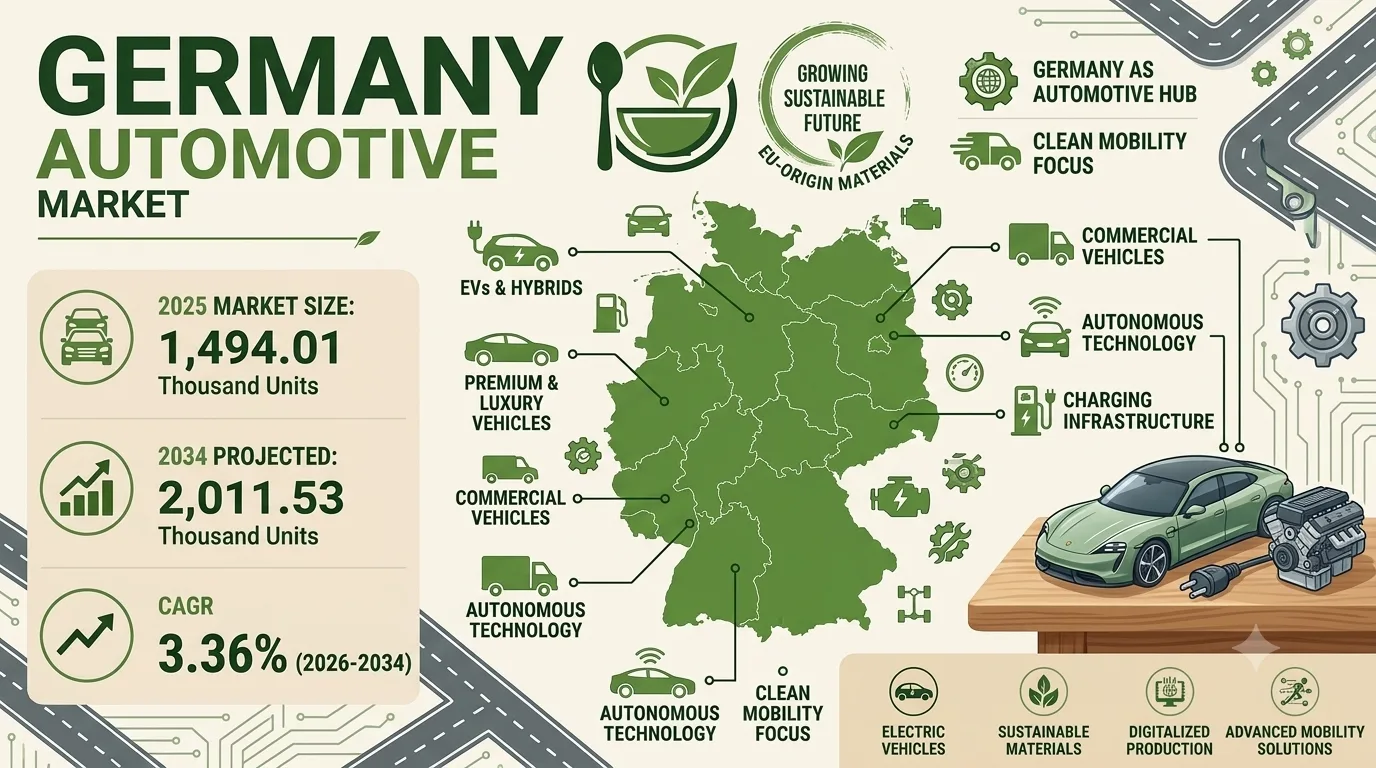
The Germany automotive market is experiencing a period of dynamic transformation as it navigates its transition toward sustainable mobility, reinforced by its position as Europe's largest vehicle market and a global hub for automotive engineering. The market size reached 1,494.01 Thousand Units in 2025 and is projected to reach 2,011.53 Thousand Units by 2034, exhibiting a compound annual growth rate (CAGR) of 3.36% during 2026-2034. As the birthplace of the modern automobile, Germany's automotive sector remains a critical pillar of its economy, accounting for approximately one-fifth of the country's total industrial value added and supporting around 721,400 jobs in the sector. The german automotive industry overview reveals a sector that produced about 4.15 million passenger cars domestically in 2025, with around 3.17 million exported, underscoring its significant export-oriented nature and global reach.
The Germany automotive market is poised for sustained expansion, driven by accelerating electric vehicle adoption, stringent EU emission regulations, and continued technological innovation in autonomous driving and digital connectivity. With a projected CAGR of 3.36% through 2034, the market presents significant opportunities for established manufacturers and new entrants focused on sustainable mobility solutions and next-generation vehicle technologies.
GERMANY AUTOMOTIVE MARKET SUMMARY
The Germany automotive market encompasses a wide range of vehicles designed for personal mobility, commercial transport, and specialized applications across passenger and commercial vehicle segments. The ecosystem includes global OEMs (Volkswagen, BMW, Mercedes-Benz), tier-1 suppliers (Continental, Bosch, ZF Friedrichshafen), technology partners, dealership networks, and end-use consumers. Major segments identified in the market include propulsion type (electric vehicles and internal combustion engine vehicles), vehicle type (passenger vehicles and commercial vehicles), and region (Western Germany, Southern Germany, Eastern Germany, and Northern Germany). The passenger vehicle segment is the dominant category, accounting for approximately 76% of total market share, driven by strong consumer demand for personal mobility and diverse model offerings from premium and mass-market manufacturers.
PORTER'S FIVE FORCES ANALYSIS — GERMANY AUTOMOTIVE MARKET
The competitive dynamics of the Germany automotive market can be analyzed using Porter's Five Forces framework.
- **Competitive Rivalry: High, with intense competition between established domestic manufacturers (Volkswagen, BMW, Mercedes-Benz) and new entrants from China and the United States. Rivalry is driven by accelerating electrification, autonomous driving capabilities, digital integration, and sustainability credentials. Business implication: Manufacturers must differentiate through technological innovation, compelling value propositions, and strong brand loyalty to maintain market positioning.
- **Supplier Power (Tier-1 Suppliers): Moderate. Major suppliers like Bosch, Continental, and ZF Friedrichshafen hold significant negotiating power due to specialized expertise in critical components such as battery systems, autonomous driving sensors, and software-defined vehicle platforms. Business implication: OEMs must develop strategic partnerships and diversified supply chains to mitigate dependency and secure competitive advantages.
- **Buyer Power (Consumers): High. German consumers are increasingly price-sensitive, with the average budget for the next vehicle purchase at around 44,000 Euros. 65% of respondents still plan to buy a new or demonstration car, but buyers are taking longer to decide and comparing more thoroughly. Business implication: Automakers must offer clear value propositions, pricing transparency, and compelling product differentiation to attract and retain customers.
- **Threat of Substitutes: Moderate. Alternative mobility solutions, such as public transport, shared mobility services, and ride-hailing, pose substitution threats for personal vehicle ownership. Additionally, the growing used car market remains a strong alternative, with 35% of respondents planning to buy a used car next. Business implication: Automakers must articulate clear advantages of new vehicles, including advanced technology, safety features, and sustainability credentials.
- **Threat of New Entrants: High, particularly from Chinese electric vehicle manufacturers who are entering the German market with competitively priced and technologically advanced products. Chinese brands achieved a record market share of 6.2% from January to July 2026, with BYD overtaking Volvo in the German market. Business implication: Established players must accelerate innovation cycles, expand EV portfolios, and defend their premium positioning against new competition.
Competitive Rivalry — High (Intense)
- Multi-tier competition spans domestic giants (Volkswagen, BMW, Mercedes-Benz), international players (Tesla, Stellantis), and technology disruptors, driving differentiation through product innovation, sustainability credentials, and digital service offerings rather than destructive price competition.
- German manufacturers are accelerating electrification strategies, launching affordable electric models, and enhancing digital integration across vehicle platforms. The German EV market is projected to reach USD 259.1 Billion by 2034 at a 22.44% CAGR, reflecting the intensity of investment in sustainable mobility solutions.
Request for Sample Report: https://www.imarcgroup.com/germany-automotive-market/requestsample
MARKET GROWTH DRIVERS:
Accelerating Electric Vehicle Adoption and Market Penetration
The germany automotive industry market is experiencing a rapid shift toward electric mobility as a wider range of electric models becomes available and affordability improves for everyday consumers. This transition is being shaped by stricter environmental regulations, changing buyer expectations, and increasing competitive intensity across the automotive landscape. The Germany electric vehicle market size reached USD 41.9 Billion in 2025, with projections to reach USD 259.1 Billion by 2034, exhibiting a growth rate of 22.44% during 2026-2034. Latest data shows strong growth in German electric car sales, with battery-electric vehicles (BEVs) accounting for a significant portion of registrations. The VDA anticipates nearly one million (979,000) new registrations of electric passenger cars in Germany in 2026, representing a 17% increase compared to 2025. Growing acceptance of electric vehicles reflects rising confidence in performance, driving range, and overall usability, together with ongoing improvements in charging networks and vehicle technologies, reinforcing the momentum of electrification and supporting the long-term transformation of the country's automotive ecosystem.
Stringent EU Emission Regulations and Government Policy Support
The European Union's progressively tightening CO2 emission standards are fundamentally reshaping Germany's automotive landscape, compelling manufacturers to accelerate their transition toward cleaner propulsion technologies. The regulatory framework requires automakers to achieve increasingly lower fleet-average emissions, with significant financial penalties for non-compliance creating strong incentives for electrification. Germany's federal government has complemented these regulations with targeted industrial policies aimed at maintaining the country's leadership in automotive innovation. Under the National Innovation Programme for Hydrogen and Fuel Cell Technology, the Federal Ministry for Digital and Transport invested EUR 259 million in research and development and EUR 285 million for market activation, supporting the development of alternative powertrain technologies and reinforcing Germany's position at the forefront of sustainable transportation solutions. Without a faster ramp-up of e-mobility, a CO2 price of up to EUR 300 per tonne looms in a few years, potentially adding 70 to 80 cents more per liter of fuel, making new government funding indispensable for advancing e-mobility to the mainstream of society.
Technological Innovation and New Model Launches by German OEMs
Germany's automotive sector is advancing through sustained investment in next-generation vehicle architectures, electrified powertrains, and digitally enabled technologies. Intensifying competition from global electric vehicle specialists and new entrants is pushing faster innovation cycles and encouraging broader model offerings across multiple price points. This environment is fostering rapid platform evolution and greater flexibility in vehicle design and drivetrain options. As a result, manufacturers are accelerating portfolio renewal while strengthening technological depth, reinforcing Germany's position as a hub for automotive engineering and supporting long-term germany automotive manufacturing market growth amid shifting consumer expectations and regulatory pressures. For instance, in September 2025, Volkswagen presented its comprehensive electric mobility strategy at the IAA Mobility show in Munich, unveiling four new electric models in the small car and compact segment, while BMW marked a major milestone with the unveiling of its first Neue Klasse production model, the all-new BMW iX3 electric SUV.
MARKET GROWTH DRIVERS:
Rapid Expansion of Electric Vehicle Charging Infrastructure
The aggressive expansion of public and private charging infrastructure across Germany is removing a critical barrier to electric vehicle adoption and supporting overall market growth. The availability of convenient and reliable charging options is essential for building consumer confidence and facilitating the transition from conventional vehicles. Germany's charging network has grown substantially, reaching approximately 184,000 public charging points by mid-2025, with a year-on-year increase of nearly 20,000 installations. The country's motorway charging coverage stood at 67%, significantly exceeding the EU target of 15%. The top eight fast-charging operators collectively rolled out over 4,165 new CCS fast chargers in the first eight months of 2025, bringing their combined total to 29,737 stations. For instance, EnBW, operating Germany's largest high-power charging network with over 8,000 fast-charging points, continues to expand through strategic partnerships and technology diversification, further supporting market growth.
Growing Consumer Demand for Connected and Autonomous Vehicles
Modern vehicles in Germany are increasingly incorporating advanced connectivity features that enhance safety, convenience, and the overall driving experience. Automakers are integrating sophisticated infotainment systems, telematics, and vehicle-to-everything communication capabilities into new models. The development of fifth-generation networks is further enhancing vehicle connectivity by enabling faster and more reliable communication for real-time navigation and remote diagnostics. Germany is emerging as a key testing ground for autonomous driving technologies, with both domestic and international companies investing in research and development. For instance, in March 2025, UK-based AI autonomous driving company Wayve established an on-road testing and development hub in Baden-Württemberg following its USD 1.05 billion Series C funding round, deploying a fleet of test vehicles across Germany's diverse driving environments, including Autobahns, urban areas, and winter road conditions. Additionally, in April 2024, Germany and China signed a joint declaration to cooperate on autonomous and connected driving, aiming to develop shared standards and rules for data management, reflecting the growing importance of cross-border collaboration in advancing connected mobility solutions.
Germany Automotive Market Segmentation
Segmentation analysis provides a detailed view of the Germany automotive market by category:
- Propulsion Type Insights: Internal combustion dominates the market with a share of 81% in 2025, driven by consumer familiarity, well-established fueling infrastructure, and ongoing demand for conventional powertrains across passenger and commercial vehicle segments. However, the electric vehicle segment is rapidly gaining traction, with BEV registrations surging by over 43% in 2025.
- Vehicle Type Insights: Passenger vehicles lead the market with a share of 76% in 2025, reflecting strong consumer preference for personal mobility solutions, diverse model availability from premium and mass-market brands, and robust urban commuting demand.
- Regional Insights: Western Germany benefits from high population density, strong economic activity, and the presence of major metropolitan centers such as Cologne and Düsseldorf. Southern Germany is a major automotive hub, home to the headquarters and manufacturing facilities of premium brands including BMW in Munich and Mercedes-Benz in Stuttgart. Eastern Germany has emerged as an important region for automotive innovation, with Tesla's Gigafactory in Grünheide near Berlin serving as a major EV manufacturing hub. Northern Germany benefits from its strategic location for logistics and export, with major ports in Hamburg facilitating vehicle exports.
Germany Automotive Aftermarket Market Overview:
The germany automotive aftermarket market is a significant component of the overall automotive ecosystem, driven by increasing vehicle age, growing demand for improved vehicle performance and safety, and technological advancements in automotive components. The Germany automotive aftermarket market size reached USD 19.6 Billion in 2025 and is projected to reach USD 28.7 Billion by 2034, exhibiting a growth rate of 4.33% during 2026-2034. The increasing vehicle age is a key driver, with the average age of vehicles rising and the number of registered vehicles reaching an all-time high of 60.1 million road motor vehicles in 2023. The germany automotive retail market is also evolving, with e-commerce expansion and the rising trend of DIY repairs creating new distribution channels and service models.
Germany Automotive Manufacturing Market Overview:
The germany automotive manufacturing market is undergoing significant transformation as it adapts to the shift toward electric mobility and sustainable technologies. Germany remains the world's second-largest production location for electric cars, with domestic production of electric passenger cars expected to increase by 5% in 2026, driven by a strong rise in BEVs (+11%). The market is characterized by intense competition and investment in next-generation vehicle architectures, electrified powertrains, and digitally enabled technologies. German manufacturers are strategically repositioning their product portfolios to meet evolving regulatory requirements and shifting consumer preferences toward sustainable mobility solutions, with major automakers investing billions in retooling factories for electric vehicle production.
COMPETITIVE LANDSCAPE
The Germany automotive market features a highly competitive landscape characterized by the presence of well-established domestic manufacturers alongside an increasing number of international entrants. Key companies operating in the market include:
- Volkswagen AG
- BMW Group
- Mercedes-Benz Group AG
- Tesla, Inc.
- Stellantis N.V.
- Ford-Werke GmbH
- Opel Automobile GmbH
- Toyota Deutschland GmbH
- Hyundai Motor Deutschland GmbH
- BYD Auto Co., Ltd.
Strategic developments are shaping the competitive arena, notably Volkswagen's comprehensive electric mobility strategy unveiled at the IAA Mobility show in Munich, and BMW's launch of its first Neue Klasse production model, the all-new BMW iX3 electric SUV. Chinese manufacturers are achieving record market shares, with BYD overtaking Volvo in the German market, reflecting the intensifying competition from international EV manufacturers offering compelling technology at competitive price points.
REGIONAL ANALYSIS:
Regional dynamics within the Germany automotive market are shaped by varying levels of industrial concentration, infrastructure activity, and economic development. Southern Germany emerges as a critical automotive hub, home to the headquarters and manufacturing facilities of premium brands including BMW in Munich and Mercedes-Benz in Stuttgart, alongside a dense network of automotive suppliers and technology companies concentrated in Bavaria and Baden-Württemberg. Western Germany benefits from high population density, strong economic activity, and the presence of major metropolitan centers such as Cologne and Düsseldorf that drive substantial vehicle demand across both passenger and commercial segments. Eastern Germany has emerged as an important region for automotive innovation, with Tesla's Gigafactory in Grünheide near Berlin serving as a major EV manufacturing hub, contributing to the region's growing role in electric vehicle production and advanced manufacturing. The plant recently received approval for site expansion to double its capacity to 100 GWh of battery production. Northern Germany benefits from its strategic location for logistics and export, with major ports in Hamburg facilitating vehicle exports, alongside Volkswagen's extensive manufacturing operations in Lower Saxony that anchor the region's automotive ecosystem.
RECENT INDUSTRY DEVELOPMENTS
September 2025: Volkswagen presented its comprehensive electric mobility strategy at the IAA Mobility show in Munich, unveiling four new electric models in the small car and compact segment, including the ID. Polo, ID. Polo GTI, ID. Cross concept, and ID. EVERY1 concept.
September 2025: BMW marked a major milestone in its electrification journey with the unveiling of its first Neue Klasse production model. The all-new BMW iX3 electric SUV made its official debut in Munich during the IAA Mobility exhibition, nearly 60 years after the original Neue Klasse concept helped the company overcome financial challenges in the 1960s.
March 2025: UK-based AI autonomous driving company Wayve established an on-road testing and development hub in Baden-Württemberg following its USD 1.05 billion Series C funding round, deploying a fleet of test vehicles across Germany's diverse driving environments.
April 2024: Germany and China signed a joint declaration to cooperate on autonomous and connected driving, aiming to develop shared standards and rules for data management, reflecting the growing importance of cross-border collaboration in advancing connected mobility solutions.
July 2024: Tesla received German environmental authority approval for site expansion at its Grünheide Gigafactory, planning to double its German plant capacity to 100 GWh of battery production and 1 billion cars per year.
Key Aspects Required for the Germany Automotive Market
- Market Performance: 1,494.01 Thousand Units in 2025, with a projected trajectory to 2,011.53 Thousand Units by 2034.
- Market Outlook: A 3.36% CAGR through 2034 indicates robust growth driven by electrification, technological innovation, and supportive government policies.
- Growth Drivers: Stringent EU emission regulations compelling electrification; rapid expansion of EV charging infrastructure; technological innovation and new model launches by German OEMs; growing consumer preference for connected and autonomous vehicles; supportive government policies promoting sustainable transportation.
- Competitive Landscape: A highly competitive environment with domestic giants (Volkswagen, BMW, Mercedes-Benz), international players (Tesla, Stellantis), and emerging Chinese manufacturers (BYD) competing across multiple dimensions including electrification, autonomous driving capabilities, digital integration, and sustainability credentials.
- Value Chain Analysis: From raw material suppliers and component manufacturers through OEM production, dealership networks, and aftermarket services to end-use consumers.
- Industry Trends: Accelerating electric vehicle adoption and market penetration; advancement of autonomous driving and AI-powered mobility solutions; expansion of connected vehicle technologies and digital integration; intensifying competition from international EV manufacturers; workforce restructuring and industry transition challenges.
- Strategic Recommendations: Focus on accelerating electric vehicle portfolio expansion; invest in autonomous driving and connected vehicle technologies; develop strong partnerships with technology companies for software-defined vehicles; build differentiated capabilities in battery technology and sustainable mobility solutions; strengthen relationships with suppliers and dealership networks; adapt to changing consumer preferences for transparency, trust, and clear value propositions.
Note: If you need any specific information that is not covered currently within the scope of the report, we will provide the same as a part of customization.
Request Customization:
https://www.imarcgroup.com/request?type=report&id=23723&flag=E
Write this before about us —
- Report Format, Delivery, and Customization Details
- Report Format Mode: PPT, PDF, and Excel
- Report Delivery Mode: Online Delivery, Physical Delivery
- Report Delivery Time: Report Delivered Over Email within 24 to 48 hours. If requested by the client, a physical copy will be delivered within three to ten days.
- Report Confirmation Mode: Yes via Email
- Report Customization Mode: Yes via Email / Call
- Report Table of Content: Yes
- Report List of Figures: Yes
- Report Methodology Mode: Yes
- Request For Sample Report: Yes