

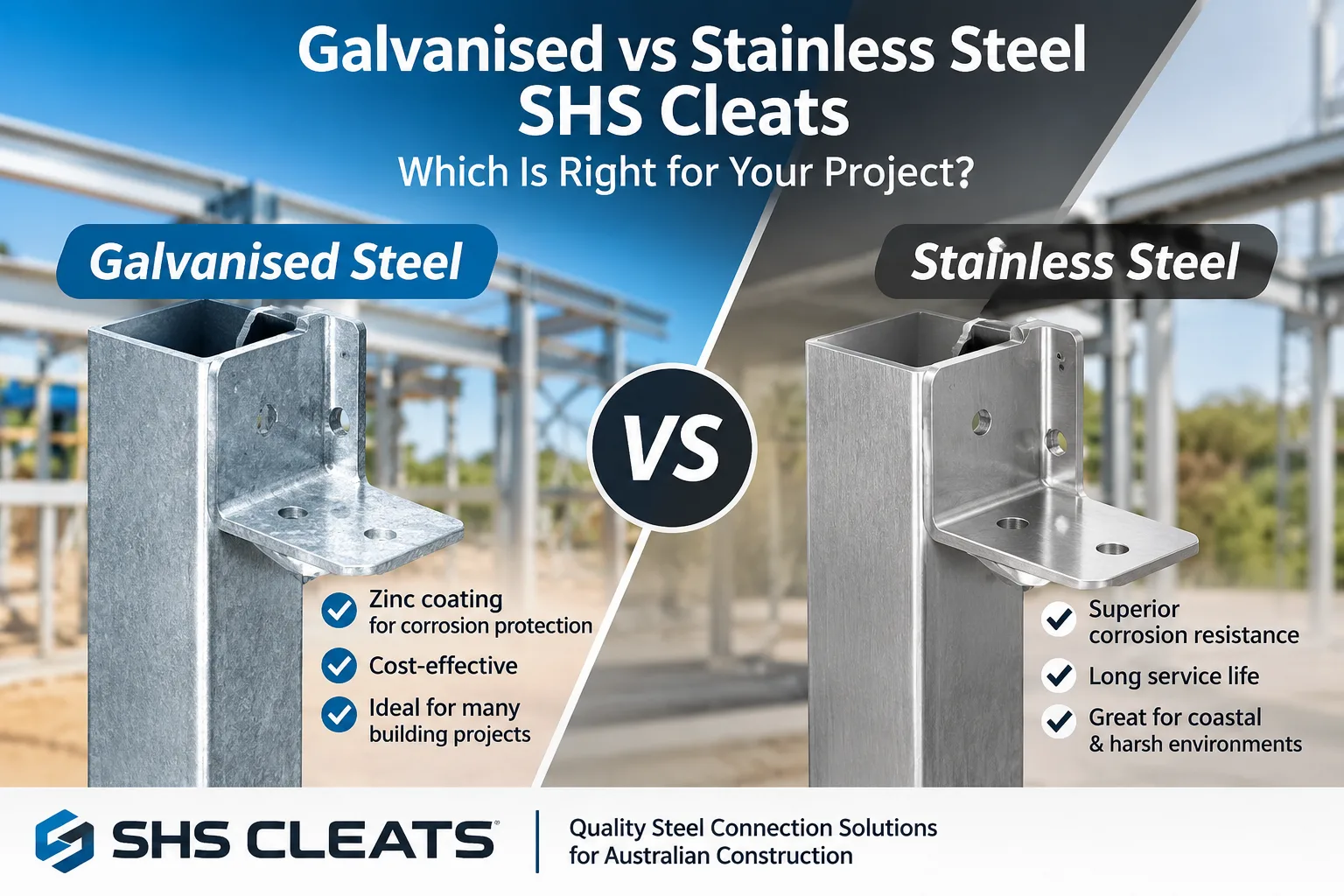
Galvanised vs Stainless Steel SHS Cleats: Which Is Right for Your Project?
Choosing the right material for SHS cleats is an important consideration in Australian construction. Steel connection components must suit the structural requirements of a project while providing appropriate protection against corrosion and environmental exposure.
Two materials often considered for steel connections are galvanised steel and stainless steel. Both offer corrosion resistance, but they achieve it differently and may be suitable for different applications.
For builders, fabricators, engineers and construction professionals, understanding these differences can help with material selection, maintenance planning and long-term project costs.
In this guide, we compare galvanised and stainless steel SHS cleats, explain their key differences and outline the factors to consider when choosing a connection solution.
What Are SHS Cleats?
SHS stands for Square Hollow Section, a type of hollow steel section commonly used for posts and columns in structural frameworks.
SHS cleats are connection components designed to join these posts to other structural members, including timber beams, steel beams, floor bearers and bracing members.
Depending on their purpose, cleats may be used in applications such as:
- Timber verandah and roof beam connections.
- Timber floor bearer support.
- PFC steel beam connections.
- Steel angle bracing systems.
- Column baseplate connections.
- Residential and commercial structural frameworks.
SHS Cleats offers several connection categories, including SHS Timber Beam Cleats, Timber Beam Top Plate Cleats and SHS-PFC Beam Cleats.
The choice of material and protective finish should match the intended application, exposure conditions and engineering specifications.
What Are Galvanised Steel SHS Cleats?
Galvanised steel cleats are generally manufactured from steel protected by a zinc coating. This coating helps protect the underlying steel from corrosion.
Zinc provides a protective barrier and can also offer sacrificial protection at small exposed areas, such as scratches, under suitable conditions.
Galvanised steel is widely used for construction components because it combines the properties of steel with an added layer of corrosion protection.
Advantages of Galvanised Steel Cleats
1. Practical corrosion protection
The zinc coating helps protect the steel from moisture and oxygen. Its performance depends on coating type and thickness, surface condition and environmental exposure.
2. Suitable for many building applications
Galvanised steel may be suitable for numerous residential and commercial construction applications, including appropriately specified external connections.
3. Practical material choice
For many projects, galvanised steel can provide an appropriate balance between corrosion protection, material cost and expected service life.
4. Compatibility with common steel construction
Galvanised steel components are commonly used with structural steel posts, beams and other building components, provided the complete connection is correctly specified.
Limitations of Galvanised Steel
Galvanising does not make steel completely immune to corrosion. The zinc coating gradually wears or corrodes over time, and its service life depends on the environment.
Coastal areas, salt exposure, industrial pollution, persistent moisture and damage to the coating can increase corrosion risk.
Cutting, drilling or welding galvanised components can also affect the protective coating and may require appropriate repair or additional protection. Welding galvanised steel requires suitable controls because heating zinc coatings can generate hazardous fumes.
What Are Stainless Steel SHS Cleats?
Stainless steel contains chromium, which enables the formation of a thin passive surface layer that helps resist corrosion.
Different stainless steel grades offer different levels of corrosion resistance. Grade 304 and grade 316 are common examples, but the appropriate grade depends on the application and environment.
Grade 316 generally provides improved resistance to chloride-related corrosion compared with grade 304, making it a common consideration for demanding marine and coastal environments.
However, stainless steel is not completely corrosion-proof. It can still experience staining, pitting or crevice corrosion under unsuitable conditions.
Advantages of Stainless Steel Cleats
1. Corrosion resistance
Stainless steel can provide excellent corrosion resistance when the grade, finish, design and maintenance arrangements suit the exposure conditions.
2. Reduced reliance on a zinc coating
Unlike galvanised carbon steel, stainless steel relies on its own passive surface layer rather than a separate zinc coating.
3. Potential for long service life
In appropriately selected environments, stainless steel may provide long service life with suitable cleaning and maintenance.
4. Suitability for demanding environments
Selected stainless steel grades can be appropriate for coastal, marine or industrial applications where ordinary galvanised steel may require more frequent maintenance or a different protection strategy.
Limitations of Stainless Steel
Stainless steel may have a higher initial material cost than galvanised steel, although the difference depends on the grade, product design, fabrication and market conditions.
Its performance also depends on proper detailing. Trapped moisture, salt deposits, surface contamination and unsuitable contact with other metals can cause problems.
Stainless steel components must still be designed for the required structural loads. Corrosion resistance alone does not establish whether a cleat is structurally suitable.