Dr. Maya Chen pressed her eye against the microscope's eyepiece, her breath catching as she focused the lens. The ant specimen before her told a story more terrifying than any horror novel she'd ever read.
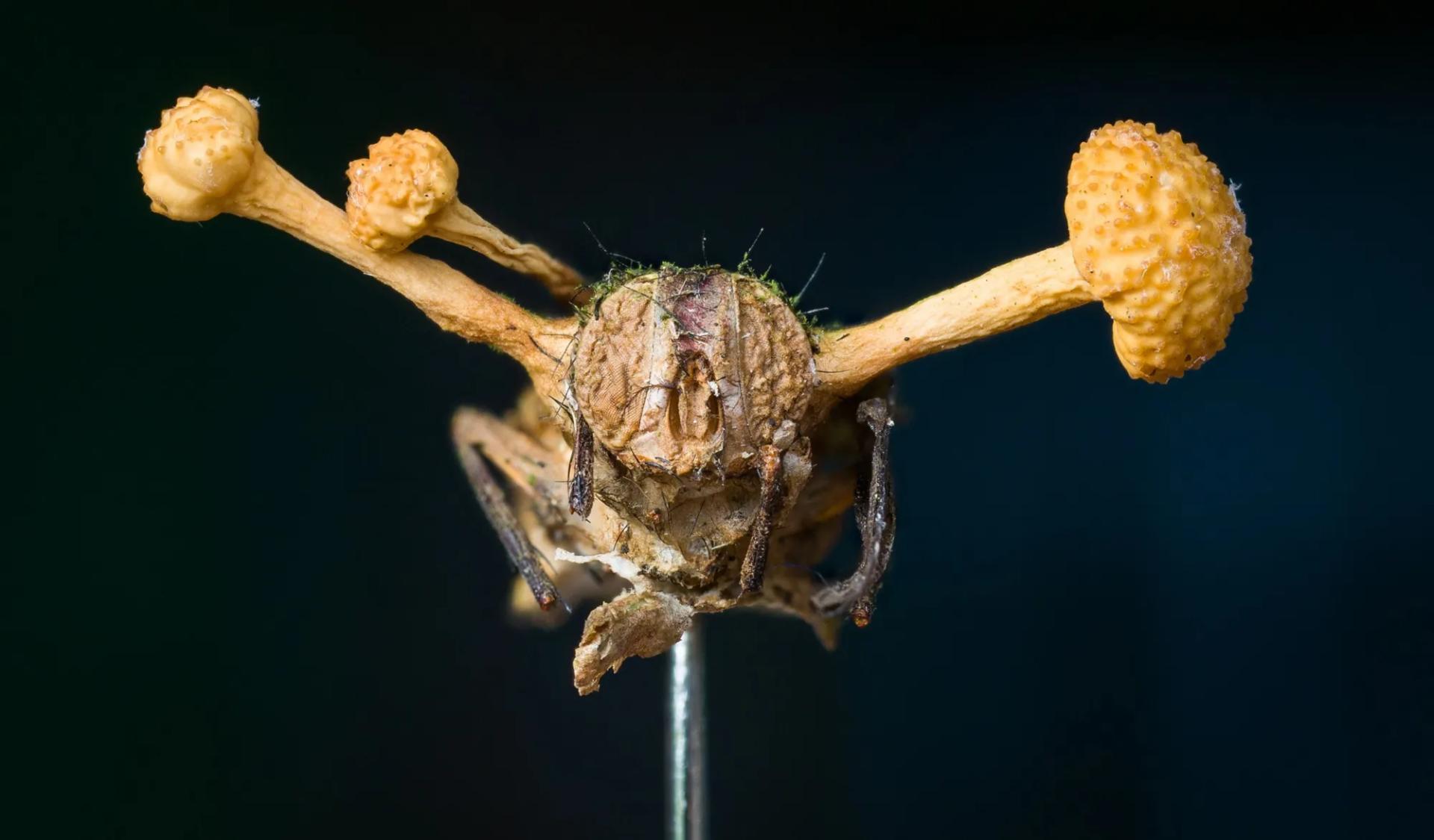
"Ophiocordyceps unilateralis," she whispered to her research partner, Dr. James Rodriguez. "Patient zero in nature's most sophisticated mind control operation."
The ant's exoskeleton was pristine, almost peaceful in death. But erupting from its head like some grotesque crown was a thin, orange stalk—the fungus that had orchestrated its final moments. Maya had spent years studying this phenomenon in the Amazon rainforest, watching as these parasitic fungi turned their hosts into biological marionettes.
"The precision is what gets me," James said, adjusting his own microscope. "The fungus doesn't just kill—it programs. It forces the ant to climb exactly twenty-five centimeters above ground, always on the north side of vegetation, always at solar noon. Then it makes the ant bite down with 6.5 times its normal jaw force, locking itself in place before death."
Maya nodded, her mind racing. She'd documented dozens of these zombie ants, each following the same eerie choreography. The fungus had evolved over millions of years to perfect this macabre dance, turning its victims into spore-launching platforms with surgical precision.
"That's not even the disturbing part," Maya continued, pulling up thermal imaging data on her laptop. "Look at this."
The screen showed heat signatures from infected ants over the past month. Red dots clustered in patterns that made James's stomach drop.
"They're adapting to temperature changes," Maya explained. "As global temperatures rise, I've been tracking new infection behaviors. The fungi are becoming more aggressive, more... experimental."
James leaned closer. "What do you mean?"
"Three weeks ago, I found cordyceps attempting to infect a gecko. It failed, but the attempt itself shouldn't be possible. These fungi have been ant-specific for millennia. Now they're trying to expand their host range."
The implications hung heavy in the humid laboratory air. Outside, the Amazon buzzed with life, but Maya couldn't shake the feeling that they were witnessing the early stages of something unprecedented.
"The temperature threshold theory," she murmured, more to herself than to James. "Most fungi can't survive in warm-blooded mammals because our body temperature is too high. But if they adapt..."
"You're talking about science fiction, Maya."
"Am I?" She pulled up another data set—global temperature records showing year-over-year increases. "Climate change isn't just melting ice caps. It's pushing every organism on Earth to evolve rapidly. Fungi are particularly good at genetic adaptation."
James was quiet for a long moment, studying the microscopic horror before them. The cordyceps had infiltrated every aspect of the ant's nervous system, essentially wearing its body like a biological spacesuit while the original consciousness was... somewhere else. Trapped. Aware. Screaming silently as its limbs moved against its will.
"Even if they adapted to warmer temperatures," James said finally, "the jump from insects to mammals would require—"
His words were cut short by Maya's sharp intake of breath. She was staring at her laptop screen, her face pale in the blue glow.
"James, look at this." Her voice was barely above a whisper. "I set up automated cameras throughout the forest to track infection patterns. This footage is from last night."
The grainy night-vision video showed a small capuchin monkey moving through the canopy with strange, jerky movements. Its normally fluid locomotion was replaced by mechanical precision—the same twenty-five-centimeter climbing pattern they'd observed in infected ants.
"That's impossible," James breathed.
"The monkey died three hours after this footage," Maya continued. "I found the body this morning. No fungal stalk yet, but the spore count in its brain tissue..." She trailed off, her scientific training warring with the implications of what she'd discovered.
The laboratory's air conditioning hummed in the silence. Outside, howler monkeys called through the canopy, their voices carrying across the humid darkness. But Maya wondered—were those calls entirely their own anymore?
"We need to contact the CDC immediately," James said, his voice steady despite the circumstances. "If cordyceps is making the evolutionary leap to primates..."
Maya was already reaching for her satellite phone, but she paused as another thought occurred to her. "James, what if this isn't new? What if we're just the first to notice?"
She pulled up global health databases on her laptop, searching for patterns in recent unexplained behavioral anomalies, neurological conditions, reports of people acting strangely before disappearing into remote areas.
The data painted a picture that made her hands shake as she typed. Small clusters of unusual cases in tropical regions worldwide. People found in trees, dead, always positioned the same way. Always on the north side. Always twenty-five centimeters high.
"My God," James whispered, reading over her shoulder. "How long has this been happening?"
"Maybe months. Maybe years." Maya's voice was hollow. "We've been so focused on ants, we never thought to look up the food chain."
The satellite phone crackled to life in her trembling hands. As she dialed, she couldn't shake the feeling that they weren't just reporting a discovery—they were sounding the first alarm in humanity's strangest war.
Because somewhere in the forest outside, cordyceps was learning. Adapting. Growing hungry for more complex minds to control.
And unlike the ants, humans had built cities.
"The boundary between science and horror isn't a line—it's a temperature reading away from our worst nightmares becoming reality. In nature's laboratory, evolution never stops experimenting, and we're all just potential test subjects waiting for the right conditions to arise."
— Dr. Maya Chen's final research notes, Amazon Research Station Alpha