
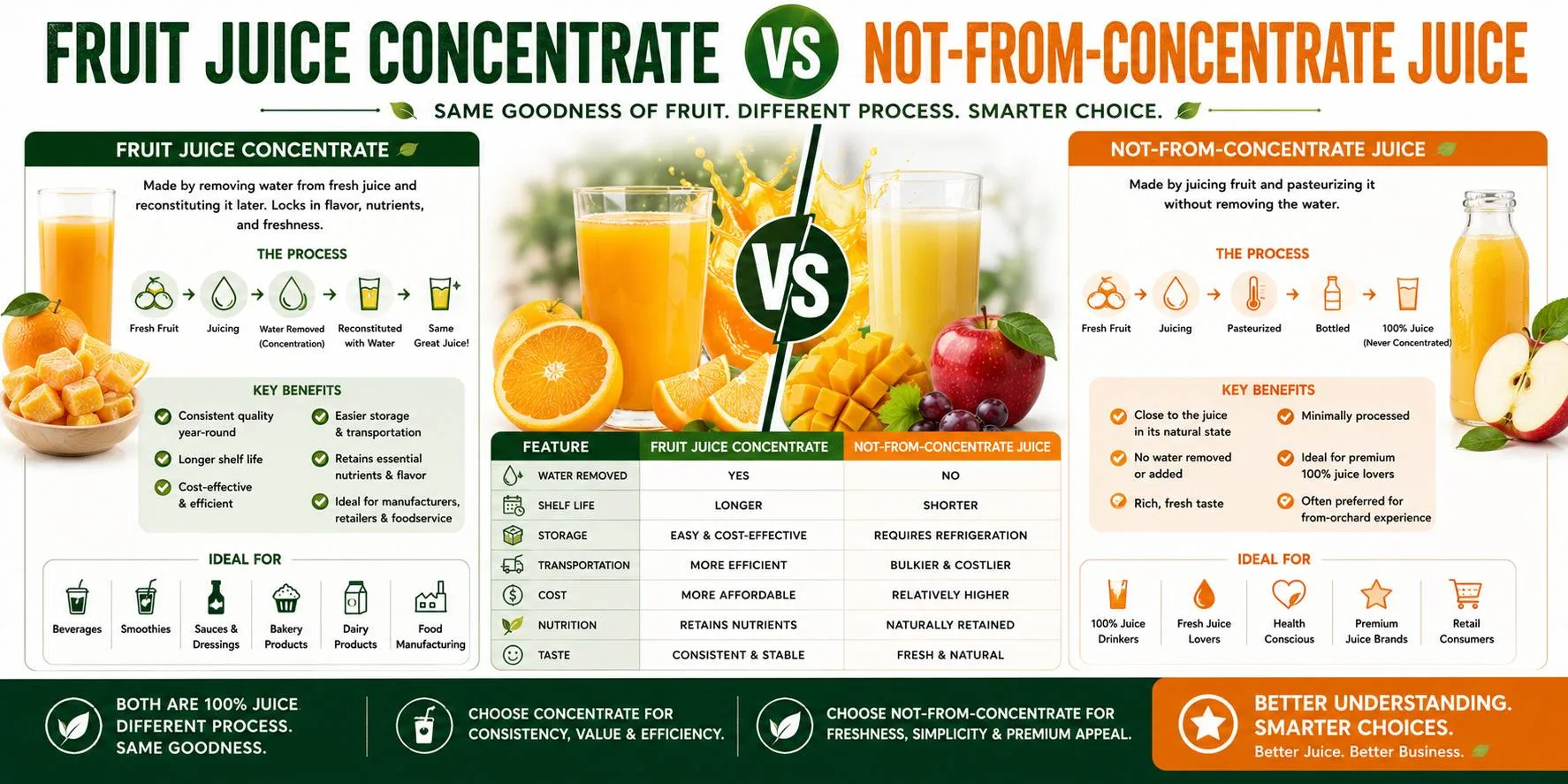
What should a buyer choose when the product brief calls for real fruit, consistent flavor, and a formula that will still behave on production day?
That question comes up more often than most people think. A smoothie brand may want a direct juice base. A jam manufacturer may need strong fruit solids without loading the kettle with extra liquid. A craft beverage company may care more about freight and storage than a café chain buying smaller volumes. In many of those situations, fruit juice concentrate gives formulators more control over Brix, acidity, and finished yield.
For commercial buyers, choosing between the two formats is not only about price. Processing methods, application fit, sourcing risks, supplier consistency, and pre-purchase questions all need to be assessed before an ingredient is approved.
How Processing Changes The Buying Decision
Concentrate starts as pressed juice. The processor removes part of the water, which leaves a denser ingredient with higher soluble solids. That changes almost everything after purchase. Shipping gets easier. Storage gets tighter. Formulators gain room to adjust the recipe. Fruit juice concentrate also helps when a manufacturer wants more fruit input without adding more bulk liquid to the batch.
Not-from-concentrate juice, usually called NFC juice, keeps its original water content. It may still be pasteurized, chilled, frozen, or packed aseptically. It is not a raw product by default, and buyers sometimes miss that point.
The practical difference shows up fast on the plant floor. A pail of concentrated apple can stretch much further than the same pail of NFC apple. But the concentrated version asks more from the production team. Reconstitution must be accurate. Specifications must be checked. A few points off in Brix can throw off sweetness, label values, or even how the drink tastes after a week in storage.
JuiceDeals supplies conventional and organic juice ingredients, including clarified options and selected NFC products, for commercial users that need more than a generic catalog item.
Key Buying Differences At A Glance
A buyer should never compare these two formats on price per container alone. That is where costly mistakes begin.
Buying PointConcentrated JuiceNot-From-Concentrate JuiceFreight LoadLower volume for the same usable outputMore weight and more pallet spaceRecipe ControlAllows tighter adjustment of solids and sweetnessEasier as a direct liquid basePlant StorageOften more efficientCan demand more cold storage roomBatch PlanningRequires dilution accuracyFewer reconstitution stepsTypical UseSauces, drinks, jams, brewing, dairy, fillingsChilled juices, smoothies, direct beverage useThe better choice depends on the end use, not the label. A reliable bulk juice concentrate supplier should ask where the ingredient is going, how it will be processed, and what the finished product needs to do. Those details change the recommendation.
Where Concentrate Usually Wins
Buyers usually turn to concentrate when the production brief leaves little room for waste, inconsistency, or freight-heavy sourcing. That is one reason fruit juice concentrate stays common across beverage manufacturing, bakery fillings, brewing, cultured dairy, sauces, and fruit preparations.
A few examples make the point clearer:
- A startup may need one pail for a pilot run and does not want to overbuy.
- A regional jam producer may need a stronger strawberry input without flooding the batch with extra water.
- A brewer may need guava or passion fruit that local distributors do not carry.
- A sauce manufacturer may have to match an older formula, including color and acidity.
- A larger processor may want scheduled truckload deliveries instead of spot purchases.
That flexibility has real value. It is not only about size of order. It is about getting the right spec in the right pack for the actual application.
JuiceDeals supports orders from a single pail or case through multiple truckloads, and that range helps both trial-stage brands and high-volume processors.
When NFC Juice Deserves A Serious Look
NFC juice works well when the finished product depends on a direct juice profile and the plant can manage the storage load. Chilled citrus drinks are a common example. Smoothies can be another. Some premium beverage lines also prefer NFC because the starting point is closer to a ready liquid base.
Still, NFC is not automatically simpler. It can take up more warehouse space. It can raise freight cost. It may also show more seasonal variation from one crop cycle to the next. Those shifts are not always dramatic, but they do show up in aroma, acidity, and mouthfeel.
Some manufacturers use both formats in the same formula. NFC juice may carry the base, while fruit juice concentrate corrects Brix or boosts fruit impact. That approach can work very well, though bench testing should come first. Added solids can change more than flavor.
Questions Buyers Should Ask Before Ordering
The smartest buying conversations start with the finished product, not with a vague request for mango or apple. Suppliers need the target Brix, acidity range, annual volume, heat process, pack preference, storage conditions, and whether the ingredient must meet organic or other documentation standards.
Buyers should also ask about crop origin, clarification, microbiological specs, shelf life, thawing guidance, and substitute options. This is where an experienced bulk juice concentrate supplier earns trust. A good supplier will flag issues before they hit production, not after a batch fails or the formula drifts off target.
Choosing The Right Format For The Job
No single answer fits every product. Concentrate usually gives better freight efficiency and tighter formulation control. NFC often suits products that rely on a direct juice base and have the storage setup to support it.
The safer path is simple. Review the technical sheet, test the sample in the actual process, and check the yield against the delivered cost. Buyers who need help sorting through those choices often benefit from consulting an experienced sourcing specialist before locking in a fruit juice concentrate order.