
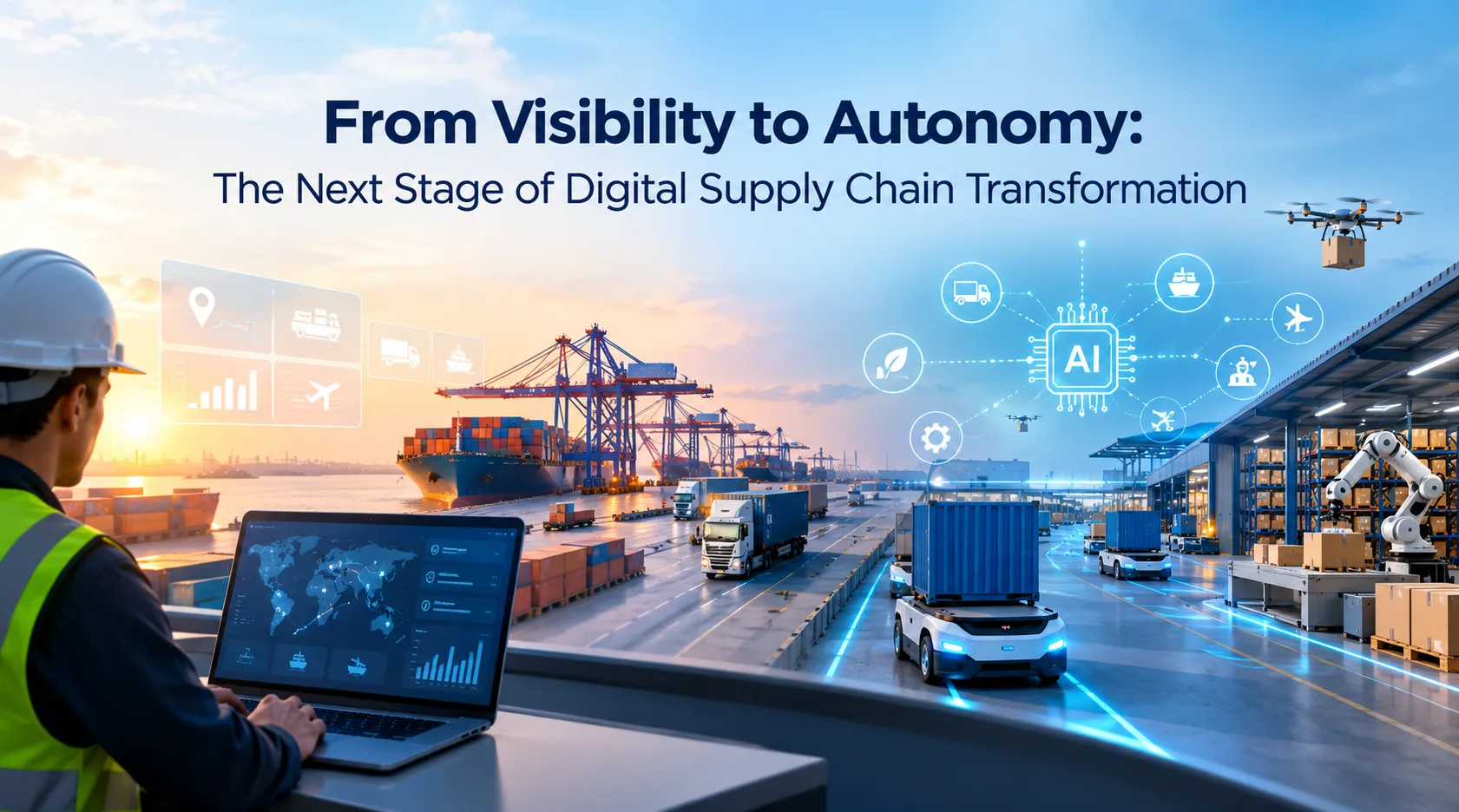
Supply chains are becoming more complex, connected, and difficult to manage. Businesses today need to coordinate suppliers, manufacturers, warehouses, transportation providers, distributors, and customers across multiple locations. At the same time, disruptions, changing customer expectations, fluctuating demand, and rising operating costs are putting additional pressure on supply chain teams.
For years, digital supply chain solutions have focused primarily on visibility—helping businesses understand what is happening across their operations. But the next stage of transformation is moving beyond simply seeing problems. It is about enabling systems to understand situations, predict what could happen, recommend actions, and increasingly execute decisions automatically.
This transition from visibility to autonomy is shaping the future of supply chain management.
What Does Supply Chain Autonomy Mean?
Supply chain autonomy refers to the ability of connected technology systems to monitor operations, analyze data, identify potential issues, and take or initiate appropriate actions with limited human intervention.
Traditional systems generally work like this:
Data → Dashboard → Human Decision → Manual Action
Autonomous supply chain systems aim to evolve this process:
Data → Intelligence → Decision → Automated Action → Continuous Learning
The objective is not necessarily to remove humans from supply chain operations. Instead, autonomous technologies can handle repetitive and data-intensive decisions while employees focus on strategic planning, exception management, and business-critical decisions.
Why Visibility Alone Is No Longer Enough
Supply chain visibility has become an important foundation for modern operations. Businesses can use dashboards, tracking systems, IoT devices, warehouse systems, and transportation platforms to monitor shipments, inventory, orders, and other operational data.
However, visibility does not automatically solve a problem.
For example, knowing that a shipment is delayed is useful, but a supply chain system becomes considerably more valuable when it can also determine:
- Why the shipment is delayed
- Which orders may be affected
- Whether alternative transportation is available
- How inventory levels could change
- Which customers could experience delays
- What corrective action should be considered
This is where artificial intelligence, predictive analytics, automation, and advanced logistics technology solutions become increasingly important.
AI Is Helping Supply Chains Move Toward Autonomy
Artificial intelligence is one of the major technologies driving this transition. Modern AI systems can analyze large volumes of operational data much faster than traditional manual processes.
AI can support supply chain functions such as:
- Demand forecasting
- Inventory optimization
- Route planning
- Delivery prediction
- Supplier analysis
- Warehouse optimization
- Risk detection
- Transportation planning
- Order prioritization
For example, an AI-powered system could identify a potential inventory shortage based on historical demand, current orders, supplier lead times, and market conditions. Instead of simply displaying a warning, the system could recommend inventory adjustments or trigger predefined workflows.
This creates a more proactive approach to supply chain management.
The Rise of AI Agents in Logistics
Another development influencing autonomous supply chains is the emergence of AI agents.
Unlike conventional software that follows fixed workflows, AI agents can be designed to interpret information, reason through specific tasks, and coordinate multiple steps toward an objective.
In logistics, AI agents could potentially assist with activities such as shipment planning, exception management, carrier selection, and delivery coordination.
For example, if a transportation disruption occurs, an AI agent could analyze available shipment information, identify alternative options, compare estimated costs and delivery times, and present an action for approval—or execute predefined actions where appropriate.
This can reduce the amount of manual coordination required from logistics teams.
Digital Twins Can Support Smarter Decisions
Digital twins are another technology contributing to the evolution of digital supply chains.
A digital twin creates a digital representation of a physical operation, allowing businesses to model and analyze different scenarios before implementing changes in the real world.
For supply chain operations, organizations could use simulations to evaluate questions such as:
- What happens if demand increases by 20%?
- How would a warehouse relocation affect delivery times?
- What happens if a major supplier experiences disruption?
- How would changing transportation routes affect costs?
- Where could additional warehouse capacity be required?
Instead of reacting only after a problem occurs, businesses can use simulations to evaluate potential scenarios and prepare appropriate responses.
Integration Is the Foundation of Autonomous Supply Chains
Autonomy requires more than adding AI to an existing system. Intelligent decisions depend on reliable, connected data.
A modern supply chain may involve ERP systems, warehouse management systems, transportation management systems, procurement platforms, customer systems, IoT devices, carrier platforms, and external data sources.
If these systems operate in isolation, AI may not have the complete information needed to make effective decisions.
This makes system integration an important part of logistics software development services. Connecting operational systems can create a unified data environment where information can move between different stages of the supply chain.
Better integration can also reduce duplicate data entry, improve information consistency, and create a stronger foundation for automation.
Humans Will Still Matter
Autonomous supply chains should not be viewed simply as a replacement for human expertise.
Supply chain decisions can involve financial, contractual, regulatory, customer, and operational considerations that require human judgment.
A practical approach is therefore human-in-the-loop automation.
Under this model, technology handles monitoring, analysis, predictions, recommendations, and predefined actions, while humans remain responsible for complex or high-impact decisions.
This approach can help businesses gain the efficiency benefits of automation without removing appropriate oversight.
What Businesses Should Consider Before Moving Toward Autonomy
Companies considering autonomous supply chain capabilities should start with a strong digital foundation.
Important areas to evaluate include:
- Data quality: AI depends on accurate and consistent data.
- System integration: Critical platforms should be able to exchange information effectively.
- Process maturity: Automating an inefficient process will not necessarily improve it.
- Security: Connected systems require strong cybersecurity and access controls.
- Scalability: Technology should be capable of supporting future operational growth.
- Human oversight: Businesses should define which decisions can be automated and which require approval.
Starting with specific high-value use cases can also help organizations demonstrate measurable benefits before expanding automation across the wider supply chain.
The Future: From Reactive to Self-Optimizing Supply Chains
The evolution of supply chain technology is moving through several stages.
First came digitization, where manual processes were converted into digital workflows. Then came visibility, which enabled businesses to monitor operations more effectively. Predictive analytics added the ability to anticipate potential problems.
The next stage is autonomy—where intelligent systems can increasingly coordinate decisions and actions based on real-time information.
The future supply chain will likely combine AI, automation, IoT, digital twins, predictive analytics, cloud platforms, and integrated logistics software to create operations that can continuously monitor and optimize themselves.
Businesses that build the right digital foundation today can be better positioned to adopt these capabilities as the technology matures.
How INTECH Creative Services Can Help
INTECH Creative Services helps businesses explore modern technology solutions for logistics and supply chain operations. Its expertise in logistics software development, digital supply chain solutions, and logistics technology solutions can support organizations looking to connect systems, improve operational visibility, automate workflows, and build technology platforms aligned with evolving supply chain requirements.
As supply chains move from simply seeing what is happening to predicting, deciding, and acting, digital transformation is becoming an ongoing journey rather than a one-time technology project. The organizations that combine reliable data, integrated systems, intelligent automation, and appropriate human oversight can build a more responsive and connected supply chain for the future.


