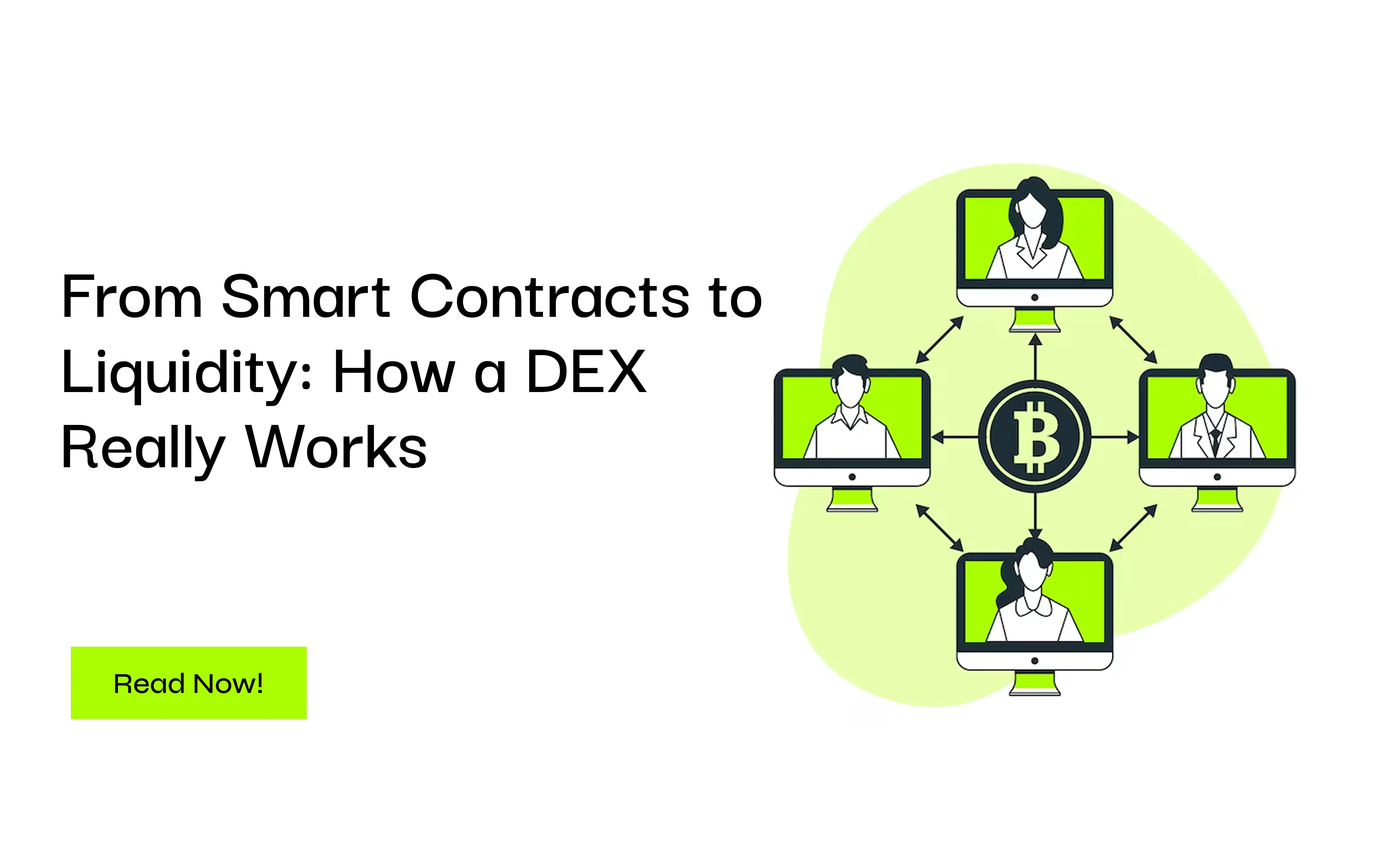
Decentralized exchanges have brought about a new form of trading of digital assets without the involvement of any centralized authority. Rather than leaving your funds in the hands of an intermediary, the user can link their wallets to the protocol.
Underlying this seemingly straightforward process is a highly complex architecture of smart contracts, liquidity solutions, blockchain networks, wallets, and decentralized systems. Grasping the relationships between these systems will give you insight into how DEX operates.
What Is a DEX and How Does It Differ From a CEX?
The decentralized exchange, or DEX, enables users to trade their digital assets using blockchain technology. Users have to put their faith in the central intermediary when it comes to a centralized exchange, whereas the DEX makes sure that users are holding on to their assets using non-custodial wallets.
The decentralized exchange does not have an order book. Instead of the centralized order book, automated market makers and liquidity pools are used.
The Role of Smart Contracts in a DEX
Smart contracts provide the core functionality for many DEXs. They are programs that work based on the blockchain and automatically perform actions depending on particular conditions being satisfied.
For instance, once a user tries to make an exchange of tokens, a smart contract is used to validate the transaction, calculate its conditions, transfer the required number of assets, and write down all the results to the blockchain.
Good smart contracts are extremely important, since otherwise, users’ funds can become quite vulnerable.
How Liquidity Pools Power Token Swaps
Liquidity is crucial in a DEX. Insufficient liquidity will subject the user to issues such as price impact, slippage, and failed transactions.
The majority of DEX designs based on automated systems involve the use of liquidity pools of paired or grouped assets. These liquidity providers may get a share of the fees generated from the protocol as compensation.
In a liquidity pool, there can be assets such as ETH and USDC. The smart contract will interact with this pool based on its pricing model.
Understanding Automated Market Makers
The automated market makers, or AMMs, substitute most of the conventional matching mechanisms with a pricing algorithm. Rather than waiting for the other party to supply an order that will match yours, users will deal with existing liquidity.
The pricing formula differs across various protocols. Some use the constant-product model while others have more sophisticated models like concentrated liquidity, dynamic pricing, or specific curves.
This model is an important example of a decentralized technology application since pricing and execution can be regulated by protocol rules rather than a centralized dealing desk.
How a DEX Processes a Token Swap
A typical procedure for executing trades on a decentralized exchange usually includes several connected steps as follows:
- The user connects his/her cryptocurrency wallet and selects the coins that should be exchanged.
- The DEX determines the outcome of the trade regarding output, fee, and possible price slippage.
- The user accepts and signs the transaction using his/her connected wallet.
- The smart contract executes the trade using the offered liquidity.
- The blockchain validates the performed transaction.
Security and Transparency in DEX Architecture
One of the most important concerns that should be taken into consideration when designing a decentralized exchange is the problem of security. Potential threats include vulnerabilities in smart contracts, oracle attacks, improper access control mechanisms, and liquidity attacks. To design an adequate platform, contract audits, secure wallets, transaction monitoring, price feeds, and testing are required. On-chain transparency of data could be useful for independent transaction monitoring.
Key Components of a Modern DEX
A comprehensive DEX platform can have various interlinked components such as smart contracts, liquidity pools, wallet integration, token handling, swapping platforms, blockchain nodes, price oracles, analytics, and administrative functions.
However, the architecture of the system needs to be based on scalability and user experience. Selecting the appropriate blockchain platform and executing the transaction process is highly significant as the number of transactions increases.
Benefits and Business Potential of DEX Platforms
Rising demand for self-custody and permissionless financial systems has provided some prospects to enterprises looking to build their DeFi exchange platforms. An efficient platform will provide the functionality of token swaps, liquidity, staking, governance mechanisms, and other aspects of decentralized finance.
Nevertheless, in order to implement the project successfully, it is not sufficient to replicate a currently existing user interface; enterprises need a proper architecture, adequate blockchain technology, secure smart contracts, a solution for liquidity, and a unique value proposition of the product.
Professional services in decentralized exchange platform development can assist enterprises in turning these needs into reality.
Why Choose Justtry Technologies?
Justtry Technologies focuses on building blockchain and Web3 solutions around practical business requirements. Its approach can combine smart contract engineering, blockchain integration, wallet connectivity, security considerations, and scalable platform architecture.
For businesses exploring crypto exchange development, choosing a development partner with experience across blockchain infrastructure and decentralized applications can help reduce technical complexity and create a stronger foundation for future expansion.
Conclusion
However, a DEX is not just a platform where tokens are exchanged. It has smart contracts for automatic processing, liquidity pools as sources for token exchanges, automated market makers for price formation, wallets to allow users to have control over their actions, and blockchain networks to make transactions transparent.
Thus, combining these elements creates a new approach to trading digital assets that does not involve a centralized intermediary. With the growth of DeFi, knowing about the architecture of this technology is important for companies wishing to get involved in its development. Is your business prepared to implement this technology into your digital platform?