
A beautiful model is not the finish line
A 3D character can look impressive in a still frame and still fail the moment it has to move. That is the gap many teams discover late in production. A sculpt may have strong likeness, detailed skin, clean materials, and a great silhouette, but none of that guarantees believable performance.
Production readiness starts when the character is tested under real conditions. Can the face hold an expression without collapsing? Can the shoulders rotate without breaking the costume? Does the hairstyle behave when the character turns quickly? Does the asset still look good inside a real-time engine with performance limits?
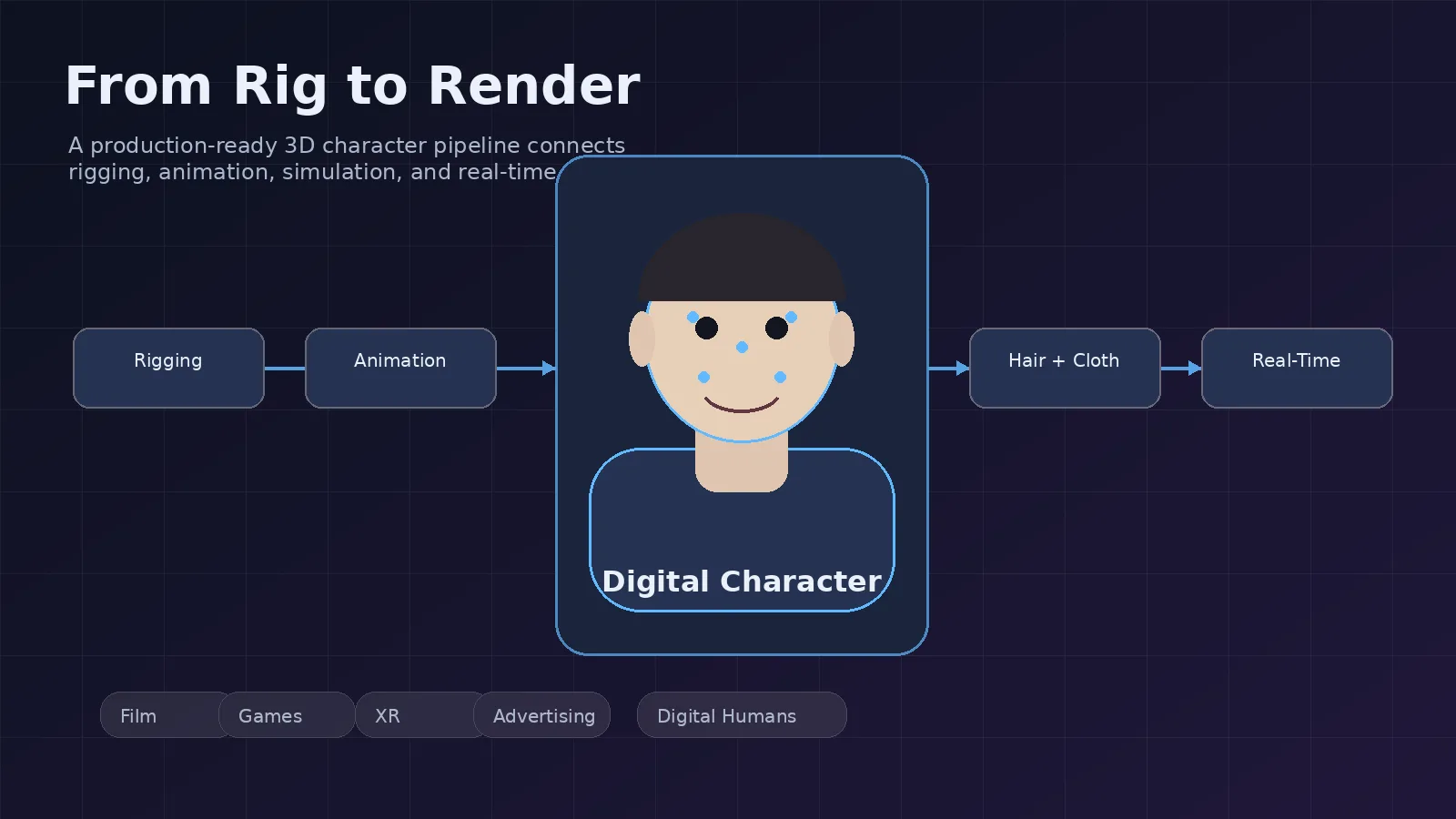
The answer rarely depends on one department. It depends on how modeling, rigging, animation, hair, clothing, lighting, rendering, and technical integration work as a connected pipeline. This is especially true for digital humans, where viewers notice tiny errors immediately. A stiff eyelid, a sliding foot, or a jacket that cuts through the body can break the illusion faster than a low-resolution texture.
The best studios treat 3D character production as a performance system, not a collection of assets. The model is only the visible layer. The real work is the invisible structure that makes the character act, react, and survive production pressure.
Rigging is the character’s control system

Figure 1: Rigging acts as the control system for believable facial and body performance. Image credit: custom illustration for Mimic Productions.
A rig is often described as the skeleton of a digital character, but that description is too small. A good rig is a control system. It translates an animator’s intent into deformation, expression, body mechanics, and subtle performance details.
This is why a reliable 3d rigging service matters so much. The quality of the rig determines whether a character can smile, blink, breathe, gesture, twist, crouch, look afraid, or deliver a line without losing believability.
Facial rigging is especially demanding. Blend shapes, corrective shapes, wrinkle maps, eye controls, jaw behavior, lip compression, and cheek motion all need to cooperate. A technically correct rig is not enough. It has to give animators intuitive control over the character’s emotional range.
Body rigging has a different set of problems. It has to support weight, balance, contact, and extreme movement while protecting the mesh from ugly stretching or collapsing. A creature, athlete, digital double, or stylized character may each require a different approach to joints, muscles, constraints, and deformation zones.
Unity’s Animation Rigging documentation describes rigs as sets of constraints used to add procedural motion and interaction adjustments to animated objects, which is a useful reminder that rigging is not just setup. It is a production tool that helps solve motion problems as they appear in context.Source: Unity Animation Rigging documentation
Animation turns structure into performance

Figure 2: Animation polish converts motion data into readable performance. Image credit: custom illustration for Mimic Productions.
Once the rig is stable, animation decides whether the character feels alive. Animation is where motion gains intent. The difference between a moving character and a performing character is timing, weight, focus, rhythm, and emotional logic.
A professional 3d animation studio usually has to balance multiple animation sources. Motion capture can provide natural body rhythm and authentic performance data. Keyframe animation can add precision, exaggeration, and cleanup where mocap does not deliver the required result. Facial animation may combine capture, hand cleanup, audio analysis, and animator judgment.
The most important work often happens in the details. A character’s hand should settle on a surface instead of floating above it. Eyes should find focus before the head finishes turning. A breath should arrive before a line of dialogue. A shoulder should react to a reach before the arm extends. These small decisions create the feeling that the character is thinking, not simply executing motion.
For digital humans, micro-expression cleanup matters because the audience already knows how humans move. If the mouth forms a sound without correct lip compression, the viewer notices. If the brow moves but the eyelids do not respond, the expression feels disconnected. If the body says confidence and the face says nothing, the performance loses clarity.
That is why animation should never be treated as a final polish stage. It needs to be part of the pipeline early, because rigging, simulation, and real-time integration all need to serve the performance.
Hair and clothing are where realism fails first

Figure 3: Hair and cloth workflows must balance physical realism, optimization, and art direction. Image credit: custom illustration for Mimic Productions.
Hair and clothing are two of the fastest ways to expose a weak character pipeline. They move constantly, interact with the body, catch light, reveal scale, and create secondary motion that audiences read instinctively.
A strong 3d hair simulation workflow is not only about creating thousands of strands. The right approach depends on the shot, platform, budget, style, and interaction requirements. A cinematic close-up may need detailed dynamic hair. A real-time avatar may need optimized hair cards, bone-driven motion, or a hybrid system that suggests movement without overloading the engine.
Clothing creates similar decisions. A heavy leather jacket should not behave like silk. A tight bodysuit may be managed through skinning and corrective shapes. A flowing dress may need cloth simulation, cached motion, or a real-time approximation depending on the final use case.
The production question is always practical: what level of realism does the audience need, and what can the platform afford? Film can spend more time on simulation and rendering. Games and XR often need assets that respond in real time. Advertising may need both, a hero-quality render for campaign visuals and optimized versions for interactive experiences.
Good hair and clothing work is a negotiation between art direction and physics. The goal is not to simulate everything at maximum complexity. The goal is to choose the method that supports the character, the story, and the delivery format.
Real-time rendering changes the brief

Figure 4: Real-time characters need engine-ready lighting, shader, rig, and frame-performance checks. Image credit: custom illustration for Mimic Productions.
Real-time production has changed what clients expect from 3D characters. A digital human may no longer live only in a film shot or a pre-rendered commercial. It may need to perform inside a game engine, appear in VR, run on a live screen, respond to a performer, or interact with a user.
That shift changes the meaning of quality. In offline rendering, a frame can be expensive if the final image is strong. In real time 3d rendering, quality has to coexist with speed. The character has to hold up while the camera moves, the lighting changes, and the system keeps responding.
This is where optimization becomes creative work. Texture resolution, shader complexity, LOD behavior, rig evaluation cost, hair density, cloth method, and animation data all affect the final experience. If optimization is done too late, the team may be forced to remove the very details that made the character appealing.
Real-time rendering is also becoming visually more ambitious. NVIDIA describes real-time ray tracing as a rendering method that simulates the physical behavior of light, and its developer resources discuss shadows, reflections, global illumination, denoising, and super resolution as part of modern real-time workflows.Source: NVIDIA Real-Time Ray Tracing
For character teams, that means the pipeline must plan for both beauty and responsiveness. The question is not only how good the character looks in a still frame. The question is how well the character performs across frames.
A practical checklist for production-ready characters
A production-ready character does not need every technique at maximum complexity. It needs the right choices for the job. Before production starts, teams should answer a few practical questions.
First, what is the final platform? A cinematic render, game engine asset, VR character, hologram, virtual influencer, and live-performance avatar all require different constraints.
Second, how close will the camera get? A face built for close-up performance needs more expression detail, skin fidelity, eye behavior, and facial deformation testing than a background character.
Third, what kind of motion will the character perform? A seated spokesperson, martial artist, dancer, creature, and sports avatar all place different demands on body rigging, mocap cleanup, and muscle behavior.
Fourth, what needs to move dynamically? Hair, fabric, accessories, straps, armor, and props should be planned before rigging and animation are locked. Late simulation decisions often cause avoidable rework.
Fifth, what does success look like? For film, success may be emotional believability. For gaming, it may be performance and responsiveness. For advertising, it may be brand likeness. For XR, it may be presence and interaction. A single character may need different versions to satisfy different outcomes.
The strongest character pipelines make these decisions early. They also keep communication open between artists and technical teams, because every department affects the others.
The takeaway
The future of 3D character production belongs to pipelines that combine craft and technical readiness. A beautiful model is valuable, but it is only one layer of the system. Rigging gives the character control. Animation gives it intent. Hair and clothing give it physical presence. Real-time rendering gives it responsiveness. Together, these choices turn a digital asset into a believable character.
For studios, brands, game teams, and immersive media producers, the real question is not whether a character can be built. The question is whether it can perform under the conditions where the audience will meet it.
That is the difference between a render and a character. A render is seen once. A production-ready character can keep showing up, moving, reacting, and staying believable.
Sources and further reading
Unity Animation Rigging documentation, constraints and procedural motion workflows: Unity Animation Rigging
NVIDIA developer resource on real-time ray tracing and light simulation: NVIDIA Real-Time Ray Tracing
Mimic Productions service pages are linked in context for rigging, animation, hair and clothing, and real-time integration.