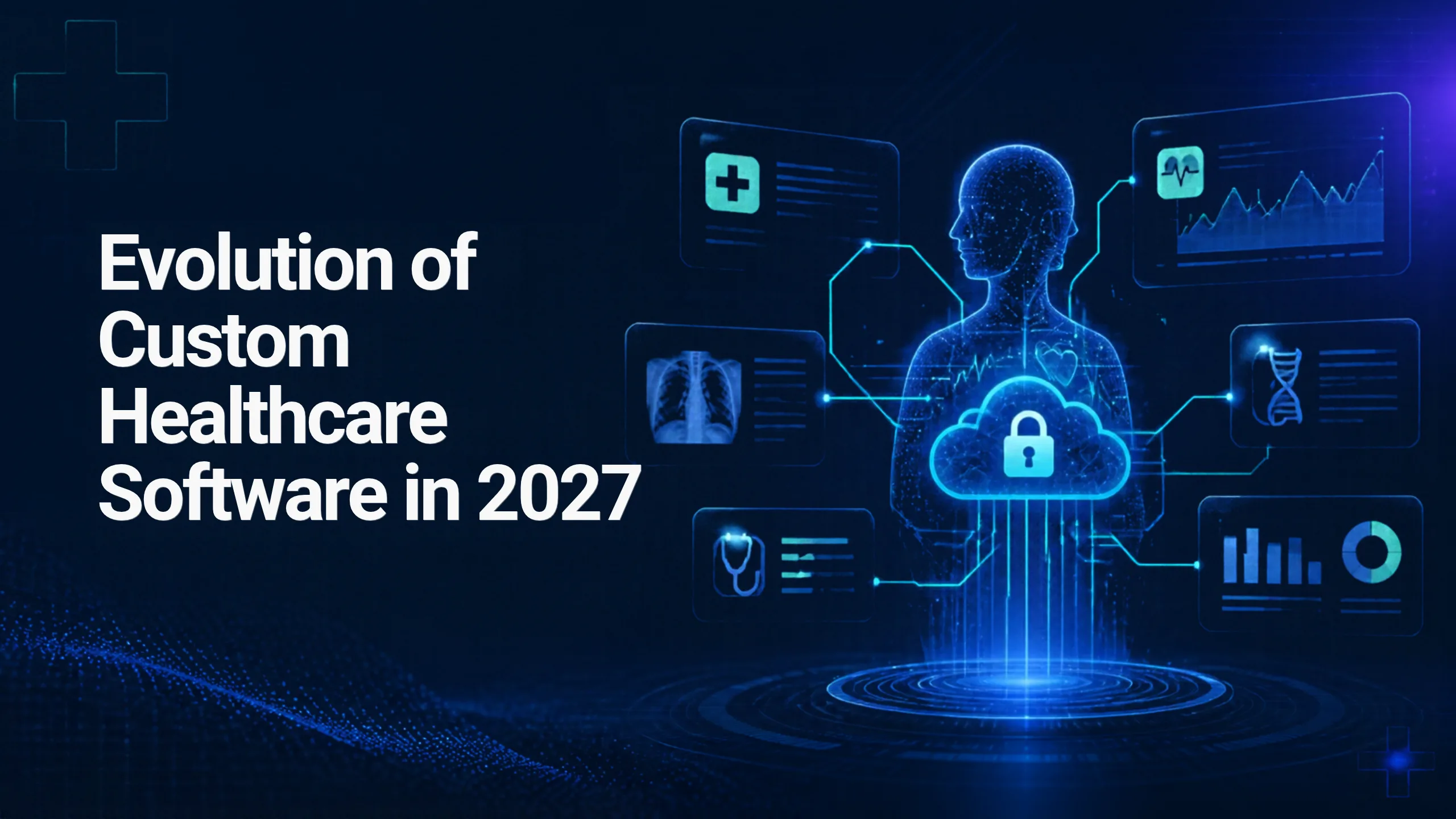
A new era of healthcare software is coming. Electronic patient records and scheduling systems have revolutionized the way healthcare organizations handle information. By 2027, the focus of software will shift to more intelligent systems that integrate clinical information, automate processes, and predict patients' needs.
Artificial intelligence, predictive analytics, remote monitoring, and interoperable software are creating the future for the industry. Custom healthcare software is crucial because it enables healthcare organizations to build technologies based on the unique needs.
From Digital Patient Records to Intelligent Healthcare Systems
The advent of Electronic Health Records (EHR) has transformed the healthcare industry through the transition from paper-based documentation to the more accessible digital format. Medical history, prescriptions, test results, diagnoses, and therapy plans are now easier to record and retrieve.
Nonetheless, just making records digital is not enough. Healthcare institutions must use systems that will allow them to gather all the data across different departments and make it relevant to their work.
Healthcare-specific custom software allows consolidating the patient’s history, laboratory systems, pharmacy systems, billing systems, and appointment scheduling system.
AI Adoption Is Moving Beyond Experimentation
AI is starting to become an integral part of healthcare operations rather than a pilot initiative.
According to the CHIME 2026 Digital Health Most Wired National Trends Report, 93.2% of healthcare organizations participating in the survey reported employing AI within clinical or operational processes. Furthermore, the survey found that fully adopted generative AI grew from 31% to 54.8% over just one year. All the statistics cited above are supported by data gathered from 48,800+ healthcare organizations in 46 US states and five other countries.
In 2027, it is crucial for the adoption of AI in healthcare to reach everyday healthcare work. It may include such areas as clinical documentation, patient communication, appointment scheduling, healthcare data analysis, and automation of administrative processes.
Platforms built specifically for such purposes can help connect these capabilities with existing healthcare systems without creating disjointed technology environments.
Predictive Analytics Is Supporting Earlier Clinical Decisions
Predictive healthcare is all about spotting risks before they materialize into something worse. Through analysis of medical history, diagnostic results, vital signs, and many other pieces of data, predictive analytics can assist healthcare providers to spot patterns and focus on follow-up care.
The trend is already evident. According to the U.S. health IT agency's September 2025 report, 71% of surveyed hospitals in the USA employed predictive analytics through their EHR systems in 2024, while in 2023 the figure was only 66%.
By 2027, predictive analytics is likely to be more tightly integrated into clinical processes. Among possible applications, predicting readmissions, monitoring of chronic diseases, and predicting patient demand are the most probable.
These technologies are supposed to facilitate, not substitute, clinical decision-making. Predictions have to be verified properly and taken into account together with patient's case specifics by healthcare providers.
Interoperability Is Becoming Essential to Personalized Care
One of the issues in healthcare IT is that patient data tends to reside on many different platforms. As a result of the inability of the platforms to exchange data, healthcare specialists can experience lack of information, unnecessary tests, and extra administrative tasks.
With interoperability, the issue can be addressed due to the ability of healthcare IT platforms to exchange data with each other. The technologies and standards like HL7 FHIR and secure APIs can ensure communication between EHRs, diagnostic tools, pharmacies, and patient applications.
In 2027, the development of custom healthcare IT solutions will require integration. Integrated systems can provide healthcare specialists with the necessary information about the patient.
Agentic AI Could Transform Healthcare Workflows
- Another promising development in 2027 will be agentic AI, which refers to software that is intended to complete task sequences with a goal and within certain permissions and control.
- Agentic AI was recognized as an important field of future development by technology leaders of the healthcare industry in November 2026 when they were interviewed by Becker's Hospital Review.
- The use of agentic AI may be helpful in managing administrative procedures, in revenue cycle management, and even in assisting patients with appointments and services.
- For instance, such AI software can assist with appointments, collect necessary data, and direct requests to the relevant department. More complicated medical tasks should have certain precautions and supervision.
- Custom software can aid in implementing these features with proper control and integration into current systems.
Remote Monitoring Is Extending Care Beyond Hospitals
Technologies have become increasingly involved in gathering health information from patients in nonclinical environments.
Wearable devices as well as remote patient monitoring devices, can measure various health metrics, including heart rate, blood pressure, and blood glucose level, among others, depending on the type of equipment and its clinical application.
The customized healthcare software can integrate these health metrics into the patient medical records and dashboards. Remote monitoring can help healthcare professionals to spot the changes, schedule additional visits, and assist patients with chronic diseases.
In 2027, the key issue is to make remote monitoring more feasible and integrated. It is necessary not only to gather information but also to have an efficient system for alert management and patient communication.
Healthcare Data Security Must Keep Pace With Innovation
As healthcare organizations get more interconnected, ensuring the privacy of their patients becomes more important. Any custom-made application should include features related to security, such as encryption, role-based access control, authentication, logging, and vulnerability scanning.
Healthcare organizations should comply with all pertinent regulations related to healthcare and data security, for example HIPAA regulations in the US.
Security should be one of the concerns from the very start of the development process. AI governance, model monitoring, data quality assurance, and accountability will become important issues in addition to that.
What Healthcare Organizations Should Prioritize in 2027
AI usage cannot define the future course of action for the development of healthcare software. Reliable data infrastructure, interoperable technologies, proper automation, and technologies that will fit into the workflow of health care professionals will be necessary.
In Deloitte’s outlook for the US healthcare market for 2026, the difference between experimentation and implementation can be observed: 49% of the respondents in the healthcare sector were experimenting with generative and agentic AI while only about one-third of the respondents were operating AI at scale.
Conclusion
The transition from patient record systems to predictive care marks a huge shift in the use of technology by healthcare organizations. Digital record-keeping laid the foundation; system integration improved communication between parties, while AI implementation brings new possibilities.
Custom ai healthcare software development company will be critical for the achievement of these goals in 2027. It is not about the implementation of the new technology per se; rather, it is about developing a solution that can be used safely and effectively.
Frequently Asked Questions (FAQs)
1. What is custom healthcare software?
Custom healthcare software is a digital solution developed to meet the specific needs of healthcare organizations. It can manage patient records, appointments, billing, diagnostic reports, and clinical workflows while integrating with existing healthcare systems.
2. How is AI changing healthcare software in 2027?
AI is helping healthcare organizations automate administrative tasks, analyze medical information, support clinical documentation, and identify potential health risks. In 2027, its growing integration into everyday workflows is expected to make healthcare systems more intelligent and efficient.
3. What is predictive analytics in healthcare?
Predictive analytics uses historical and current patient information to identify patterns and estimate potential health risks. It can help healthcare professionals identify patients who may need additional monitoring, assess readmission risks, and support earlier clinical intervention.
4. How does custom healthcare software improve patient care?
Custom healthcare software connects important functions such as patient records, appointment scheduling, diagnostic reports, and treatment information. This can improve access to relevant information, reduce administrative delays, and support better coordination between healthcare professionals.
5. What is interoperability in healthcare software?
Interoperability is the ability of different healthcare software systems to exchange and use information. Standards such as HL7 FHIR and secure APIs help connect EHR platforms, laboratories, pharmacies, and patient applications.
6. How does remote patient monitoring work?
Remote patient monitoring uses connected devices to collect health information, such as blood pressure, heart rate, and blood glucose levels. Healthcare software can organize this information so authorized professionals can monitor relevant changes and arrange follow-up care.
7. How can healthcare software protect patient information?
Healthcare software can protect sensitive information through encryption, secure authentication, role-based access controls, audit logs, and regular security assessments. Healthcare organizations must also follow applicable data protection regulations, including HIPAA where relevant.
8. What should healthcare organizations consider before developing custom software?
Healthcare organizations should evaluate their clinical workflows, integration requirements, data security needs, scalability, regulatory obligations, and user experience. They should also consider how AI and predictive analytics can be introduced responsibly and validated before clinical use.