
Hexaview uses a zero-downtime migration approach to move organizations from aging on premises systems to modern cloud platforms while keeping business services continuously available. With more than 14 years of experience, over 300 successful transformation projects, and around 90% client retention, Hexaview delivers phased cloud transitions, smart rollback controls, and ongoing performance tuning that protect mission critical operations.
Every hour of downtime costs a typical mid-sized business about $25,620, while large enterprises can lose more than $540,000 in the same window. For the largest global companies, a single hour of outage can easily exceed $1 million, which makes a reliable on-prem to cloud migration strategy a direct driver of revenue protection.
Why does legacy infrastructure blocks growth?
Many enterprises still run core applications on old on premises hardware that cause frequent incidents, capacity limits, and rising maintenance costs. As digital usage grows and customers expect always available services, this legacy footprint becomes a serious barrier to scalability, innovation, and regulatory readiness.
In sectors such as fintech, healthcare, and travel, every second of unplanned downtime can affect transactions, clinical workflows, or bookings. Hexaview has helped organizations in these regulated industries execute on-prem to cloud migration programs while maintaining 100% uptime across critical journeys, including large scale Salesforce Health Cloud implementations.
High impact benefits of cloud migration
1- Elastic scalability at your fingertips: For many companies, the most visible benefit of on-prem to cloud migration is elastic scalability where resources can expand or contract in minutes instead of weeks. Cloud platforms automatically absorb traffic spikes using auto scaling, load balancing, and serverless services, so user experience stays smooth during campaigns or seasonal peaks.
·
2- Cost optimization unlocked: Cloud migration also unlocks cost optimization, with independent AWS research reporting up to 66% savings in infrastructure and related costs after moving workloads to the cloud. Organizations typically reduce hardware refresh spend, power usage, cooling, and administrative overhead while paying only for resources they actually consume.
3- Innovation speed accelerates: Innovation speed is another powerful driver for cloud modernization, as development teams can spin up managed databases, analytics engines, and AI tools on demand. This capability shortens release cycles and helps financial, and healthcare products reach the market faster, which aligns strongly with search intent around agile cloud migration approach and digital transformation.
4- Security posture strengthens: Security posture also improves because leading cloud providers offer built-in encryption, granular access control, continuous threat monitoring, and compliance programs aligned with standards such as HIPAA, PCI DSS, and SOC 2. When these capabilities are combined with Hexaview expertise in regulated industries, organizations get a cloud migration strategy that strengthens both security and compliance at the same time.
5- Disaster recovery enhanced: Cloud platforms further enhance disaster recovery by supporting multi-record deployments, automated backups, and rapid failover patterns that improve recovery objectives by large margins. Studies on cloud adoption show that companies using resilient cloud architectures face fewer major incidents and can restore services faster after disruptions.
Key Drivers of Cloud Adoption
Business goal
Cloud outcome
Supporting in
Common challenges in cloud migration
Many organizations struggle with monolithic applications and tightly coupled integrations that do not align with modern cloud native patterns.
1- Architectural gap often demands refactoring or replatforming before workloads can move safely, which complicates even the best designed cloud migration strategy.
2- Large data volumes and complex dependencies create further risk because long migration windows raise the chance of data loss, duplication, or drift between systems.
3- At the same time, users expect continuous performance, so even short slowdowns during migration can hurt satisfaction and brand perception.
4- Security and compliance risks also rise if sensitive workloads move without robust controls, encryption, and audit logging, especially in financial and healthcare environments.
5- Weak rollback planning can turn a single error into prolonged downtime if there is no safe path back to the previous stable state.
These challenges explain why zero downtime cloud migration is both attractive and technically complex, making expert guidance essential for banks, fintech platforms, and health systems that must keep services live 24/7. Hexaview addresses these issues directly through its focus on zero downtime transitions inside its legacy modernization and cloud migration services.
The 5-Phase Methodology by Hexaview:
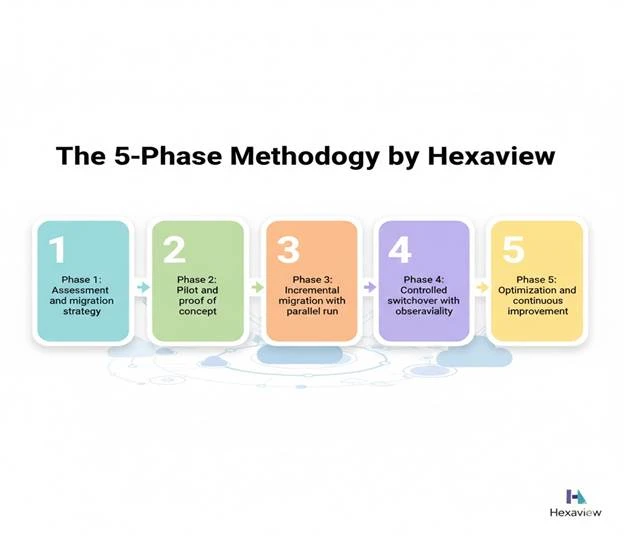
1. Phase 1: Assessment and migration strategy begins with a detailed evaluation of the existing on premises infrastructure, including application dependencies, data volumes, and compliance requirements. Hexaview designs a target cloud architecture and selects the optimal public, private, or hybrid model aligned with business goals.
2. Phase 2: Pilot and proof of concept validate critical workloads in the cloud environment under realistic conditions. Performance, security, and resilience metrics are captured while rollback mechanisms and safety guardrails are tested.
3. Phase 3: Incremental migration with parallel run moves applications and data in controlled waves using continuous replication and dual write patterns. Both on premises and cloud systems run simultaneously to ensure zero downtime.
4. Phase 4: Controlled switchover with observability gradually redirects traffic to the cloud platform. Rich monitoring with metrics, logs, and alerts ensures any anomaly triggers safe automated rollback.
5. Phase 5: Optimization and continuous improvement focus on performance tuning, cost control through rightsizing, and strengthening security controls. Ongoing managed services keep the cloud estate optimized and compliant.
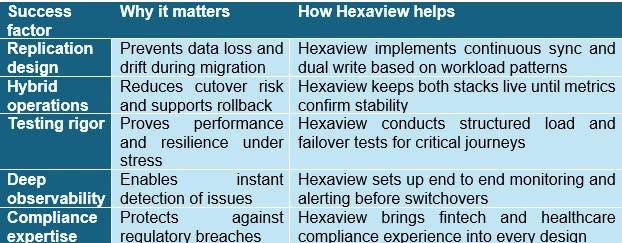
Success factor
Why it matters
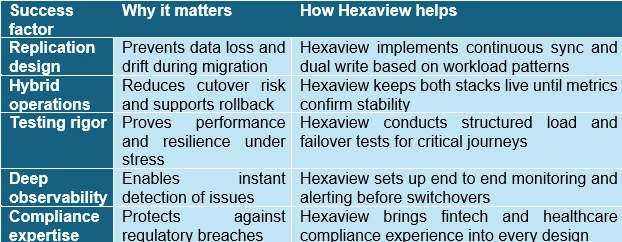 How Hexa
Conclusion
Decision makers who evaluate partners for high-risk migrations need proof of experience, depth in regulated domains, and end-to-end delivery capabilities. Hexaview checks all these boxes with a strong record across fintech, banking, and healthcare where downtime and compliance failures are simply unacceptable.
For organizations that cannot afford disruption, Hexaview zero downtime cloud migration approach delivers a reliable route to modern platforms while keeping operations running and customers happy from day one to final cutover. Engaging Hexaview cloud migration experts is the next smart step for any enterprise ready to turn on prem to cloud migration into a strategic growth engine instead of a risky technology project.