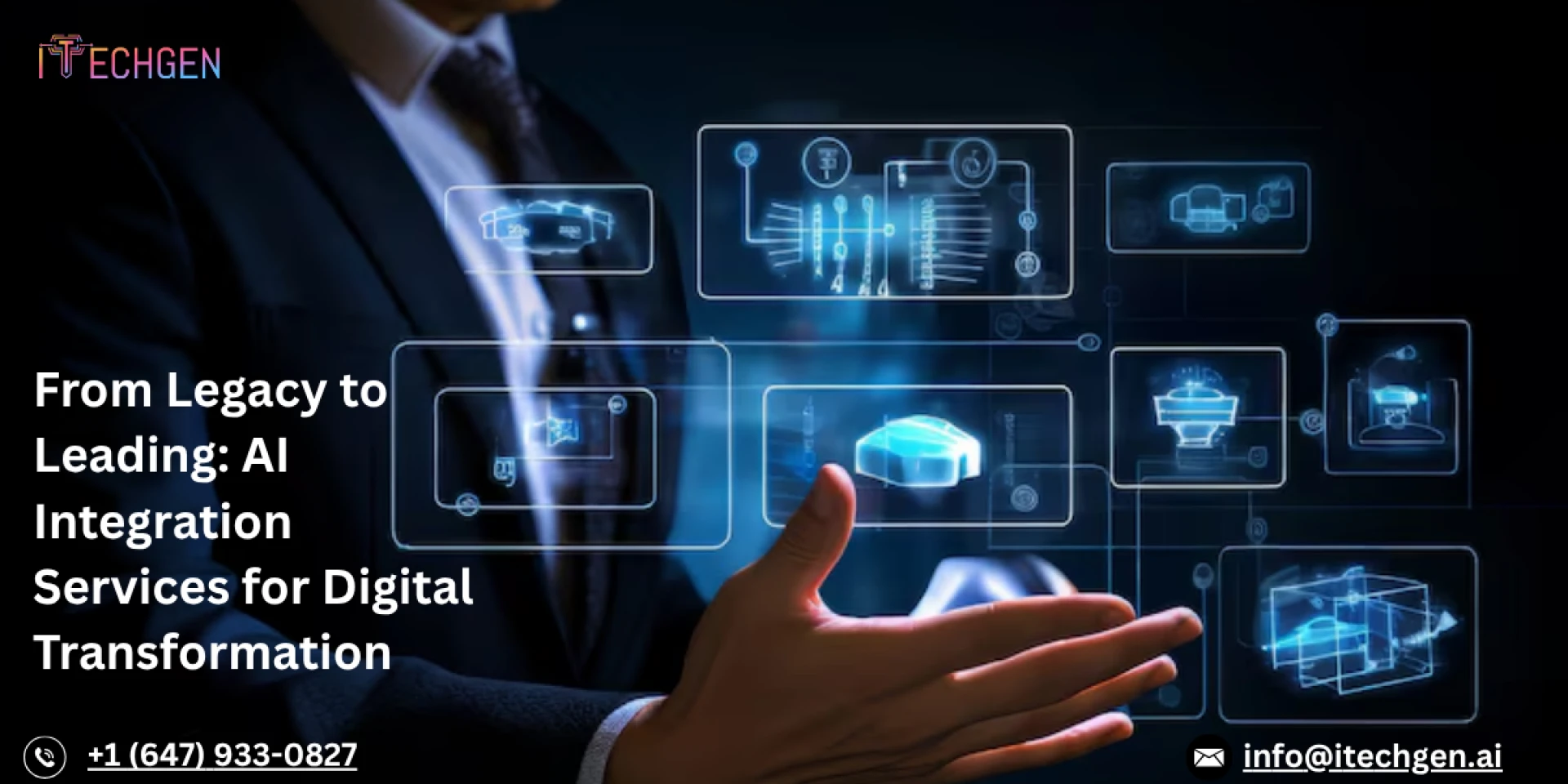
In the modern business world, where things move rapidly, remaining competitive necessitates continuous innovation and adaptation. Even though lots of companies are very enthusiastic about using AI, they sometimes find a big problem that is their dependence on old, inefficient, and complicated legacy systems, which stands in the way of them.
First of all, it is worth mentioning that AI Integration Services are the pillars that support the bridge over the gap between traditional and current business. These services are a good response to the problems that businesses face in their journey to become truly digitally transformed. We will also highlight the enormous benefits that come with these services.
Understanding AI Integration Services: Beyond Standalone Tools
Artificial Intelligence (AI) Integration Services, after all, means that you are effectively implementing the AI technologies directly into business processes, which then get used in applications and infrastructure. It is not only about trying out an AI tool here and there but rather an AI-driven business.
These offerings may be the implementations of various high-end AI features. Here are some examples:
- Machine Learning (ML) Models: For predictive analytics, anomaly detection, forecasting, and automating complex decision-making.
- Natural Language Processing (NLP): Enabling systems to understand, interpret, and generate human language, crucial for chatbots, sentiment analysis, and smart document processing.
- Robotic Process Automation (RPA): Automating repetitive, rule-based tasks across various applications, often serving as a bridge to more advanced AI.
- Computer Vision: Allowing systems to "see" and interpret visual information from images and videos, useful for quality control, security, and asset management.
The major difference between the two is using some AI tools versus building fully integrated AI systems. Let's say a CRM system that, by means of AI integration, can not only recognize customer trends but even anticipate customer churn based on past data, or an ERP system utilizing predictive analytics to instantly adjust the stock in the warehouse according to the real-time consumption. These are the situations that are unleashed by the truly integrated AI, where intelligence is omnipresent in the core business functions.
The Legacy System Problem: A Drag on Modern Business
Largely, most of the established companies operate on what are known as "legacy systems" – the old software applications, hardware, and infrastructure that have been in use for a number of years. These systems that were reliable at their time, however, are now definitely not digitally friendly and can become the biggest roadblocks to companies in the digital era:
- Such systems are very inflexible, which leads to a slow reaction to the market. Meeting new market demands, abiding by regulatory changes, or catching up with evolving customer expectations definitely becomes a very slow and expensive process.
- Maintenance costs are high. In most cases, it is not possible to keep old systems running without people with specialized skills. Finding such people is difficult, and thus their salaries are high. The operation of these people results in very high costs.
- Data silos issue is present. Information is usually partitioned within systems that are different from each other and which are not communicate with each other. In this way, it is very difficult to get a clear picture of your business, customers, or operations.
Currently, technology is evolving at a great speed, and the whole digital transformation is not just a matter of choice but rather a critical need in order to compete in the market and keep up with the industry. If this is not done, businesses will find themselves cornered by those competitors who are more agile and data-driven.
The Role of AI in Digital Transformation: Powering the Future
AI, for one, is just a technology, a revolutionary one that changes the very nature of businesses, but it also has a great power of enabling a digital transformation by deeply boosting:
- Speed and Efficiency: AI is the main factor in task automation, data processing pace increases, workflow optimization, and energy saving, resulting in staff being freed up for more strategic work.
- Decision-Making: AI, which is able to search for numerous relationships in datasets of unlimited size, generates real-time insights and prediction tools that help make the most logical data-based decisions.
Some target areas of digital transformation where AI is indispensable are:
- Automation: From straightening back-office to complex manufacturing processes.
- Data Analysis: discovery of hidden trends, forecasting of results, and conversion of data into executable intelligence.
- Customer Experience: provision of recommendations that are customized, chatbots with no downtime, and quick solutions to issues via smart bots.
- Cyber Security: The AI system can carry out the task of detecting and responding to a threat without human intervention in a fraction of a second.
Just to give some examples: manufacturing companies employ AI for predictive maintenance to avoid downtime, which can become very expensive, while retailers use AI to create hyper-personalized marketing campaigns, and financial institutions apply AI for fraud detection – these are only some instances of businesses moving from reactive, legacy-bound operations to proactive, AI-driven systems.
Benefits of AI Integration Services: Unlocking Strategic Advantages
The strategic advantages of adopting AI Integration Services are profound and directly impact a business's bottom line and market position:
- Improved Operational Efficiency: By automating routine tasks and optimizing workflows, businesses can significantly reduce operational costs and boost productivity.
- Real-time Insights and Better Decision-Making: Access to immediate, data-driven intelligence empowers leadership to make agile, informed, and strategic decisions that drive growth.
- Enhanced Customer Experience: AI-driven personalization, 24/7 automated support, and predictive service lead to higher customer satisfaction, loyalty, and ultimately, increased revenue.
- Scalability and Competitive Edge: Integrated AI systems are inherently more scalable, allowing businesses to expand operations and respond to market shifts with greater agility, thereby gaining a significant competitive advantage.
Challenges in AI Integration: Navigating the Complexities
While the rewards are substantial, the journey of AI integration, especially with legacy systems, comes with its own set of challenges:
- Data Compatibility with Legacy Systems: Older systems often store data in disparate formats, lack consistent structures, and may have quality issues, making it difficult to feed clean, usable data into modern AI models. Significant effort in data cleansing, migration, and transformation is often required.
- Cultural Resistance and Lack of AI Literacy: Employees may fear job displacement, resist new workflows, or simply lack the understanding of how AI can augment their roles. Effective change management and comprehensive training are crucial.
- Integration Complexity and Vendor Lock-in: Integrating multiple AI components with existing legacy systems can be technically intricate. Additionally, relying too heavily on a single AI vendor can lead to "lock-in," limiting future flexibility and innovation.
- Security and Compliance Concerns: Integrating AI, especially when dealing with sensitive data, raises critical questions around data privacy, ethical AI use, data governance, and adherence to industry-specific regulations (e.g., GDPR, HIPAA).
Best Practices for a Successful AI Integration: A Strategic Roadmap
To navigate these challenges and ensure a successful AI integration, a well-planned and strategic approach is paramount:
- Start with a Clear Strategy and Business Case: Don't integrate AI for AI's sake. Define specific business problems you aim to solve, establish measurable goals, and calculate the potential ROI.
- Choose Scalable and Interoperable AI Platforms: Select AI technologies and platforms that are designed to grow with your business and can seamlessly connect with both existing and future systems. Open standards are often preferred.
- Focus on Data Quality and Preparation: AI models are only as good as the data they're trained on. Invest significant time and resources into cleaning, structuring, and preparing your legacy data for AI consumption. This is often the most critical step.
- Collaborate with Experienced AI Integration Partners: Leveraging external expertise can be invaluable. Experienced partners can provide strategic guidance, technical know-how, and help mitigate risks, accelerating your integration journey.
- Ensure Team Training and Change Management: Proactively educate your workforce about the benefits of AI, train them on new tools and processes, and address any concerns to foster adoption and enthusiasm.
Choosing the Right AI Integration Services Provider: Your Strategic Ally
The decision to select the best AI integration services provider for your business is of utmost importance. Find a supplier or collaborator who shows the following main characteristics:
- Comprehensive Service Offering: Are they capable of providing a full spectrum of services, such as strategy, data preparation, deployment, maintenance, and continuous optimization?
- Proven Track Record: Verification through case studies, client reviews, and similar instances of successful integrations is necessary.
- Technical Expertise: Confirm that they're proficient in various AI areas (ML, NLP, Computer Vision) and possess experience with numerous technology stacks, including legacy systems.
- Agile Methodology: The adaptable, repeated process of integration may assist in dealing with unexpected problems.
Future Trends in AI Integration: A Glimpse into Tomorrow
The AI integration sphere is going through a never-ending process of changes, and there are several thrilling futurist orientations in sight.
- Rise of No-Code/Low-Code AI Platforms: Thus, AI is the new productivity for business users as they can build and deploy AI solutions without extensive coding knowledge. They will be able to develop their projects much faster than before.
- AI and IoT Convergence: The integration of AI with the Internet of Things (IoT) will result in more intelligent, responsive, and autonomous systems. AI is going to process a huge amount of data coming from all the devices connected to it and assist humans in such tasks as preventing breakdowns in advance, managing smart cities, and providing super-personalized service.
Conclusion: Embracing the AI-Powered Future
Moving from legacy systems to AI-powered infrastructure is definitely a change of strategy rather than just a tech upgrade. This shift is focused on achieving increased efficiency, improving decision-making, and obtaining a sustainable competitive advantage. AI Integration Services are no longer a matter of choice but the necessary connection for enterprises that want to fully utilize their data and management in the digital era.
Besides, don't allow your outdated infrastructure to limit your progress. It is a perfect time to evaluate your existing systems, identify your business needs, and seek the expertise of AI Integration Services providers. Taking this step will enable you to not only survive but also thrive in the digital world, thus opening the gates for long-term development and innovation.