
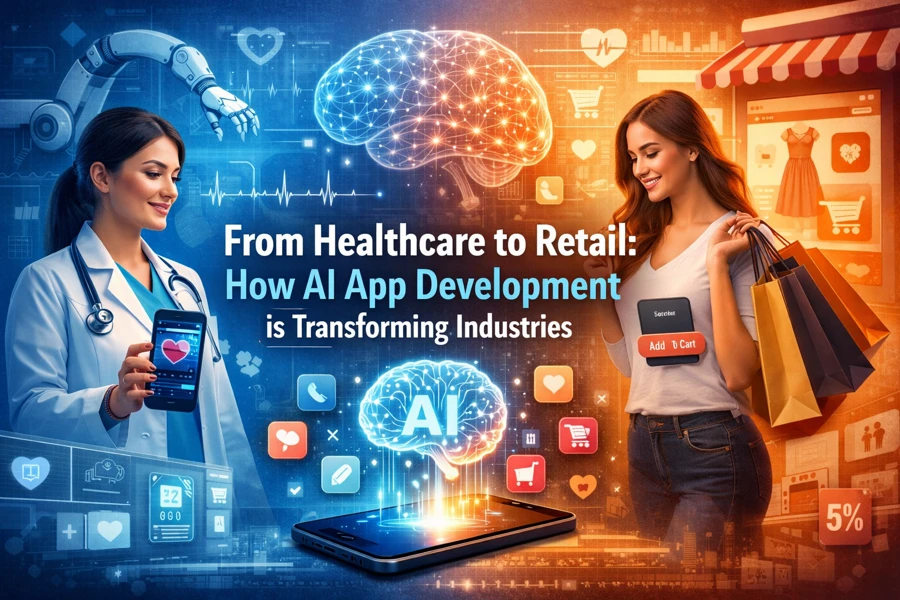
AI Applications Are Now Business Infrastructure, Not Experiments
Businesses are not investing in AI to keep up with trends. They are taking this action because it is getting harder to overlook the operational divide between companies with functional AI systems and those without. Global AI spending is expected to reach $630 billion by 2028, according to IDC, but what's more telling is that the money is going toward production systems rather than pilots.
Most of this is happening with help. Building reliable AI from scratch requires data engineering, model development, and integration work that most companies don't have internally. That's why businesses across healthcare, retail, finance, and manufacturing are partnering with an AI development company to get systems into production. The AI development services supporting this shift aren't experimental anymore. They're operational.
Why Businesses Keep Investing in AI Development
Most of the early AI projects were unsuccessful for obvious reasons. Their budget was exceeded along with data which were more disorganized than anticipated. They performed flawlessly during testing but failed in real-world scenarios. Even after that, businesses was investing in AI development.
The reason is simple: the businesses that worked through those early failures and got something live saw results that justified the difficulty. Fraud detection that actually catches new attack patterns. Inventory models that cut overstock without creating shortages. Diagnostic tools that make clinical teams faster.
Companies partnering with AI development companies in the USA and globally aren't working on hope at this point. The AI development company you choose determines how well the system integrates, how it performs as your data grows, and whether it's still useful 18 months after launch. The right AI development services can make a huge difference between a project that is not utilizing the true potential of technology and one that is accumulates value over time.
Industries Where AI Is Making a Real Difference
Most industries started to adopt AI as soon as possible because it has all the fundamental applications they need. Here are some of the industries where AI adoption are currently most noticeable and quantifiable.
Healthcare
Artificial intelligence in healthcare has moved past the hype phase and into clinical infrastructure. The applications running today aren't replacing doctors. They are handling volume problems that were already overwhelming for clinical teams before AI existed.
One of the most viable use of AI in healthcare is imaging, monitoring and research work. By combining AI and healthcare, it can produce outcomes that were simply not possible through manual process alone,
- Medical imaging tools which are trained on millions of labeled scan can flag tumors, fractures and vascular abnormalities for radiologist to review.
- We can use it for predictive patient monitoring that can easily detects deterioration patterns hours before any clinic issue become visible.
- Clinical decision support systems pulling drug interaction data and relevant research during live consultations
- Drug discovery platforms modeling molecular behavior to shorten early-stage research timelines by years
The FDA had approved over 520 AI-enabled medical devices by 2023. This is not a future category.
Retail
AI in retail started with recommendation engines and has expanded into nearly every back-end function. Amazon's recommendation system drives roughly 35% of total revenue, per McKinsey research. That number explains why retailers of every size followed.
What's running in production today goes well beyond "customers also bought":
- AI in retail can be used for demand forecasting models that can provide data on weather patterns, local events along with historical data to predict inventory needs weeks before.
- We can use it for customer behavior analysis tools that can map the decision path between first visit and completed purchase, reducing kart abandoned rate.
- With an automated support system, like AI chatbot, it can handle returns, order tracking and product questions at volume which a human team cannot manage.
- By adding dynamic pricing systems with AI allow us to adjust in real time based on stock level, competitors behavior and demand signal.
Finance
Financial institutions had both the data and the urgency to adopt AI early. Fraud doesn't take breaks, and older rule-based systems were always a step behind new tactics.
Current AI deployments in finance are mature and measurable:
- Fraud detection models processing millions of transactions simultaneously, flagging anomalies that no fixed ruleset would catch
- Credit risk assessment tools that factor behavioral signals alongside traditional credit history
- Algorithmic trading analysis systems processing market data faster than any human trader
- Customer service automation resolving a large share of routine inquiries without routing them to a live agent
Some banks have reported false positive rates on fraud detection dropping by close to 50% after moving from rule-based to machine learning systems. Every false positive is a blocked transaction and an irritated customer, so that number matters.
Logistics and Supply Chain
Logistics runs on margins that don't forgive inefficiency. A route that's 10% longer than necessary, compounded across thousands of daily deliveries, costs real money. AI is addressing exactly that.
What major logistics operations are running:
- Route optimization tools recalculating delivery paths in real time using live traffic, vehicle load, and driver availability data
- Demand forecasting models positioning inventory closer to where it's actually needed before demand spikes hit
- Warehouse automation systems tracking goods movement and directing picking operations with minimal manual input
- Inventory management tools reducing carrying costs by keeping stock levels tied to actual consumption patterns
DHL, UPS, and FedEx have all published specifics on their AI deployments. This is core infrastructure at that scale, not a pilot program.
Manufacturing
Manufacturing generates more sensor data per hour than most industries produce in a week. For a long time, most of it went unused. AI changed the economics of doing something with it.
Predictive maintenance alone has driven significant ROI. A machine failure that shuts down a production line for two days is catastrophic. A model that reads temperature, vibration, and pressure data and flags a likely failure 72 hours in advance turns a crisis into a scheduled repair.
Other production-level applications:
- Computer vision quality inspection catching surface defects and dimensional errors at line speed
- Production planning tools adjusting schedules based on material availability and order priority
- Energy optimization systems reducing consumption during non-peak production windows
- Machine health dashboards giving operations teams real-time visibility across an entire facility
Education
Education was a slower adopter, partly due to budget constraints and legitimate concerns about student data privacy. The pandemic forced the infrastructure changes that made wider AI adoption possible.
What's actually in use across educational platforms today:
- Adaptive learning systems adjusting content difficulty and pacing based on how a student is progressing through material
- Student performance analysis tools giving teachers early indicators of who's falling behind, before grades reflect it
- Automated grading for objective assessments, freeing instructor time for feedback that genuinely requires a human
- AI tutoring platforms providing personalized practice and explanations outside school hours, particularly valuable for students without other academic support at home
What AI Projects Actually Cost
AI app development cost is the question most companies ask too late. Realistic benchmarks exist.
Most AI app development projects in 2026 range between USD 40,000 and USD 300,000+, depending on scope and complexity. Enterprise platforms with compliance requirements and ongoing monitoring sit higher. When companies ask how much does it cost to develop an AI app, the follow-up questions matter more than the headline number: How clean is your data? How complex is the integration with existing systems? What does post-launch model maintenance look like?
Data preparation alone accounts for 20 to 30 percent of total project cost on most AI builds. Most companies underestimate this going in.
Choosing the Right AI Development Partner
Most failed AI projects fail because of problems that had nothing to do with the algorithm. Bad data, wrong problem definition, integration work that was scoped incorrectly, or a development team that understood the technology but not the industry context.
When evaluating AI development companies in USA or internationally, experience in your specific industry matters more than a general portfolio. Look at security practices, compliance knowledge, validation processes before deployment, and what post-launch support actually covers. The AI development services that matter most aren't the ones that get you to launch. They're the ones that keep the system working after launch.
To Sum Up: The Gap Is Getting Harder to Close
The businesses setting the pace in every sector covered here started building two or three years ago. The results they're reporting now, in reduced costs, faster decisions, and measurable operational gains, are the product of that head start.
Working with an experienced AI development company gives businesses a path that skips the most expensive early mistakes. Vrinsoft has built production AI systems across healthcare, retail, logistics, and manufacturing, functioning as a long-term partner for companies that need working systems, not just working demos. The window to start without being significantly behind is still open. It won't stay that way indefinitely.