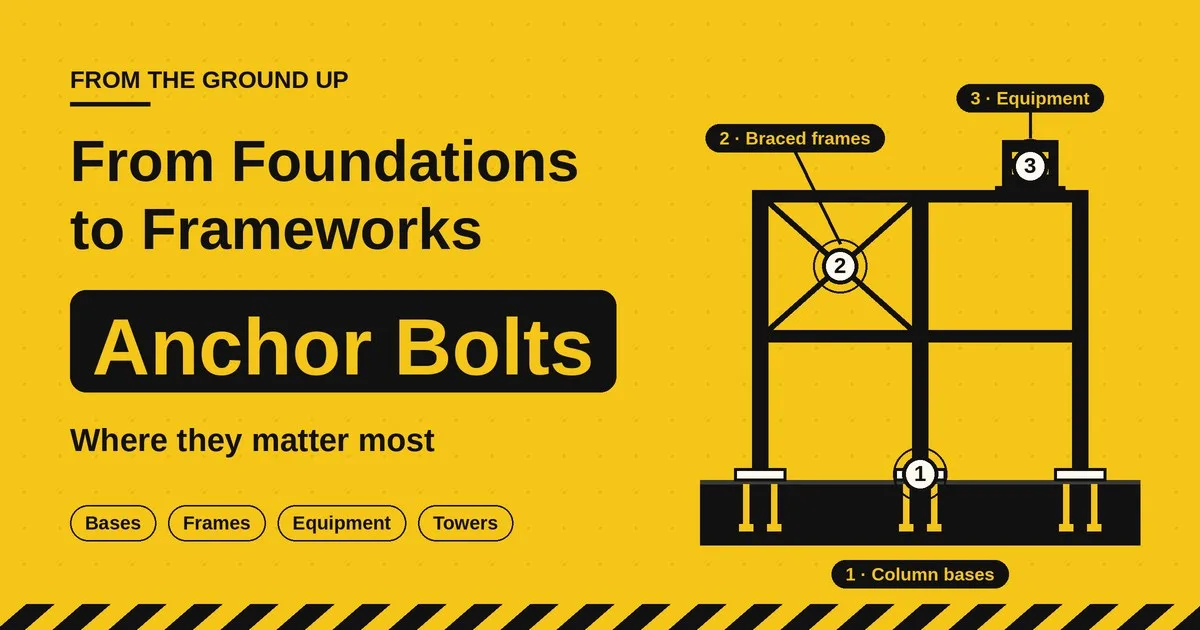
Every structure has a few places where failure would be costly, and Anchor Bolts tend to sit at many of them. They are small, hidden, and rarely discussed, yet they connect steel to concrete at exactly the points where loads change direction and material. This article follows the load path from the foundation up through the framework and highlights where these anchors matter most.
The common thread: where load changes material
Steel and concrete behave very differently. Steel is ductile and uniform, while concrete is strong in compression, weak in tension, and prone to cracking. Anchors sit at the joint between the two, so they have to translate forces from one material into the other.
That is why they matter most wherever one of these conditions applies:
- The load tries to lift or overturn the structure
- The load tries to slide the base sideways
- The load repeats, as with vibration or wind
- The consequences of failure are serious for safety, production, or the environment
The following locations tend to combine several of those conditions.
Column bases in steel frameworks
In a steel frame, every column ends at a base plate fixed to the foundation by anchor rods. Under gravity alone, the plate mostly bears on grout and concrete. Wind, seismic action, and crane loads change that. They push the frame sideways and try to lift the windward columns, so the rods resist tension and shear.
Details at this location decide how well the frame behaves:
- Pinned bases handle axial load and shear with modest plates and bolts close to the column
- Fixed bases also resist bending, so they need larger plates, wider bolt spacing, and deeper embedment
- Erection stability depends on the rods too, since a partly built frame relies on them before bracing is complete
Braced and moment frames
Lateral loads concentrate at specific points. In a braced frame, the columns at the braces collect large uplift and shear forces. Moment frames push bending into their bases. The anchor groups at these columns are often larger and more heavily detailed than at gravity-only columns.
Designers usually aim for the steel to yield before the concrete breaks, because ductile behavior gives warning and lets forces redistribute. Concrete breakout, by contrast, is sudden. Codes such as ACI 318 and AISC guidance on base plates and anchor rods deal with this directly.
Heavy equipment and machinery
Pumps, compressors, turbines, and generators add a different demand: repeated loading. Vibration can loosen nuts and start fatigue cracks, usually at thread roots, so these foundations often use pretensioned bolts, locking devices, and sleeves that give the rod free length to stretch.
Alignment matters as much as strength. A machine that shifts a few millimeters can strain piping and couplings. Proper grouting and tightening records, plus a recheck after initial operation, help keep the installation stable.
Tanks, silos, and process vessels
Tall, narrow vessels full of liquid or bulk material are strongly affected by overturning. Wind or seismic action tilts the vessel, and the anchors on one side go into tension while the other side bears down. Anchor chairs and rings are commonly used to spread those forces into the shell and the foundation.
In these cases, corrosion and thermal movement deserve extra thought. Hot or cold contents can change dimensions, and spills or washdown water can collect around the anchors.
Towers, poles, and masts
Transmission towers, wind turbines, lighting masts, and signal supports are flexible and exposed. Gusts apply loads thousands of times, so fatigue becomes a main concern. Many of these foundations use large-diameter, pretensioned rods in a circular layout. Pretension keeps the joint clamped so the bolts see only part of each load cycle, which improves fatigue life.
Periodic inspection is worth the effort here. Loosening and corrosion at the base are common, and they are far easier to correct early.
Bridges and infrastructure
Bridge bearings, barrier posts, noise walls, and signal structures face water, de-icing salts or coastal air, temperature swings, and repeated traffic loads. Corrosion protection and drainage details are as important as bolt strength, because water collecting around an exposed anchor is a common starting point for deterioration.
Access can be difficult once the structure is in service, so designers tend to favor durable materials and details that make inspection easier.
Retrofits, expansions, and upgrades
Many projects now add equipment or extra floors to existing structures. Post-installed anchors are often the practical answer, including expansion, undercut, screw, and adhesive types. They are valuable, but they leave less margin for error because performance depends on the condition of the concrete, hole preparation, and installation workmanship.
Before choosing an anchor for an existing foundation, check:
- The strength and condition of the concrete, including any cracking
- Edge distances and spacing available around the new anchors
- Whether the product is qualified for the conditions, such as cracked concrete or seismic loading
- The manufacturer’s instructions for hole size, cleaning, and cure time, since dust left in an adhesive anchor hole is a well-known cause of poor performance
Facades and secondary framing
Not every important anchor sits at the bottom. Edge-of-slab supports, curtain wall brackets, handrails, and platform framing all rely on anchors set into concrete at upper levels. These are often loaded by wind suction and by people, and failure can drop material onto the ground below. Edge distance is especially tight near slab edges, so careful design and qualified products matter.
What goes wrong most often
Across all these locations, the same problems keep appearing:
- Bolts that shift during the pour, then get bent or forced to fit the plate
- Insufficient embedment or edge distance
- Mismatched bolt, nut, and washer grades
- Missing or poor grout under the base plate
- Corrosion at the point where the bolt leaves the concrete
- Substitutions made without engineering approval
None of these looks dramatic on the day. The consequences tend to arrive later.
Choosing and sourcing with care
Because anchors are hidden once installed, quality has to be established beforehand. ASTM F1554 is widely specified for anchor rods, and mill test certificates, grade markings, and coating details let an engineer rely on the assumed properties. Suppliers differ in what they make and document, so compare them on certification, testing, and size range as well as price. UAE-based manufacturers such as Petrofast Middle East FZC, which lists stud anchors among its products, are one example of the sources available to Gulf projects. Whoever you choose, check the paperwork against the specification on arrival and reject anything that doesn’t match.
A quick checklist for critical locations
- Load types and combinations defined, including uplift
- Concrete strength, thickness, and cracking confirmed
- Cast-in or post-installed chosen deliberately
- Bolt, nut, and washer specified as a matched set
- Coating suited to the environment, with drainage detailed
- Positions and projection surveyed before and after the pour
- Tightening method followed and recorded
- Inspection plan in place for the structure’s life
The takeaway
Anchor Bolts matter most where structures resist the forces that try to move them: column bases, braced frames, vibrating machinery, tall vessels, slender towers, exposed bridge elements, and retrofit connections. In each case, the principle is the same. The load path only works if the connection to the foundation works, and that connection depends on the right type, the right material, careful installation, and inspection over time. Always follow the project engineer’s specifications and the applicable code.