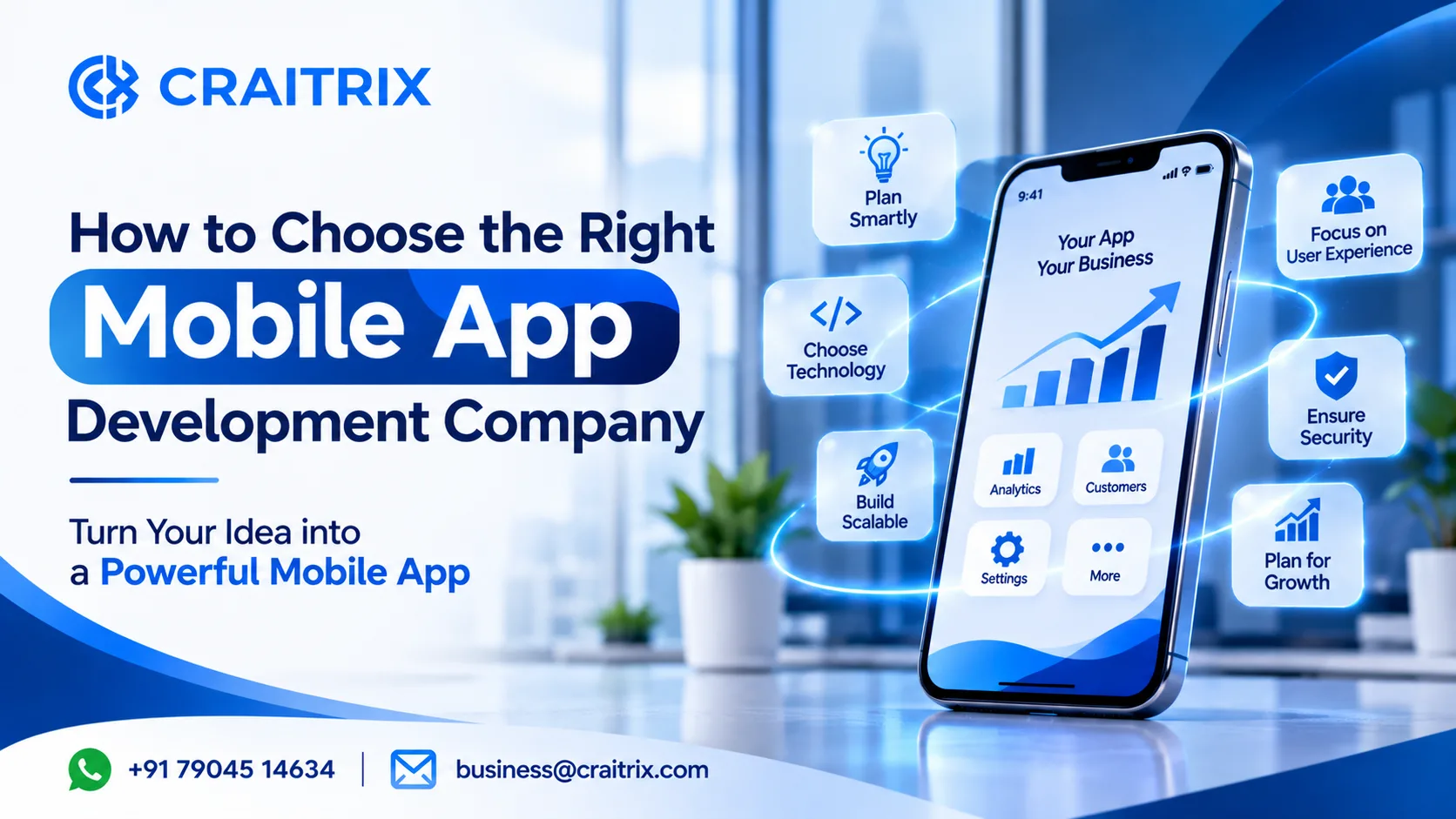
Every business has growth goals. Some want to reach more customers, others want to simplify daily operations, and many are looking for new ways to generate revenue. But what if a mobile application could help achieve all three?
Today, mobile applications are becoming an important part of how businesses operate and connect with customers. However, having an app idea is only the beginning. Turning that idea into a reliable, scalable product requires proper planning, the right technology, and an experienced development partner.
Choosing the right mobile app development company can help businesses move beyond an idea and build a digital solution that delivers measurable value.
Why Are Businesses Investing in Mobile App Development?
Customer expectations are changing. People want faster services, convenient payments, personalized experiences, and access to businesses from anywhere.
A mobile application can help businesses meet these expectations while creating opportunities for growth.
Here are some practical benefits:
- Improved customer engagement: Notifications, personalized offers, and in-app communication help businesses stay connected with users.
- Operational efficiency: Automation can reduce repetitive tasks and simplify business workflows.
- Better accessibility: Customers can access services and information directly through their smartphones.
- New revenue opportunities: Subscription plans, premium services, and in-app purchases can introduce additional revenue streams.
- Customer retention: Convenient features and consistent experiences encourage repeat usage.
The real value of mobile app development comes from identifying a genuine business problem and building an application that solves it.
How to Build a Mobile App That Supports Business Growth
An app should not be developed simply because competitors have one. It should serve a clear purpose and provide value to its intended users.
If you're wondering how to build a mobile app, here are five important stages to understand.
1. Start with a Clear Business Idea
Define what your application should accomplish. Identify your target audience, the problem you're solving, and the essential features your users need.
For example, a food delivery business may prioritize restaurant listings, order tracking, and payment integration, while a healthcare application may require appointment scheduling and secure patient communication.
2. Plan the Features and User Experience
Create a feature roadmap based on business priorities. Start with essential functionalities rather than adding every possible feature at once.
Wireframes and prototypes help visualize the application before development begins. This also makes it easier to identify usability issues early.
3. Select the Right Development Technology
Depending on your requirements, you can choose native iOS development, Android development, or cross-platform frameworks such as Flutter and React Native.
The decision should consider performance, budget, maintenance, development timelines, and future scalability.
4. Develop, Test, and Secure the Application
Development involves building the frontend, backend, database, APIs, and required integrations.
Thorough testing is equally important. Check application performance, navigation, device compatibility, payment workflows, and security before launch.
5. Launch and Continuously Improve
Launching an application is not the final step. User feedback, performance monitoring, regular updates, and new feature improvements help keep the product relevant.
Why Does Custom Mobile App Development Matter?
Every business operates differently. A ready-made application may provide basic functionality, but it might not support your specific workflows or long-term objectives.
Custom mobile app development gives businesses greater control over application functionality, design, integrations, and scalability.
For instance, an eCommerce business might require inventory synchronization, personalized recommendations, multiple payment options, and order management. A logistics company may need live GPS tracking, delivery assignment, and operational dashboards.
A customized solution brings these requirements together while allowing the business to expand its functionality as needed.
The objective is not to develop the biggest application. It is to build one that fits your business and your customers.
What Influences Mobile App Development Cost?
Budget is another important consideration before starting a project.
The mobile app development cost depends on several factors, including:
- Application complexity and feature requirements.
- Native or cross-platform technology selection.
- UI/UX design and customization.
- Backend infrastructure and third-party integrations.
- Security, testing, and compliance requirements.
- Ongoing maintenance and support.
A basic MVP generally requires less investment than a feature-rich enterprise application. Instead of focusing only on the initial price, businesses should evaluate long-term maintenance, scalability, and overall development value.
A detailed project assessment helps establish realistic budgets and timelines before development begins.
How to Choose the Right Development Partner
Your development partner plays an important role in turning your idea into a working product.
Before selecting a mobile app development company, review its portfolio, technical expertise, development methodology, communication process, and post-launch support.
Ask how the team handles project planning, security, testing, integrations, and future upgrades.
A reliable partner should understand your business goals, suggest practical improvements, and provide transparent communication throughout the project.
Turn Your Mobile App Idea into Reality with Craitrix
A successful application starts with more than good coding. It requires the right combination of business understanding, user experience, technology, and long-term planning.
At Craitrix Technologies, we help startups and established businesses transform their ideas into scalable mobile applications. From initial planning and UI/UX design to development, testing, deployment, and ongoing support, our team focuses on building solutions around real business requirements.
Whether you're planning your first MVP or expanding an existing digital product, the right development strategy can make a meaningful difference.
Have an app idea? Let's explore what it can become.
Discover our Mobile App Development Services and take the next step toward building your digital solution.