
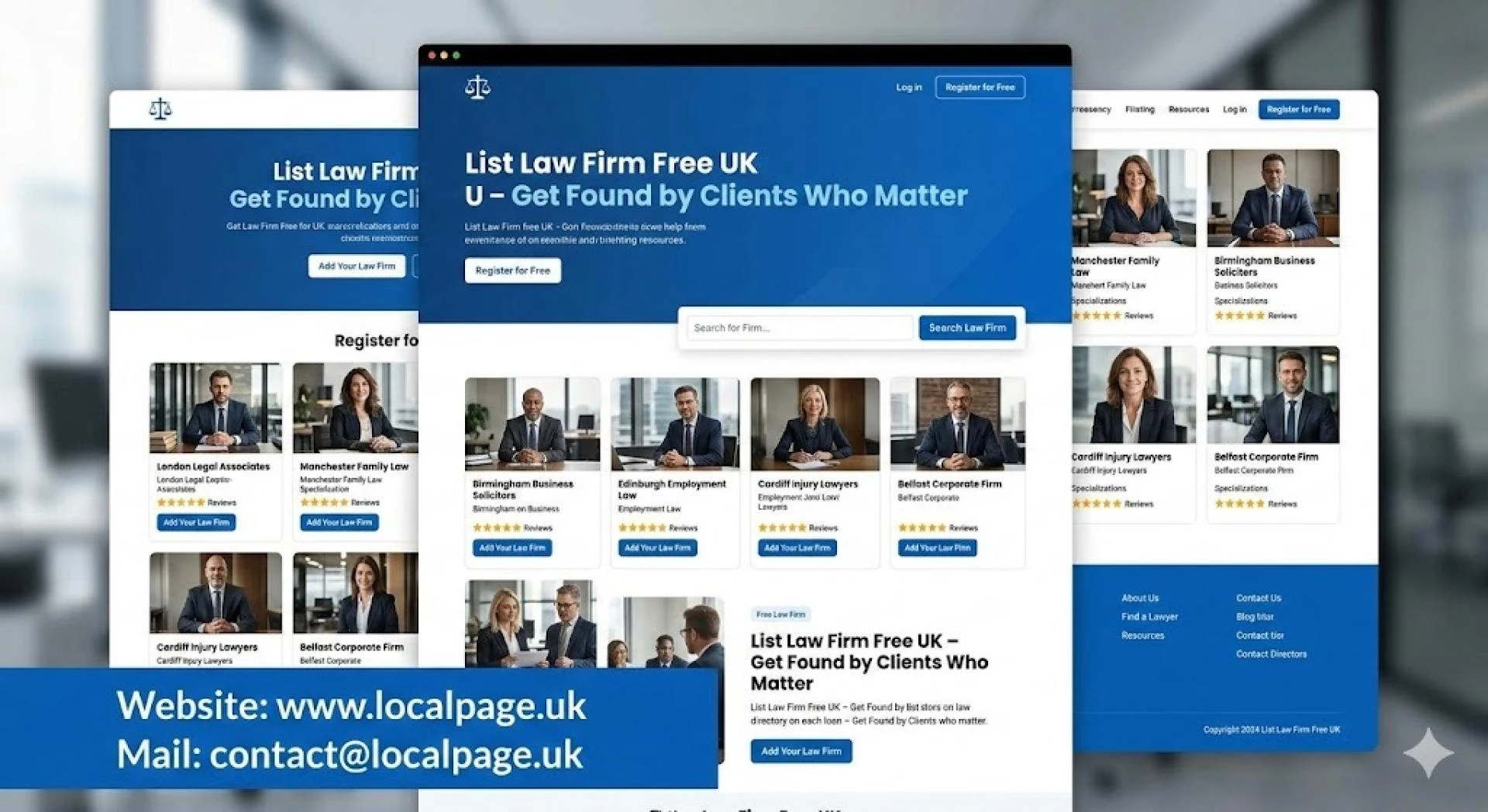
The landscape of legal practice development in the United Kingdom is undergoing a significant transition as we move through 2026. For the modern solicitor or barrister, the challenge is no longer just about practicing law with excellence; it is about ensuring that excellence is visible in an increasingly fragmented digital ecosystem. A free legal services directory UK has become a fundamental component of a firm’s visibility strategy, acting as a bridge between high-intent clients and specialized practitioners. As client behavior shifts toward deeper pre-instruction research, the role of centralized, authoritative platforms is more critical than ever for maintaining a competitive edge in the domestic market.
The role of a free legal services directory UK in 2026
The necessity for a free legal services directory UK is driven by the fact that the traditional "high street" visibility model has almost entirely migrated to digital specialized hubs. According to the Law Society’s 2026 practice management survey, approximately 73% of potential clients now research multiple solicitors before making their first point of contact. This research is not merely superficial; clients are looking for specific indicators of expertise, regulatory compliance, and cultural fit.
What I am observing across the UK legal sector is a flight to quality. It is no longer sufficient to have a basic website. Firms must exist within an ecosystem where they can be compared based on merit and specialism. By utilizing a free legal services directory UK, firms can place their expertise directly in the path of those seeking niche advice, whether that be in commercial litigation, family law, or complex regulatory matters.
Shifting patterns in client instruction
Five years ago, legal services relied heavily on legacy reputation and physical proximity. Today, the "digital first" instruction model dominates. Clients expect to find comprehensive profiles that include professional firm photography and detailed practice overviews before they even consider picking up the phone.
The impact of preliminary research on conversion
Data from the early half of 2026 suggests that 68% of clients value detailed practice area information during their initial research phase. If a firm’s profile lacks depth—missing case studies or representative work—the conversion rate from "viewer" to "enquirer" drops by nearly half.
Trust signals in the digital age
The Solicitors Regulation Authority (SRA) has continued to emphasize transparency. In this context, a directory listing serves as a third-party validation of a firm’s standing, providing a structured format for displaying the credentials that clients now take for granted as essential.
Reducing irrelevant enquiries through specialism
One of the most significant benefits of a detailed directory listing is the ability to filter out non-target work. By clearly defining service specialisms, firms save significant administrative time that would otherwise be spent dealing with enquiries outside their expertise.
How client acquisition has changed for legal professionals
The traditional methods of client acquisition—primarily networking events and print advertising—have seen a marked decline in effectiveness. In the current market, the "pull" method of marketing, where clients find the lawyer through expert content and directory presence, has superseded the "push" method. "As Sarah Chen, partner at Chen & Co Solicitors, told me recently, the modern solicitor must be an author and a thought leader as much as a legal technician," notes the shift in how firms are perceived.
The rise of the informed client
By 2026, the average client comes to an initial consultation with a surprising amount of baseline knowledge. They have likely read legal articles demonstrating expertise and have reviewed several client FAQs before even submitting an enquiry form.
The importance of case study libraries
Case studies have become the currency of trust. 82% of clients now expect to see representative work that mirrors their own situation. This transparency allows the client to visualize the solution before the first meeting.
Video introductions as a rapport builder
We are seeing an increase in firms using video introduction capability within their directory profiles. This humanizes the firm, allowing potential clients to gauge the personality and communication style of the partners they will be working with.
Direct messaging and initial engagement
The expectation for immediacy has grown. Direct messaging with potential clients via directory platforms allows for a low-friction initial touchpoint, which often leads to a more formal instruction once the initial rapport is established.
Integrating professional social links
A firm’s directory profile should not be an island. Linking to professional social profiles like LinkedIn ensures that the client can verify the professional trajectory of the individual lawyers handling their matters.
Why traditional legal directories no longer suffice
The directories of the past were often nothing more than digital phonebooks. They lacked the nuance required to showcase the sophisticated nature of modern UK law. A contemporary free legal services directory UK must offer more than just a name and address; it must provide a platform for practice-wide visibility that reflects the firm's actual daily work.
The move toward holistic firm profiles
A modern profile must include a practice overview that speaks to the firm’s values and specific approach to the law. This is where firms can differentiate themselves from the "big law" machines or the overly generalized high street practices.
Showcasing multiple practice area listings
Most successful firms are not monolithic. They have various departments, and each deserves its own dedicated space. A directory that allows for multiple practice area listings ensures that the firm’s property department isn't overshadowed by its personal injury team.
The necessity of professional firm photography
Visual representation is a key E-E-A-T signal. Professional photography increases enquiry rates significantly because it conveys a level of established permanence and professionalism that stock imagery or low-quality mobile photos simply cannot match.
Document downloads as lead magnets
Providing value before the instruction is a key strategy for 2026. Offering legal guides or white papers as document downloads establishes the firm as an authority in its field and keeps the firm top-of-mind for the client.
Managing webinars and event listings
For firms that engage in public speaking or client education, the ability to list webinars and events within their profile creates a dynamic presence that shows the firm is active and engaged with current legal developments.
A modern approach to legal practice visibility
Achieving visibility in the UK legal sector requires a multi-faceted approach. While SEO for the firm's own website is important, leveraging the established authority of a free legal services directory UK provides a faster route to appearing in search results for high-value keywords. This is particularly true for mid-sized firms looking to compete with larger entities in major legal hubs like London, Manchester, or Birmingham.
Leveraging secondary search authority
Directories often rank for broad terms that individual firm websites find difficult to target. By being present on these platforms, a firm captures traffic that is looking for "the best" or "specialist" services within a specific region.
Strategic use of service specialisms
Precision is the goal. Instead of listing "Family Law," a firm should list "International Divorce" or "High-Net-Worth Financial Provision." This level of detail attracts highly qualified enquiries that are much more likely to result in profitable instructions.
The role of client FAQs in SEO
By answering common questions within their profile, firms are effectively targeting "long-tail" search queries. When a client types a specific question into a search engine, the directory’s FAQ section is often what provides the answer, leading the client directly to the firm.
Representative work as a conversion tool
Listing representative work isn't just about showing off; it's about demonstrating a track record. In 2026, clients are more risk-averse than ever, and a proven history of success in similar cases is often the deciding factor.
Using firm news for ongoing engagement
A profile that is updated regularly with firm news and updates signals to both clients and search engines that the practice is healthy and growing. This could include new partner hires, award wins, or significant legislative updates.
Case study: A regional firm experience
In early 2025, a mid-sized practice in Leeds found that while their legal expertise was undisputed, their digital pipeline was drying up. They shifted their focus to a more aggressive directory-based strategy, specifically utilizing a free legal services directory UK to anchor their local search presence.
Analyzing the transition to digital hubs
The firm realized that their potential clients were no longer searching for them by name, but by the problem they needed to solve. By populating their profile with specific case studies and a robust FAQ section, they saw a 40% increase in qualified enquiries within six months.
Improving the quality of enquiries
The most notable change was not the volume of calls, but the relevance. Because they had detailed their specialisms so clearly, they stopped receiving calls for legal aid work which they did not provide, allowing their fee-earners to focus on their core commercial strengths.
The impact of professional firm photography
After updating their profile with high-quality images of their offices and staff, the firm reported that clients mentioned "feeling like they already knew the team" during the first consultation.
Building trust through legal articles
By publishing monthly articles on the directory platform regarding changes in local property regulations, the firm established themselves as the "go-to" experts for regional developers.
The result of direct client enquiry forms
The implementation of a direct enquiry form specifically tied to their directory profile allowed the firm to track exactly where their leads were coming from, proving the value of their directory presence without the need for expensive tracking software.
Selecting the right platform for your practice
Not all platforms are created equal. When choosing where to list, UK solicitors must consider the alignment between the platform’s audience and their own target demographic. For many, starting with a legal services UK focused directory is the most efficient way to build an initial digital footprint.
Criteria for an effective directory
A platform should offer a clean, professional UI that doesn't distract from the firm's message. It must be mobile-responsive, as a significant portion of legal research now happens on smartphones during commutes or outside traditional office hours.
Evaluating engagement tools
Does the platform allow for direct messaging? Does it support video? These tools are no longer "optional extras" but are becoming standard expectations for client engagement in 2026.
Assessing the peer networking potential
Directories are also used by other lawyers looking for referral partners. A well-constructed profile can lead to significant peer networking opportunities, especially for firms with highly niche specialisms that others may want to outsource to.
Understanding the value of free listing options
For smaller practices or sole practitioners, free listing options provide an accessible entry point into the digital market. It allows for a level of visibility that was previously only available to firms with substantial marketing budgets.
Checking for SRA and GDPR compliance
Any platform used by a UK law firm must be handled with an eye toward regulation. Ensure the directory allows for the clear display of mandatory regulatory information and handles client data in a GDPR-compliant manner.
Strategic recommendations for UK solicitors
As we look toward the end of 2026, the integration of directory platforms into the broader marketing mix will become even more seamless. My observation of the market suggests that those who embrace these platforms now will be the ones who dominate their local and specialist niches in the years to come.
Developing a content-rich profile
Do not treat your directory listing as a static advertisement. Treat it as a living document of your firm’s expertise. Regularly update your legal articles and case studies to reflect your current workload.
Prioritizing the client experience
Every element of your profile, from the FAQ section to the enquiry form, should be designed with the client's journey in mind. Make it as easy as possible for them to understand your value and to reach out to you.
Monitoring the competition
Use directories to see how other firms in your area are positioning themselves. If you notice a gap in their service descriptions or a lack of detail in their profiles, use that as an opportunity to differentiate your own practice.
Utilizing the expert demonstration matrix
Ensure that for every practice area you list, you have a corresponding piece of evidence—a case study, an article, or a specific FAQ. This creates a "matrix of expertise" that is very difficult for competitors to challenge.
Future-proofing with emerging technologies
By late 2026, we will likely see even more integration of AI-driven search within these directories. Firms that have well-structured, data-rich profiles will be the ones that these AI systems recommend to users searching via voice or natural language queries.
FAQ
How do I choose the right solicitor for legal matters?
Choosing a solicitor requires a balance of checking professional credentials and ensuring a good personal fit. You should look for firms that provide detailed practice overviews and specific case studies relevant to your situation. It is also beneficial to consult a free legal services directory UK to compare different firms' specialisms and client feedback before making contact.
What information should a law firm include in its directory profile?
A comprehensive profile should include a detailed practice overview, professional photography of the partners and offices, a list of specific service specialisms, and a section for client FAQs. Including representative work and links to professional social media profiles like LinkedIn further enhances the firm's credibility and demonstrates its expertise in the UK market.
Are there free options for listing my legal practice?
Yes, many platforms offer free listing options that allow law firms of all sizes to maintain a professional digital presence. For example, using Local Page allows solicitors to create a foundational profile that includes essential contact information and practice area details without any initial financial commitment, making it an excellent tool for practice development.
How can I verify a solicitor's credentials and expertise?
In the UK, you should first check the Solicitors Regulation Authority (SRA) or the Law Society’s "Find a Solicitor" service to confirm they are practicing legally. Furthermore, look for evidence of expertise through published legal articles, membership in specialist panels (such as the Law Society’s Advanced Family Law panel), and detailed case studies listed on their professional profiles.
What questions should I ask before instructing a solicitor?
Before instruction, ask about their specific experience in matters similar to yours, who will be the day-to-day contact for your case, and how they prefer to communicate. It is also wise to ask for a summary of their representative work and how they handle client updates to ensure their workflow matches your expectations.
How do solicitors typically structure their fees?
Solicitors in the UK use various fee structures depending on the nature of the work, including fixed fees for predictable matters like conveyancing or wills, and hourly rates for more complex litigation. While directories often omit specific costs, they usually indicate the firm's general approach to transparency and whether they offer initial discussions to determine the scope of work.
What should I expect during an initial consultation?
During an initial consultation, the solicitor will listen to the facts of your case, provide a preliminary assessment of the legal position, and outline the potential steps forward. It is a time for both parties to determine if they can work together effectively, so come prepared with your key documents and a list of questions.
How long do legal matters usually take?
The duration of a legal matter varies wildly depending on the practice area; a simple property transaction might take 8-12 weeks, while complex commercial litigation or a contested divorce could take over a year. A good solicitor will provide a realistic timeline based on current court schedules and the specifics of your case during your initial discussions.
Can I switch solicitors if I'm not satisfied?
Yes, clients have the right to change solicitors at any point if they are unhappy with the service provided. However, you should be aware that the original firm may have a "lien" over your file until any outstanding work is accounted for. It is usually best to discuss your concerns with the senior partner before making a move.
How do I arrange an initial discussion with a specialist solicitor?
Most modern firms provide a direct client enquiry form on their directory profile or website. Simply provide a brief overview of your legal needs and your contact details. Many practitioners will then offer a short, no-obligation telephone call or video meeting to discuss how they can assist you.
For further assistance or to manage your practice's digital presence, you may reach out via the contact details provided below.
Contact Information Email: [email protected] Website: www.localpage.uk