
Starting a food manufacturing business in India can be a rewarding opportunity, but establishing a production facility requires careful planning, regulatory compliance, investment, and technical expertise. A successful Food Factory Setup involves much more than purchasing machinery and finding a building. Entrepreneurs need to consider product development, factory layout, food safety, licenses, utilities, manpower, quality control, and production efficiency.
Whether you are planning a food processing unit, packaged food facility, dairy plant, or beverage manufacturing facility, following a structured process can help reduce risks and improve long-term profitability.
1. Define Your Food Business Concept
The first step is to clearly define what you want to manufacture. Identify your product category, target customers, expected production volume, packaging format, and market positioning.
For example, a business could manufacture snacks, sauces, frozen foods, ready-to-eat meals, dairy products, juices, packaged water, or other processed food products.
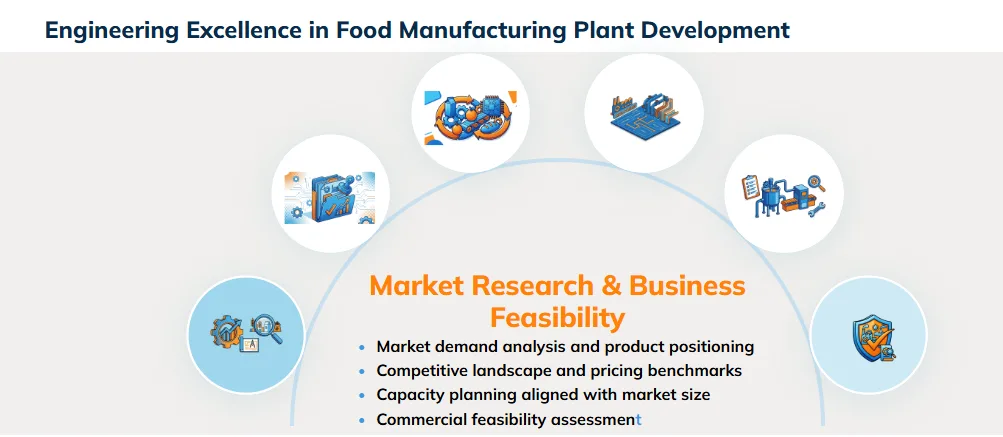
A detailed feasibility study should assess market demand, competitors, raw material availability, estimated investment, production capacity, and potential selling price.
2. Prepare a Detailed Project Plan
Once the product is finalized, prepare a project plan covering the technical and financial requirements of the facility. This should include:
- Production capacity
- Factory area requirements
- Machinery and equipment
- Raw material storage
- Packaging facilities
- Cold storage, if required
- Utilities such as electricity and water
- Manpower requirements
- Quality control facilities
- Estimated capital and operating costs
A professional Food Consultant can help businesses prepare a practical project plan based on their product and production requirements.
3. Select the Right Factory Location
Location can significantly affect operating costs and logistics. The selected site should provide suitable access to raw materials, transportation, labour, utilities, and target markets.
The factory should also have adequate space for production, storage, packaging, employee facilities, waste management, loading and unloading, and future expansion.
Before finalizing a property, entrepreneurs should verify applicable zoning, local approvals, environmental requirements, and infrastructure availability.
4. Design an Efficient Factory Layout
An efficient factory layout helps maintain smooth movement of raw materials, employees, finished products, and waste. The design should minimize unnecessary movement and reduce the possibility of cross-contamination.
A typical food manufacturing facility may include separate areas for:
- Raw material receiving
- Ingredient storage
- Processing
- Packaging
- Finished product storage
- Quality testing
- Cleaning and sanitation
- Employee facilities
The layout should be designed around food safety and the specific manufacturing process.
5. Obtain Required Licenses and Approvals
Food businesses must comply with applicable Indian regulations before starting commercial production. Depending on the type and scale of the business, this can involve FSSAI registration or licensing, GST registration, local approvals, pollution-control requirements, fire and safety approvals, factory-related permissions, and other applicable registrations.
The exact requirements vary according to the product, location, production capacity, and business structure. Professional consultation can help identify the approvals required for a particular project.
6. Select Machinery and Production Equipment
Choosing the right machinery is one of the most important decisions during a Food Factory Setup. Equipment should match the planned production capacity, product specifications, automation requirements, available space, and budget.
Businesses should evaluate machine quality, production efficiency, maintenance requirements, spare-parts availability, energy consumption, and after-sales support before making a purchase.
Buying equipment solely because it is inexpensive can increase maintenance costs and production problems in the long run.
7. Plan Quality Control and Food Safety
Food safety should be integrated into the factory from the beginning rather than added after production starts. Establish appropriate procedures for raw material inspection, processing controls, hygiene, cleaning, packaging, storage, and finished-product testing.
Depending on the business, systems such as GMP and HACCP can help establish structured food-safety practices.
Proper documentation and employee training are also essential for maintaining consistent quality.
8. Consider Beverage Plant Setup Separately
Businesses entering the beverage segment have additional technical considerations. A Beverage Plant Set up may require specialized processing, water treatment, blending, filling, sealing, labelling, and packaging systems.
Products such as juices, soft drinks, energy beverages, dairy-based drinks, and packaged water can have different processing and quality requirements.
Working with an experienced Beverage Consultant can help entrepreneurs select suitable technology, design the production process, plan utilities, and establish quality-control procedures.
9. Install Utilities and Supporting Infrastructure
A food factory requires reliable utilities to maintain uninterrupted production. Depending on the product, these may include electricity, water treatment, compressed air, refrigeration, steam, drainage, ventilation, waste management, and backup power.
Utility requirements should be calculated during the design stage to prevent costly modifications later.
10. Recruitment, Trial Production and Commercial Launch
After machinery installation, recruit and train production, quality-control, maintenance, packaging, and management staff. Conduct trial runs to identify production bottlenecks and verify product quality.
Trial production also provides an opportunity to test machinery, packaging, recipes, production capacity, cleaning procedures, and quality-control systems before commercial operations begin.
Once the facility is ready and applicable approvals are in place, the business can begin commercial production and gradually optimize its processes.
Why Work With a Food Consultant?
Setting up a manufacturing facility involves multiple technical and regulatory decisions. A professional Food Consultant can provide support across areas such as feasibility studies, plant layout, machinery selection, food safety, regulatory compliance, project planning, and production setup.
For entrepreneurs entering the food industry, professional guidance can help reduce avoidable mistakes and create a more efficient foundation for future growth.
Conclusion
A successful Food Factory Setup requires careful planning from the initial business concept through commercial production. Entrepreneurs should evaluate the market, develop a detailed project plan, select an appropriate location, design an efficient facility, obtain necessary approvals, choose suitable machinery, and establish strong food-safety and quality-control systems.
For specialized projects such as a beverage manufacturing facility, working with an experienced Beverage Consultant can provide valuable technical guidance. With proper planning and professional support, businesses can build a food manufacturing facility that is efficient, compliant, scalable, and prepared for long-term growth.
Frequently Asked Questions :-
1. What is involved in a Food Factory Setup?
A Food Factory Setup generally involves feasibility planning, location selection, factory design, machinery selection, licenses and approvals, utilities, food-safety systems, staffing, trial production, and commercial operations.
2. How much investment is required to set up a food factory in India?
Investment varies significantly depending on the product, production capacity, automation level, factory size, machinery, location, and infrastructure requirements. A detailed project feasibility study is recommended before investing.
3. Why should I hire a Food Consultant?
A Food Consultant can help with project planning, plant layout, machinery selection, regulatory requirements, food safety, quality systems, and production setup, helping entrepreneurs avoid costly mistakes.
4. What is required for a Beverage Plant Set up?
A beverage facility may require water treatment, processing and blending systems, filling and packaging machinery, storage facilities, quality-control infrastructure, and appropriate regulatory compliance.
5. Can a consultant help with a beverage manufacturing project?
Yes. A qualified Beverage Consultant can assist with process planning, technology selection, plant layout, machinery requirements, quality systems, and other technical aspects of a beverage project.
6. What should I consider before starting a food manufacturing business?
You should evaluate market demand, product feasibility, investment requirements, raw materials, factory location, production capacity, machinery, regulatory requirements, food safety, manpower, and distribution.
https://prowessbuzz.com/food-factory-setup-food-consultant/