
International Property Alerts, Own your piece of paradise, live beautifully, invest wisely.
The Foundation Before You View a Single Listing
The single most valuable thing a first-time international property buyer can do before viewing a single listing is to understand the legal and financial environment they are entering. Every international property market operates differently. Applying domestic assumptions to foreign legal frameworks is the most expensive mistake a first-time buyer can make.
Due Diligence: The Non-Negotiable Foundation
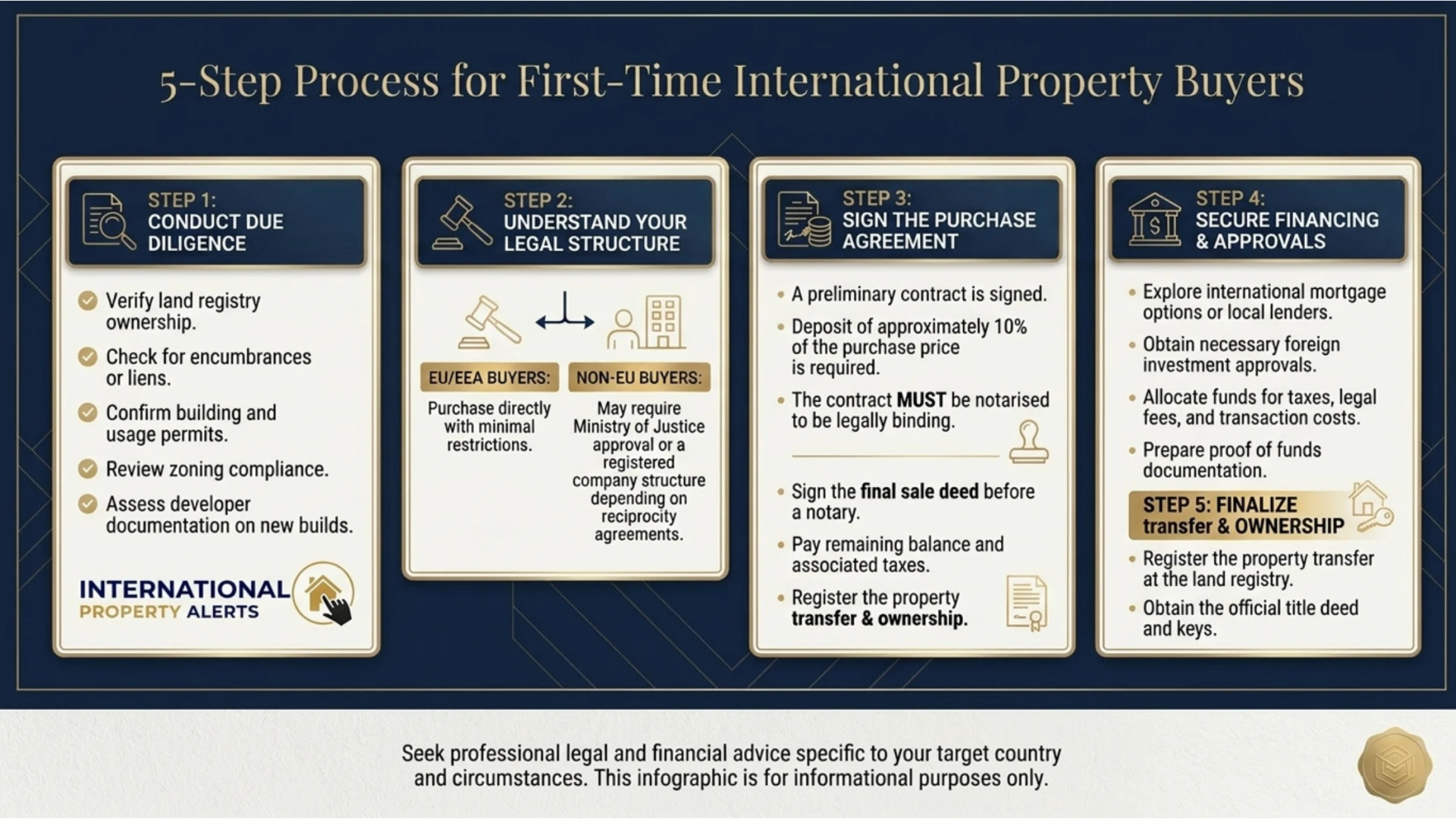
In Croatia, comprehensive due diligence before signing any agreement includes verification of land registry ownership, checking for encumbrances or liens, confirming valid building and usage permits, reviewing zoning and planning compliance, obtaining an energy certificate, and reviewing developer documentation on new builds. This process protects the buyer from legal and financial risk that may not be visible from a surface review of the property itself.
As qualified legal and real estate professionals consistently advise, this phase should always be conducted by an experienced advisory team. The cost of thorough due diligence is negligible relative to the cost of acquiring a property with unresolved legal issues.
Legal Structure: Freehold vs Leasehold and Ownership Pathway
In Croatia, EU and EEA citizens can purchase property under the same conditions as Croatian citizens, with no special approvals required. Non-EU buyers from countries with reciprocity agreements can purchase with Ministry of Justice approval, which is an administrative procedure typically taking several months. Where reciprocity does not exist, property can be acquired through a Croatian registered company structure.
Croatia is currently progressing through the OECD accession process, which could further simplify foreign property ownership frameworks in the coming years, potentially reducing administrative requirements for buyers from Australia, Canada, Japan, South Korea, the United Kingdom, the United States, and numerous other OECD nations.
In Dubai, foreign nationals can purchase freehold property in designated freehold zones, with ownership rights protected through formal registration. Understanding which zones offer freehold title and which operate on alternative structures is a prerequisite for any investment decision.
Purchase Process in Croatia: Key Steps
Step One is due diligence.
Step Two is signing a preliminary agreement or purchase contract, which requires a deposit of around 10 percent of the purchase price. If the buyer withdraws without valid reason, the deposit is typically forfeited. If the seller withdraws, they must return double the deposit amount. The contract must be notarised to be legally valid.
Step Three is completing payment and registering ownership in the Croatian land registry, which represents the final legal confirmation of ownership and provides a high level of legal certainty through Croatia's transparent public registry system.
Transaction Costs: Know Before You Commit
In Croatia, property transfer tax is 3 percent of the purchase price, paid by the buyer where VAT is not already included. New developments sold by companies may include VAT instead of transfer tax. Additional costs include agency fees and notary fees. All costs should be clearly outlined before the transaction commences.
In Dubai, the property transfer fee is approximately 4 percent of the purchase price, plus administrative and registration costs. Both markets offer cost transparency when buyers engage professional advisory support from the outset.
Financing Considerations
Croatia is a Eurozone country. All real estate transactions are conducted in EUR via bank transfer. Croatian banks may provide financing to EU and selected non-EU investors, subject to internal credit policies, with mortgage rates typically ranging between 3 to 5 percent, depending on lender policies and borrower profile. Many international buyers complete transactions using their own funds, with leverage used selectively based on return enhancement objectives and currency exposure management.
Currency Risk
For buyers whose primary wealth is held in a non-EUR currency, acquisition of a EUR-denominated property in Croatia creates a natural currency hedge against EUR exposure. Movement in the EUR against the buyer's home currency will affect the EUR-equivalent value of the investment independently of market performance. This risk is manageable and should be modelled explicitly in pre-purchase return calculations.
Developer Background Checks
Pre-construction purchases require rigorous developer due diligence. Buyers should review the developer's completed project portfolio, financial standing, and regulatory compliance history. In Croatia, a new development documentation review is part of standard due diligence. Stage-payment structures tied to verified construction milestones, rather than calendar dates alone, protect against construction delay risk.
Exit Strategy Planning
A serious investment always includes both an entry plan and an exit plan. Before purchasing, buyers should understand the depth of the resale market in the target location, typical time-on-market for comparable properties, transaction costs on sale, and the profile of likely future buyers. Croatia's prime coastal markets and established urban locations offer deeper secondary market liquidity than emerging inland areas. Dubai's high-volume transaction market provides resale liquidity that is characteristic of a mature global investment market. Aligning holding period expectations with realistic exit liquidity assumptions is a fundamental discipline, not an afterthought.
FIRST-TIME BUYER AND FIRST-TIME INVESTOR STRATEGYFirst-time international property investors operate with two distinct challenges: navigating an unfamiliar legal and market environment, and managing capital exposure within budget constraints that require careful allocation. These challenges are surmountable with the right framework.
Entry-Level Markets and Budget Tiers
Croatia offers a wide range of entry price points across property types and locations. Emerging inland regions such as Gorski kotar, Hrvatsko Zagorje, and Lika offer accessible pricing with nature, privacy, and connectivity. Established coastal and urban markets command higher entry pricing commensurate with stronger demand fundamentals and greater secondary market liquidity.
Dubai offers entry-level freehold apartments in emerging areas from approximately EUR 200,000, with well-located properties in established communities between EUR 350,000 and EUR 700,000. This range accommodates first-time international investors who wish to access a high-yield, globally mobile rental market without premium property budget requirements.
For first-time investors, the primary criterion should be market transparency, legal accessibility, and advisory support quality rather than simply the lowest available purchase price. A well-selected, legally sound property in a transparent market with professional guidance consistently outperforms a cheaper acquisition made without adequate due diligence or market understanding.
Pre-Construction vs Completed Property
Pre-construction properties in Croatia typically offer entry pricing below anticipated completed values, as developers price early-stage inventory to incentivise commitment and fund construction. For buyers with adequate risk tolerance and flexibility on holding period, pre-construction acquisitions in constrained supply micro-markets can deliver superior capital appreciation. In Croatia, however, market analysis confirms that new development prices are growing more slowly than existing home prices, indicating early moderation in this segment.
Completed property offers immediate income generation, verified build quality, and the complete absence of construction risk. For first-time international investors who prioritise certainty over maximum upside, completed property in an established location is the correct starting position.
Risk Mitigation
The common mistakes seen across international property investment are as applicable to first-time buyers as to experienced investors: buying based purely on emotional appeal, overpaying during periods of elevated market sentiment, ignoring tax planning, expecting unrealistic short-term returns, and entering without a defined exit strategy. Each of these mistakes is avoidable with disciplined pre-purchase analysis and professional advisory support.
First-time buyers are advised to seek qualified legal advice regarding any government schemes or purchase incentives that may be available in their specific circumstances, as eligibility criteria, availability, and scope of any such programmers can vary significantly and are subject to change.
About International Property Alerts
International Property Alerts is a global property platform giving buyers direct access to distressed, repossessed, and undervalued properties, with a current focus on Spain and Portugal. The platform also provides early access to pre-market, off-market, and reduced-price opportunities across Portugal, Cyprus, Spain, the United Kingdom, Bali, and Mexico.
Designed for buyers who want to live beautifully and invest wisely, International Property Alerts curates premium real estate opportunities worldwide, from beachfront villas to modern city apartments, tailored to both lifestyle and investment objectives.
For buyers taking their first steps into international property, International Property Alerts offers a free Buyer's Guide, providing a comprehensive roadmap to purchasing property overseas.
For media enquiries and further information, please contact:
Anafel Battersbee
Social Media Manager
International Property Alerts