
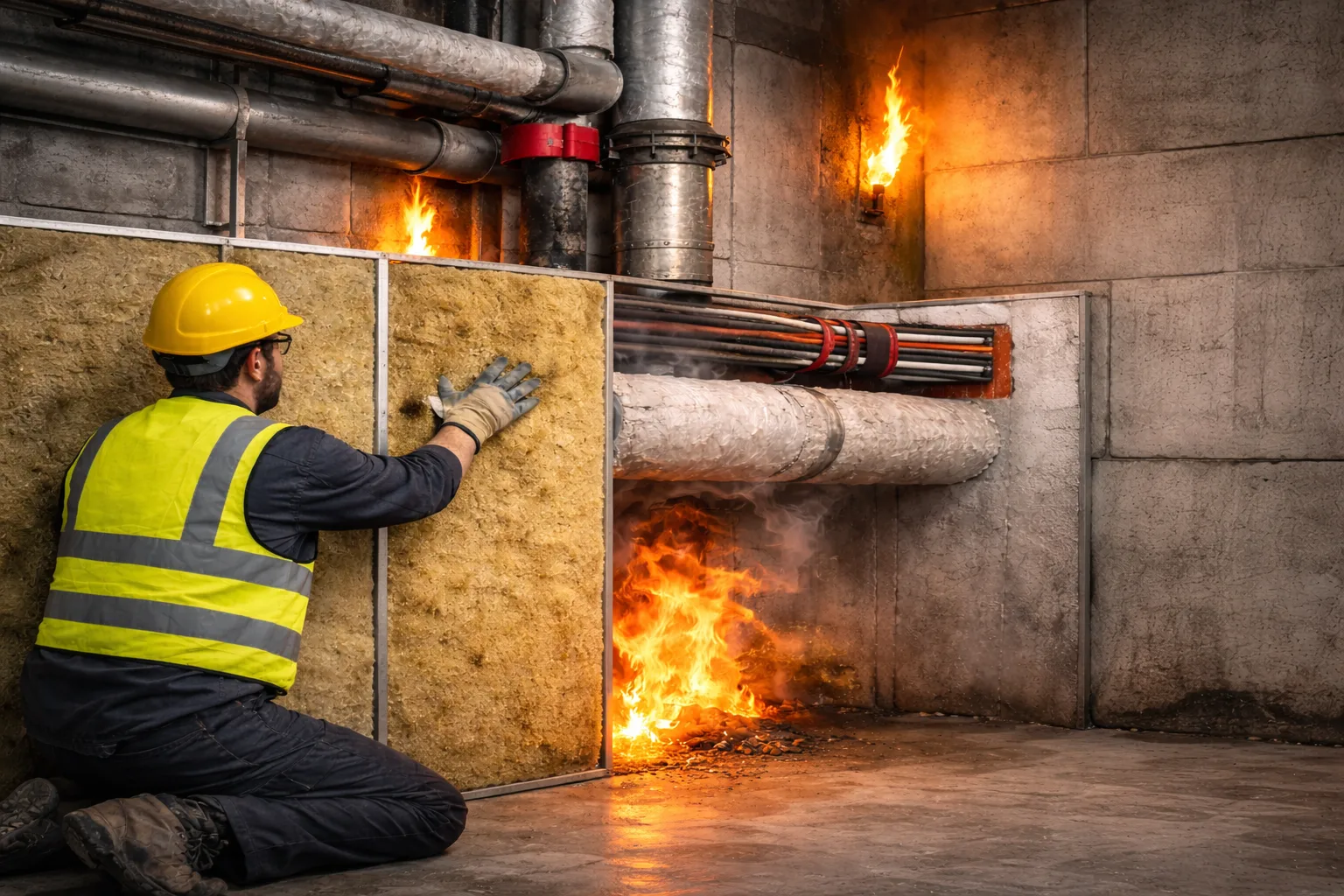
Yet one of the most effective tools available for protecting homes, apartments, and residential developments from the spread of fire and smoke remains poorly understood by most homeowners and even some builders.
Firesafe insulation is not a single product. It is a category of certified materials and systems specifically designed to resist high temperatures, prevent fire from spreading through a building's structure, and maintain the integrity of fire-rated walls, floors, and ceilings even when penetrated by cables, pipes, and building services. In residential construction, firesafe insulation is a legal requirement under the National Construction Code — not an optional upgrade.
This guide explains what firesafe insulation is, where it is required in Australian homes and apartments, which types are best suited to residential applications, and what homeowners and builders need to know about installation, compliance, and ongoing maintenance.
Why Firesafe Insulation Matters in Every Australian Home
The way fire spreads in a residential building is frequently misunderstood. Most people imagine fire as a visible, advancing front — flames moving from room to room through open doorways and corridors. In reality, the most dangerous element of a residential fire is rarely the flame itself. It is the smoke.
Toxic smoke — containing carbon monoxide, hydrogen cyanide, and a range of other combustion products — spreads far faster than flame and is responsible for the majority of fire fatalities in residential buildings. Smoke travels through every available gap: under doors, through ventilation systems, and most significantly, through unsealed penetrations in walls and floors where cables, pipes, and building services pass between compartments.
In a single-storey detached home, this may seem like a limited risk. But in a multi-storey house, a duplex, a townhouse, or an apartment building — which together represent a large and growing proportion of Australian residential stock — unsealed service penetrations create direct pathways through which smoke can travel from a fire in one dwelling or level to occupied spaces throughout the building within minutes.
Firesafe insulation addresses this risk at the structural level. By sealing every penetration and insulating every fire-rated building element correctly, firesafe insulation ensures that the compartmentation designed into the building actually performs as intended during a fire — giving occupants the time they need to evacuate safely and limiting property damage to the compartment of origin.
Common Residential Fire Risks That Firesafe Insulation Prevents
Understanding where fire risks originate in residential buildings clarifies exactly why firesafe insulation is required and where it must be installed.
Electrical cable penetrations are the single most common source of unsealed fire pathways in residential buildings. Every electrical cable that passes through a fire-rated wall or floor slab — from the switchboard to individual rooms, from one storey to another, and between attached dwellings in terraces or apartments — creates a penetration that must be sealed with a certified firesafe insulation product. In a standard two-storey home, there may be dozens of such penetrations. In a multi-unit apartment building, there are thousands.
Plumbing and hydraulic pipe penetrations create similar risks. PVC and other plastic pipes used in modern residential plumbing are combustible — when exposed to fire, they burn and collapse, leaving a large open penetration through what was a fire-rated wall or floor. Without firesafe insulation in the form of a firestop collar or pipe wrap, this penetration becomes a fire and smoke pathway at precisely the moment when the compartment boundary is most needed.
HVAC and exhaust duct penetrations create large-diameter openings through fire-rated slabs and walls in residential buildings. Kitchen exhaust ducts, bathroom ventilation, and ducted heating and cooling systems all penetrate fire-rated elements and must be protected with appropriate firesafe insulation — typically fire dampers or duct wrap systems that maintain compartmentation while allowing normal airflow during non-fire conditions.
Inter-tenancy walls in attached dwellings represent a critical fire barrier between separate households in terraces, duplexes, semi-detached homes, and apartment buildings. Any service that penetrates this wall — electrical cables, data cabling, plumbing, or gas pipework — must be sealed to maintain the full fire resistance level of the wall. An unsealed penetration in an inter-tenancy wall allows fire and smoke to travel between legally separate dwellings — a failure that carries serious consequences for both safety and liability.
Roof and ceiling cavities present a fire spread risk that is particularly relevant in older Australian residential stock but applies equally to new construction. Insulation installed in roof and ceiling spaces must be appropriate for fire conditions — standard bulk insulation products are not firesafe insulation and will not prevent fire from spreading through a ceiling cavity between fire compartments.
Where Firesafe Insulation Is Required in Residential Buildings
Under the National Construction Code, the requirement for firesafe insulation in residential buildings depends on the building class and the specific element involved.
Class 1 buildings — detached houses, semi-detached homes, duplexes, and terraces — are required to have fire-rated separation between attached dwellings, and every service penetrating that separation must be sealed. Common areas and attached garages are also subject to fire separation requirements, with service penetrations requiring compliant firesafe insulation.
Class 2 buildings — apartment buildings containing two or more separate dwellings — carry the most extensive firesafe insulation requirements in the residential sector. Every inter-tenancy wall and floor between separate apartments must maintain its fire resistance level at all penetration points. Stairwells, lift shafts, and service risers must be sealed at each floor level. Corridors and common areas must be compartmented from individual dwellings. In a multi-storey apartment building, the number of individual penetrations requiring firesafe insulation can reach several thousand.
Class 1a buildings with attached garages require fire-rated separation between the garage and the habitable areas of the home, with any service penetrations — including cables for garage door motors, lighting, and power — sealed with appropriate firesafe insulation to maintain the separation rating.
In all residential building classes, the fire resistance level required at each penetration point matches the FRL of the building element being penetrated. A wall rated at 60/60/60 requires penetration sealing systems that achieve the same rating. Products must be tested to AS 1530.4 and installed in accordance with AS 4072.1 — the two Australian Standards that together govern firesafe insulation specification and installation in residential construction.
Types of Firesafe Insulation Suited for Homes and Apartments
Residential buildings use a narrower range of firesafe insulation systems than commercial or industrial environments, reflecting the simpler service configurations typically found in homes and apartments. The following product types are most commonly specified and installed in Australian residential construction.
Intumescent sealants are the most widely used firesafe insulation product in residential applications. Applied around cables, small pipes, and conduits passing through fire-rated walls and floors, intumescent sealants expand dramatically when exposed to heat — sealing the annular gap around the service and restoring the fire resistance of the building element. They are available in silicone and acrylic formulations and are suitable for use in concrete, masonry, and plasterboard substrates. Fire rating: up to 4 hours.
Firestop collars are mechanical devices fitted around plastic (PVC and HDPE) pipes where they penetrate fire-rated walls and floor slabs. The collar contains an intumescent insert that, during a fire, contracts inward and crushes the pipe closed as it softens and collapses — preventing the open pipe penetration from becoming a fire and smoke pathway. Firestop collars are essential wherever plastic plumbing penetrates a fire-rated element in a residential building. Fire rating: up to 2 hours.
Intumescent pipe wraps perform the same function as firestop collars for larger or more complex pipe configurations where a standard collar cannot be installed. The wrap is applied around the pipe at the penetration point and expands inward during a fire, sealing the opening. Intumescent wraps are particularly useful in renovation and upgrade projects where existing penetrations need to be brought to current compliance standards. Fire rating: up to 4 hours.
Fire-rated duct wraps and fire dampers are the appropriate firesafe insulation solution for HVAC, kitchen exhaust, and ventilation duct penetrations through fire-rated slabs and walls. Fire dampers close automatically during a fire, maintaining compartmentation while the duct remains open for normal use. Duct wrap systems insulate the duct at and around the penetration, preventing heat transfer and fire spread. Both solutions are available in configurations appropriate for residential applications.
Intumescent acrylic sealant with backing rod is the standard residential solution for sealing gaps and joints in fire-rated wall and floor assemblies where no service penetration is present — including construction joints, perimeter gaps, and head-of-wall details. This product category is particularly relevant in timber-framed residential construction where movement and settlement create gaps in fire-rated assemblies over time.
NCC 2025 Compliance for Residential Fire Insulation in Australia
The NCC 2025, adopted across Australian jurisdictions from May 2025, introduces updated requirements for fire safety documentation in residential construction that significantly affect how firesafe insulation is specified, installed, and evidenced.
The most important change for residential builders and developers is the increased emphasis on evidence of suitability at each construction stage. Under NCC 2025, building certifiers require documented evidence that every firesafe insulation system installed in a residential building has been tested and certified for the specific application in which it is used. Generic or untested products — even those that appear similar to certified alternatives — do not satisfy this requirement.
For residential apartment buildings (Class 2), NCC 2025 requires a formal passive fire protection register to be compiled during construction, documenting every penetration seal installed in the building. This register must include the product used, the test reference number, the installation date, and photographic evidence captured before walls and ceilings are closed. Post-construction access to sealed penetrations is extremely costly — getting documentation right during construction is far less expensive than retrospective compliance work.
For Class 1 residential buildings, the documentation requirements are less extensive but no less legally binding. Every firesafe insulation product installed must be appropriate for the application, installed in accordance with the manufacturer's tested system specification, and able to be evidenced to the building certifier upon request.
DIY vs Professional Installation: What the Standards Require
One of the most common questions from homeowners and small builders is whether firesafe insulation can be self-installed. The answer depends on the product type and the building class — but the general principle is straightforward: firesafe insulation must be installed in strict accordance with the tested system specification that underpins the product's fire rating.
This means that the substrate type, service configuration, annular gap dimensions, and installation method must all exactly match the tested prototype. A product installed in a substrate or configuration not covered by its test evidence does not carry the claimed fire rating — regardless of how similar the installation appears to the tested configuration.
For Class 2 apartment buildings and other multi-residential developments, professional installation by trained, competent contractors is effectively mandatory. The documentation requirements, the density of penetrations, and the compliance obligations involved cannot practically be managed without specialist passive fire protection contractors.
For Class 1 residential buildings, some simpler firesafe insulation products — particularly intumescent sealants and pipe collars for straightforward applications — can technically be self-installed if the homeowner or builder is confident in matching the installation exactly to the tested system specification. However, the liability for compliance rests with the builder or owner-builder, and incorrect self-installation of firesafe insulation carries the same compliance and safety consequences as any other non-compliant penetration sealing.
In all cases, any firesafe insulation installed in a residential building should be photographically documented before it is concealed behind plasterboard, tiles, or other finishes. Once concealed, verification of compliance becomes invasive and expensive.
How to Maintain Firesafe Insulation in a Residential Property
Firesafe insulation is a passive fire protection system — it does not require power, activation, or regular servicing in the way that smoke alarms and sprinkler systems do. However, it is not maintenance-free, and residential building owners have ongoing obligations to ensure that installed firesafe insulation remains in serviceable condition.
The primary maintenance risk for residential firesafe insulation is physical damage during building works. Renovation, plumbing maintenance, electrical upgrades, and cable additions are all common activities in residential buildings that can inadvertently damage or remove existing firesafe insulation. A plumber who cuts a new pipe penetration through a fire-rated wall and does not reinstate the fire seal, or an electrician who pulls new cables through a sealed penetration without re-sealing — these are the most frequent causes of non-compliant penetrations in existing residential buildings.
For homeowners, the practical implication is simple: any tradesperson working on your home who creates or disturbs a penetration in a fire-rated wall, floor, or ceiling must reinstate the firesafe insulation to the original standard before completing the job. This obligation should be explicitly included in any trade contract or scope of works.
For strata managers and body corporates responsible for Class 2 apartment buildings, formal compartment inspections should be conducted at minimum every two years — more frequently following any common property works or individual apartment renovations. A passive fire protection specialist should assess every accessible penetration in common property fire-rated elements and produce a written report with photographic evidence. Any breaches identified must be remediated promptly and recorded.
For advanced firesafe insulation solutions tested and certified for residential, commercial, industrial, and marine applications across Australasia, Beele Australasia provides a comprehensive range of passive fire protection systems backed by full technical support and compliance documentation.
Conclusion
Firesafe insulation is not a niche product for specialist commercial or industrial buildings. It is a legal requirement in every Australian residential building where fire-rated walls, floors, or ceilings are penetrated by services — which means virtually every attached dwelling, multi-storey home, and apartment building in the country.
For homeowners, the key takeaway is that firesafe insulation is almost certainly present somewhere in your building — and that it needs to be protected from damage during any building works. For builders and developers, the message is equally clear: firesafe insulation must be specified correctly for every penetration, installed in strict accordance with the tested system, documented before concealment, and evidenced to building certifiers at each construction stage.
Getting firesafe insulation right in residential construction is not complicated — but it does require deliberate specification, competent installation, and disciplined documentation. The cost of doing it correctly during construction is minimal. The cost of retrospective rectification — or of a fire in a building with non-compliant passive protection — is not.