Every month, millions of people in India search for a daily earning app, hoping to add a little extra to their income. It is an understandable goal. But there is a question that matters just as much and gets asked far less often: what happens to the money you already earn?
Two people with the same salary can end up in very different places. One saves a little every month, avoids costly loans and slowly builds a cushion. The other earns the same amount but is always short before the month ends. The difference is rarely income. It is financial literacy.
The good news is that money management is a skill, and like any skill, you can learn it. Here are the basics worth building today, and how a learning app like Master makes them easier to pick up.
What Is Financial Literacy?
Financial literacy simply means understanding how money works in your own life. It covers how you earn, spend, save, borrow and grow your money. You do not need a commerce degree or a finance job to be good at it. You need a few clear habits and the confidence to make informed choices.
5 Money Management Skills to Build Today
1. Budgeting: know where your money goes
Most people know roughly how much they earn but have only a vague idea of where it goes. Budgeting fixes that.
A simple way to start is the 50-30-20 approach. Roughly half of your income goes to needs like rent, groceries, and bills; about a third to wants like eating out or shopping; and around a fifth to savings. The exact split can change based on your situation. What matters is that every rupee has a purpose.
Track your spending for one month using a notes app or a basic expense tracker. You will likely spot at least one habit you can cut without missing it.
2. Building an emergency fund
A medical bill, a sudden job loss or an urgent family expense can push anyone into debt if there is no backup. An emergency fund is money set aside only for these situations.
A common goal is to save enough to cover three to six months of essential expenses. That can feel like a large number, so start small. Even a fixed monthly amount, kept separate from your regular spending account, builds a safety net over time.
3. Understanding loans and avoiding debt traps
Borrowing is not always bad. Education loans or home loans can be sensible when planned well. The trouble starts when people borrow without understanding the full cost.
Before taking any loan, check the interest rate, processing fees, tenure and what happens if you miss a payment. Be especially careful with instant loan apps that promise money in minutes. Some charge very high hidden fees, and unregistered lenders can use aggressive recovery tactics. Always check that the lender is registered with or partnered with an RBI-regulated entity.
Credit cards deserve the same care. Paying only the minimum due can turn a small balance into a large debt because of high interest.
4. Knowing the basics of saving and investing
Saving keeps your money safe. Investing helps it grow. Both have a place.
Start by understanding common options such as fixed deposits, recurring deposits, the Public Provident Fund, mutual funds through SIPs and the stock market. Each carries a different level of risk and return. Stock market investing, for example, can offer higher long-term returns but can also lose value in the short term.
The key is to learn how each option works before investing, and never to invest based on a tip from a stranger promising guaranteed returns.
5. Spotting financial scams
Scams often target people who are looking to earn quickly. Fake job offers, "double your money" schemes, fraudulent trading groups and phishing messages asking for your OTP are common.
A simple rule protects you from most of them: if something promises high returns with no risk, or asks you to pay money upfront to earn money, walk away. Never share your OTP, PIN or bank details with anyone who calls or messages you.
Why Learn Money Skills on a Learning App?
Financial topics can feel intimidating when they are buried in jargon or long reports. Short, simple lessons make them easier to understand.
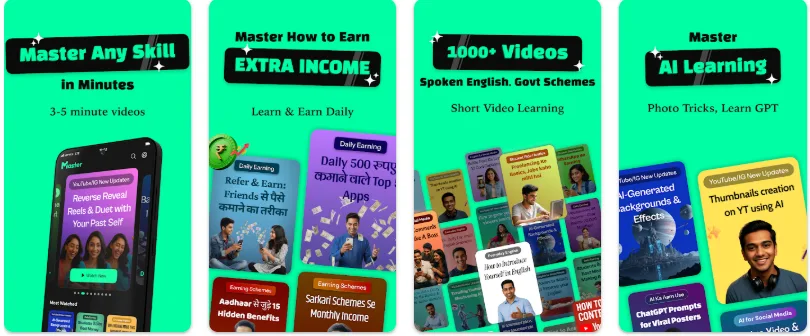
On the Master App, finance tips, stock market basics, government schemes and smart money habits are explained in easy Hindi, in videos that take just a few minutes. You can learn about budgeting during your morning commute and pick up a lesson on SIPs during lunch.
Here is what makes Master a practical choice:
- Short videos of 2 to 5 minutes, so learning fits into a busy day
- Explained in Hindi, removing the language barrier around finance
- 1,000+ videos, covering finance, careers, AI tools, spoken English and more
- Taught by real creators and experts, with practical, everyday advice
- Self-paced learning, so you move at your own speed
Earning More Starts with Managing Better
A daily earning app might add a small amount to your pocket. Strong money management decides whether that amount actually stays with you and grows. Start with one skill from this list, give the Master learning app a few minutes a day, and build the habits that make every rupee count.