
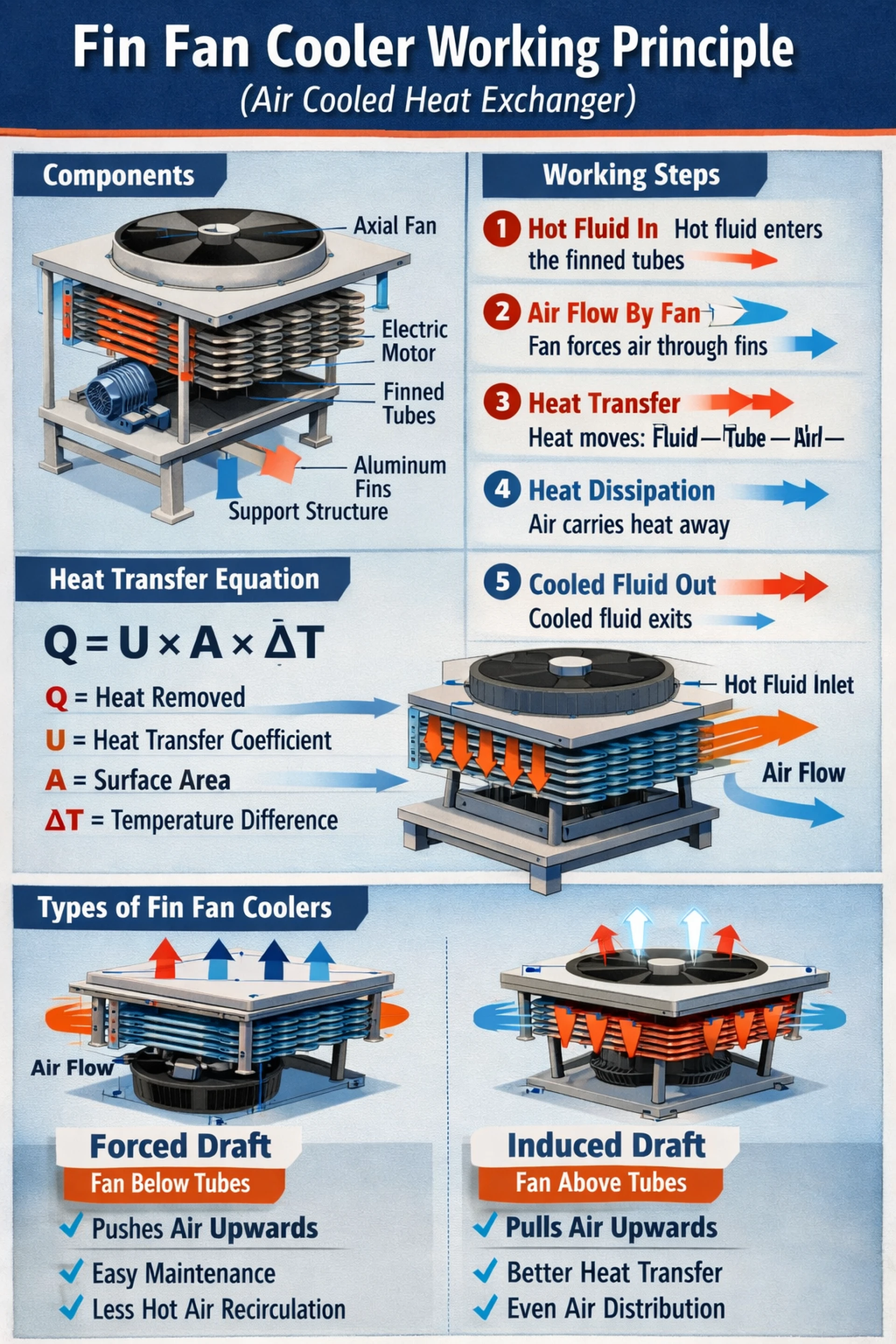
A fin fan cooler, also known as an air-cooled heat exchanger, is widely used in industries like power plants, petrochemical plants, and marine systems to remove heat from process fluids where water is scarce or unavailable.
It works by using air to cool a hot fluid (like oil, water, or other process liquids) flowing inside finned tubes.
1. Basic Concept
The main principle of a fin fan cooler is heat transfer from a hot fluid to the surrounding air using fins and fans:
- Hot fluid flows inside the tubes.
- Fins attached to the tubes increase the surface area for heat transfer.
- Fans blow ambient air across the fins.
Heat is removed from the fluid in three steps:
- Convection from fluid to tube wall – Heat moves from the hot liquid inside the tube to the tube surface.
- Conduction through the fin – Heat spreads through the fin attached to the tube.
- Convection from fin to air – Heat transfers from the fin surface to the air moved by the fan.
2. How It Works Step by Step
- Hot fluid enters the cooler – The process fluid enters the tube bundle at high temperature.
- Flow through finned tubes – The fluid moves inside tubes equipped with metal fins.
- Airflow by fans – Fans blow air across the fins, carrying away heat.
- Cooling the fluid – The fluid temperature drops as it travels through the cooler.
- Hot air exhausts – Heated air is discharged into the environment, while the cooled fluid exits the cooler.
3. Key Components
- Tubes – Carry the hot fluid.
- Fins – Increase the heat transfer surface area.
- Fans – Provide forced air circulation.
- Headers/Manifolds – Distribute fluid evenly into tubes.
- Frame/Support structure – Holds the tube bundle and fans securely.
4. Advantages of Fin Fan Coolers
- No need for cooling water
- Compact design suitable for limited space
- Effective in high ambient temperature conditions
- Can operate continuously with proper fan control
5. Important Considerations
- Fan size and airflow – Determines cooling efficiency.
- Tube and fin material – Must resist corrosion and allow efficient heat transfer.
- Ambient air temperature – Lower air temperature improves cooling.
- Maintenance – Fins can accumulate dust or debris; regular cleaning ensures optimal performance.