A material can withstand a high load during a single test and still fail when a much smaller load is applied repeatedly over time.
This difference is fundamental to understanding fatigue.
Many components do not experience one continuous load throughout their working life. Instead, they are subjected to repeated tension, compression, bending or changing forces. Each individual load may appear acceptable, but thousands or millions of cycles can gradually initiate and grow damage within the material.
Fatigue testing investigates this long-term behaviour. Rather than asking only how much force a material can withstand once, it examines how the material responds when loading is repeated under controlled conditions.
Static Strength Does Not Tell the Whole Story
A conventional tensile or compression test provides important information about material strength.
In a tensile test, a specimen is pulled under controlled conditions to determine how it responds to increasing load. Compression testing examines its behaviour when force is applied in the opposite direction. Flexural tests can provide further information about behaviour under bending.
These forms of static material testing are essential for understanding properties such as strength and deformation.
But real components may experience a different loading pattern.
A structural part may repeatedly carry and release a load. A mechanical component may experience alternating forces during operation. A specimen may be subjected to repeated stress levels that remain well below the force required to cause immediate failure.
Under these conditions, fatigue becomes important.
What Happens During Cyclic Loading
In cyclic load testing, a specimen is subjected to a repeating load pattern.
Depending on the test, the load may repeatedly move between two tensile values, alternate between tension and compression, or follow another controlled waveform.
Several variables can influence the result, including:
· Maximum and minimum load
· Stress amplitude
· Mean stress
· Loading frequency
· Number of cycles
· Material condition
· Specimen geometry
· Test environment
The objective is not simply to break the specimen. The experiment is intended to understand how repeated loading influences its behaviour and when fatigue damage develops.
From Small Damage to Fatigue Failure
Fatigue failure commonly develops progressively rather than through one sudden overload.
Repeated stress can contribute to the initiation of a small crack, often at a location where stress is concentrated. Continued cycling can allow that crack to grow. Eventually, the remaining material may no longer be able to carry the applied load.
The final failure can therefore occur even though the individual cyclic loads were below the material's static failure strength.
This is why static strength alone cannot fully describe performance under repeated loading.
Measuring How Long a Material Can Withstand Repeated Loads
One of the central goals of fatigue life testing is to establish the relationship between applied stress and the number of cycles a material can withstand.
A specimen is tested at a defined cyclic load or stress level and the number of cycles is recorded. Repeating the process under different conditions allows researchers to build a broader picture of fatigue behaviour.
Stress Level and Number of Cycles Work Together
Higher cyclic stress generally leads to failure in fewer cycles, while reducing the stress can considerably extend fatigue life.
This relationship is commonly represented through an S-N curve, also known as a Wöhler curve, where stress amplitude is related to the number of cycles to failure.
Such information helps distinguish between material behaviour under relatively high cyclic stresses and behaviour over very large numbers of cycles.
High cycle fatigue testing, for example, focuses on conditions where the specimen experiences many repeated cycles, typically with deformation largely remaining within the elastic range.
The important point is that fatigue life is not a single universal number for a material. It depends on the loading conditions under which the material is tested.
Why Controlled Dynamic Testing Matters
A meaningful fatigue experiment requires the applied cycles to be reproduced consistently.
The fatigue testing machine must control the required loading pattern while measuring the specimen's response over repeated cycles. Depending on the test method, force, displacement or strain may be used as part of the control and measurement process.
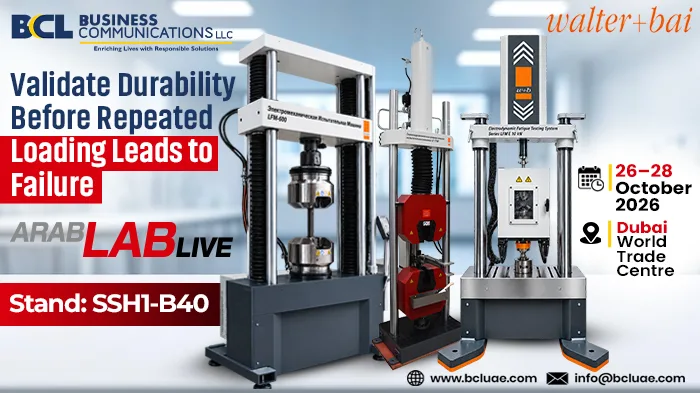
Walter+Bai's LFV-E series is an example of an electrodynamic fatigue testing system intended for dynamic and fatigue testing. The manufacturer describes the system as a fluid-free, non-hydraulic platform capable of constant, monotonic, cyclic and alternating loading, with force, stroke or strain-related channels available for measurement and control.
For fatigue research, the significance of a dynamic testing machine is therefore not simply its ability to move repeatedly. It is the ability to apply a defined loading history consistently enough for changes in the specimen to be meaningfully evaluated.
Static and Fatigue Tests Answer Different Material Questions
Static and dynamic testing are closely related, but they should not be treated as interchangeable.
A universal testing machine can establish how a material behaves under controlled tensile, compression or flexural loading. A fatigue system examines what happens when loading is repeated.
Both types of information can be important when assessing material performance.
Establishing the Static Behaviour First
Before investigating repeated loading, researchers may need a clear understanding of the material's basic mechanical response.
An electromechanical universal testing machine can be used for static tests such as tensile, compression and flexural testing.
Walter+Bai's LFM electromechanical systems represent this category of static testing equipment. Such measurements can provide the baseline mechanical information needed to understand how a material responds as load increases.
This baseline can then help inform the loading conditions selected for subsequent fatigue investigations.
When Much Higher Static Forces Are Required
Some materials, specimens and components require substantially greater force during static testing.
Walter+Bai's TTM series belongs to the company's servohydraulic static universal testing range and includes systems with capacities extending up to 5000 kN.
A high capacity universal testing machine of this type addresses a different requirement from an electrodynamic fatigue system. It is relevant where high force tensile testing, compression testing or other high-load static measurements are required.
The distinction is important.
High static force capacity does not automatically make a system a fatigue-testing solution, while a fatigue system is selected for its ability to reproduce controlled dynamic loading over repeated cycles.
Understanding that difference helps prevent static strength and fatigue resistance from being treated as the same material property.
Reading Fatigue Results in the Right Context
A fatigue result only becomes meaningful when the loading conditions behind it are understood.
Two specimens of the same material can produce different fatigue lives if the stress amplitude, mean stress, frequency, surface condition, geometry or environment changes.
For this reason, reporting only the number of cycles to failure provides an incomplete picture.
The test conditions need to remain part of the interpretation.
A Component Does Not Experience “Cycles” in Isolation
Repeated loading in service can take many forms.
Some components experience nearly constant repeated loads. Others see variable amplitudes. Some are subjected mainly to tension, while others encounter compression, bending or alternating loading.
Laboratory cyclic load testing simplifies these conditions into controlled test programmes so that particular aspects of material behaviour can be studied systematically.
The closer the test conditions represent the mechanical question being investigated, the more useful the resulting fatigue data becomes.
This is also why the appropriate testing system depends on the type of information required rather than simply on the highest force capacity available.
Fatigue and Materials Testing at ARABLAB 2026
Materials testing technologies form part of the wider scientific instrumentation landscape at arablab 2026 dubai, taking place from 26–28 October 2026 at Dubai World Trade Centre.
Walter+Bai technologies associated with the testing approaches discussed here include electrodynamic systems for fatigue and dynamic testing, LFM electromechanical systems for static material testing, and TTM servohydraulic systems for higher-force static testing.
Information on these technologies is available through Business Communications LLC at Sheikh Saeed Hall 1, Stand SSH1-B40 during ARABLAB LIVE 2026.
Within the broader field represented by scientific equipment exhibitors ARABLAB, these different testing technologies illustrate an important principle in materials characterization: static strength, high-force performance and fatigue behaviour answer different questions about the same material.
Material Performance Is a Story of Load and Time
A material that performs well during one tensile or compression test has demonstrated an important property, but it has not necessarily demonstrated resistance to repeated loading.
Fatigue introduces time and repetition into the mechanical picture.
A load that causes no immediate damage may become significant after thousands or millions of cycles. A small crack can gradually develop into a larger one. Changes in stress amplitude can substantially alter the number of cycles a specimen withstands.
This is why fatigue testing needs to be considered alongside static testing rather than treated as a replacement for it.
Static tests establish how a material responds to controlled loading at a particular stage. Dynamic tests investigate what repeated loading does over time. Together, these measurements provide a more complete understanding of mechanical behaviour and help explain not only how much load a material can withstand, but how long it can continue to withstand it.