Glass candy containers have fascinated collectors for nearly 150 years, blending nostalgia, craftsmanship, and a touch of American history. To understand why these tiny treasures are still so beloved, we turn to category expert Jim Olean, a long-time collector and officer of the Candy Container Collectors of America. His story offers a warm and personal glimpse into how these charming keepsakes became such a meaningful part of the collecting world.
A Collector’s Journey Begins by Chance
Jim’s passion for glass collectibles began in 1985, completely by accident. While searching for wild mushrooms in the woods near his home, he stumbled upon an old dump filled with discarded household items. Among the discarded items, three small glass pieces caught his eye—a candlestick telephone, a dog figure, and a headless Santa. Curious, he took them home, cleaned them, and displayed them in his game room.
When Jim showed the pieces to his uncle, a fellow antique enthusiast, he learned something surprising. These weren’t just decorative objects—they were early examples of candy containers, small glass toys originally sold with treats inside. Intrigued by the idea of “a toy and candy all in one,” Jim set out to find a complete version. His search led him to a local flea market, where he discovered an original candlestick telephone container—fully intact, candy and all. That $15 purchase sparked a collecting journey that has lasted decades.
Early History and Evolution of the Industry
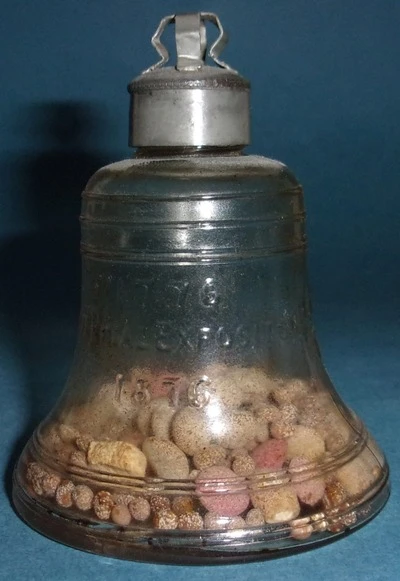
The exact origins of these collectible pieces are somewhat unclear. Some evidence suggests they may have been produced as far back as the late 1860s. The first documented example appeared in 1876, when Philadelphia confectioner James Croft sold candy at the Centennial Fair inside glass Liberty Bell souvenirs. Surprisingly, many of these have survived and can still be found today.
The true heart of the industry, however, formed in Jeannette, Pennsylvania. The area’s abundant clean-burning natural gas made it ideal for glass production, and multiple companies set up shop there in the late 19th century. The turning point came in 1906, when George West of Westmoreland Glass began patenting designs for glass toy containers. Early examples included simple shapes like trunks, horns, and clocks, often made of milk glass and decorated with painted details.
As demand grew, designs became more elaborate. Companies introduced planes, trucks, and buses that combined hand-blown glass bodies with metal parts. These pieces were labor-intensive and required multiple steps—shaping, painting, assembling, packing, and shipping—all for a toy that sold for just ten cents. Competition soon expanded, with additional manufacturers such as Victory Glass, L.E. Smith, Cambridge Glass, and T.H. Stough entering the market.
By 1940, technology began to change the industry. J.H. Millstein developed fully automatic blown molds, making production faster and more uniform. While this allowed millions of containers to be produced, it also marked the beginning of the end. As plastic became more affordable and popular, glass production declined. By 1962, the last American producer of these glass toys closed its doors.
Reflecting American Culture Through Miniature Art
One of the most appealing aspects of these collectibles is how they mirror the times in which they were made. Manufacturers often created designs based on trends, new inventions, and pop culture. Some containers resembled radios, phonographs, or airplanes like Charles Lindbergh’s famous Spirit of St. Louis. Others were inspired by cartoon characters such as Felix the Cat and Barney Google. These creative, often whimsical designs make them especially enjoyable to discover today, particularly for collectors who love finding bits of cultural history preserved in glass.
How Many Designs Exist—and What Are They Worth?
Over approximately a century of production, around 550 distinct designs were made by about 13 different companies. Some are common and easy to find, while others are extremely rare, with only one or two known examples. Even after 35 years of collecting, Olean notes that he still does not own every design—and no collector has managed to gather them all.
Values vary widely, generally ranging from $5 to $5,000 depending on age, rarity, and condition. Prices rose steadily for many years and peaked in the mid-2000s, before leveling off with the rise of online selling. Today, collectors searching for candy in containers can browse listings more easily than ever, thanks to auction platforms and online marketplaces.
Where Collectors Find Them Today
Before the internet era, finding these items required dedication and luck. Jim recalls driving for miles to flea markets and antique stores—sometimes without finding a single piece, even though he lived near the center of the original production area.
Today, online platforms make it much easier to track availability and sale prices. While the increased supply has changed the market, it has also opened the door to new collectors discovering the beauty of candy in containers for the first time.
The Candy Container Collectors of America, founded in 1981, has long served as a community hub for enthusiasts. Although its annual conventions and swap meets have paused due to recent events, the sense of community remains strong.
A Timeless Collectible With a Sweet Story
Glass candy containers may have started as simple treats for children, but today they offer a charming window into America’s past. Through Jim Olean’s experiences, we see how a chance find can spark a lifelong passion—one that continues to connect collectors, preserve history, and celebrate the artistry hidden in these tiny treasures.
For the latest updates, feature stories, and market movements, head over to Auction Daily’s News section.