
There's a particular kind of experience that's hard to engineer but easy to recognize. It's when you stop being an observer and start feeling like a participant. When the space stops talking at you and starts responding to you. When you walk out and realize, without being able to say exactly why, that you now understand something you didn't before — and you actually care about it.
That feeling is what separates an interactive experience center worth building from one worth forgetting. And it's rarer than most brands realize, because it requires the designers to make a fundamental shift: from thinking about what the brand wants to communicate, to thinking about what the visitor needs to discover.
These are not the same thing. And getting that distinction right changes everything.
Google For India: When the Technology Becomes the Story
At the 8th edition of Google For India — the same event attended by Sundar Pichai and covered by everyone from Technical Guruji to the Economic Times — Ink In Caps was brought in to make one specific Google innovation tangible to a room full of journalists, policymakers, developers, and curious citizens.
That innovation was Doc Lens: a natural extension of Google Lens that uses machine learning to read, interpret, and digitize handwritten medical prescriptions. On paper, this is a genuinely useful tool for India — a country where handwritten prescriptions remain standard, where pharmacists and patients regularly struggle to decode doctors' shorthand, and where medication errors carry real consequences.
But "on paper" was the problem. How do you demonstrate something so specific, so technical, and so genuinely valuable in an event environment where you have thirty seconds to capture someone's attention?
The Rotoscope Wall Solution
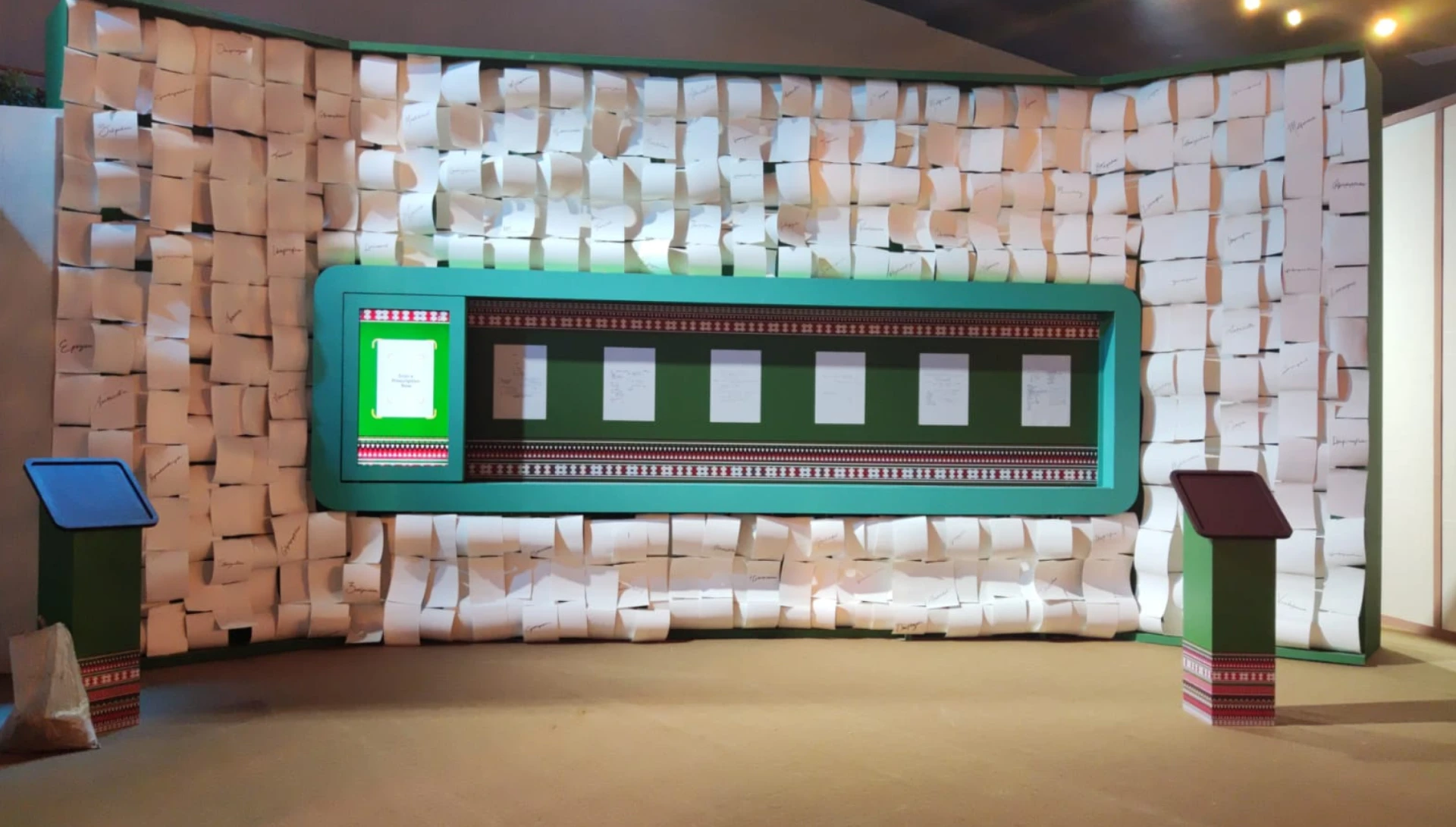
IIC Lab designed a rotoscope wall: a physical installation with six real prescriptions mounted on a display surface. Visitors scanned each one using the Doc Lens interface, and the screen responded immediately — pulling out the medicine name, dosage, and side effects, presented cleanly and clearly.
The interaction was instant. The feedback was visible. The meaning was unmistakable.
To make it reliable under expo conditions, the team built redundancy into the system — two parallel setups running simultaneously, with a custom hot-switch algorithm so that if one failed, the transition was invisible. The rotary encoder that drove the system had to be imported specifically for this build because nothing equivalent was available in India at the time. Custom software handled both the sensor reading and the media response.
The Moment That Validates the Approach
People queued. Not because they were told to. Not because there was a prize. But because the interaction was genuinely interesting — because scanning a prescription and watching the system decode it felt surprising, even to people who intellectually understood what AI can do.
That's the mark of an experience center done right. The technology serves the human moment. The visitor isn't learning about AI for healthcare. They're experiencing what AI for healthcare feels like.
Why This Matters for Brands Across Every Sector
Google's Doc Lens installation worked because it embodied a principle that applies whether you're a tech company, an FMCG brand, a financial institution, or a government body: the most effective way to explain something complex is to let people feel it rather than telling them about it.
Consider what the installation actually delivered:
- It removed the need for a spokesperson — the installation explained itself
- It made an abstract AI capability concrete through a familiar, relatable object: a prescription
- It gave visitors a story to carry out of the room — "I scanned a prescription and it read the whole thing in seconds"
- It generated organic media coverage because the experience was genuinely worth sharing
None of that required celebrity ambassadors, massive ad spends, or elaborate stage productions. It required a precise understanding of what the visitor needed to discover — and an environment built to deliver exactly that moment.
The Design Principles Behind Participatory Spaces
- Start with the 'aha' moment: Every great experience center has one moment where the visitor goes from interested to genuinely engaged. Design backwards from that moment.
- Use familiar objects as entry points: A prescription is something everyone has encountered. Using it as the interface removed the learning curve entirely.
- Build for the real world, not the demo: Queue conditions, varied lighting, continuous use — the rotoscope wall had to perform through all of it.
- Let the visitor be the protagonist: The best installations give visitors agency. They scan, they choose, they interact — and the space responds to them.
IIC Lab has built participatory experience centers for Google, Jio, BMW, Protean, and more. If you want visitors to feel part of your brand story — not just spectators of it — let's talk. Find us at Inkincaps