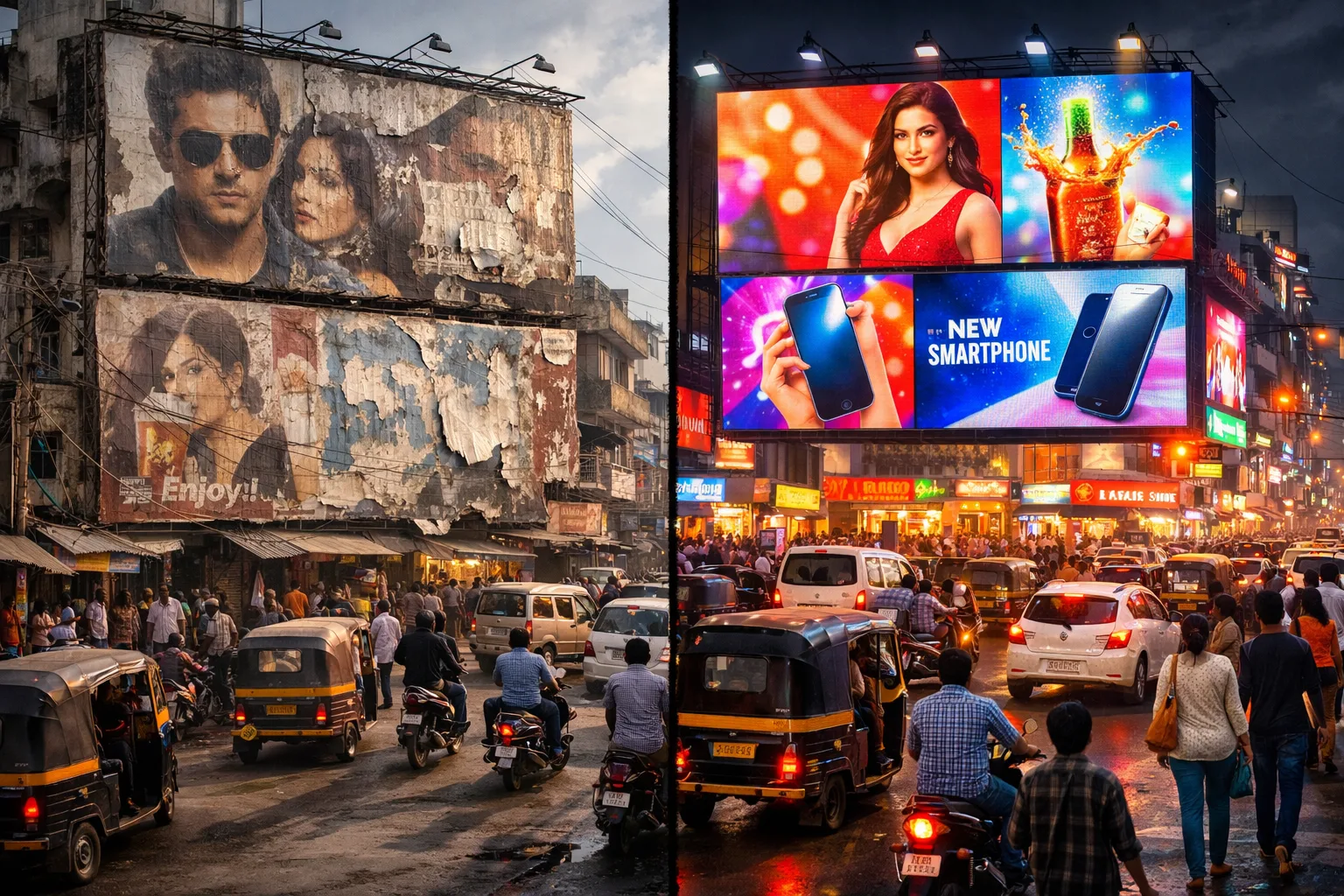
Static billboards in Indian cities are becoming a thing of the past. Conventional vinyl posters are gradually disappearing. Selecting an outdoor LED video wall is like meeting an urgent need to increase engagement in advertising. However, buying one of these displays isn't very simple. After all, you are investing in a piece of hardware that must survive extreme heat, monsoon rain, and thick dust while delivering a clear image. Making the right choice will, thus, ensure your return on investment remains high over several years.
Why Pixel Pitch Matters for Your Outdoor Screen
Pixel pitch is the most important term you will encounter. It refers to the distance from the centre of one LED cluster (or pixel) to the centre of the next one, measured in millimetres. You will usually see this written as 'P' followed by a number. For example, a P4 screen has a 4mm gap between pixels. This measurement determines the LED density on the panel.
A simple way to decide is the "Rule of Thumb" for viewing distance. You match the pixel pitch to the minimum distance your audience will be from the screen. If you install a P4 screen, your viewers should be at least 4 metres away to see a smooth image. If they are closer, the image looks "blocky" or pixelated.
There is a growing trend in India towards smaller pitches. You might see 1.95mm to 3mm screens used for street-level displays. On the contrary, you would choose a larger pitch (such as P6 or P10) for a massive billboard on a highway.
Calculating Resolution and Visual Impact for Your Outdoor LED Video Wall
The resolution of your outdoor LED video wall is determined by the pixel pitch and the cabinet's physical size. If you have a fixed space, choosing a smaller pitch gives you more pixels and a sharper image. High resolution is vital if you are installing a screen on a retail facade where fine text or detailed product photos are shown. However, if your screen sits on a high-altitude rooftop, you can get away with lower resolution. The distance does the work for you by blending the pixels.
Sunlight is another factor you cannot ignore. India gets incredibly bright. You need a screen with high-nit brightness, usually between 5000 & 7000 nits.
Features Your Screen Needs to Survive the Indian Climate
The Indian environment is brutal on electronics. You need to look for an IP66 rating. This standard ensures your screen is completely protected against heavy monsoon rains and fine dust particles. If your screen lacks proper sealing, moisture will seep in and short-circuit the modules within months.
Heat dissipation is just as critical.
Temperatures soar above 45 degrees Celsius in many parts of India. Suppose the screen does not cool itself efficiently. Then you may see color fading or total component failure.
What You Can Expect to Pay in India
Estimating the cost of an outdoor LED video wall requires considering three main areas.
First, the LED modules account for most of the price
The smaller your pixel pitch, the more LEDs you need per square foot. They drive up the price.
Second, you have the video processors and controllers.
These pieces of hardware seamlessly distribute your content across the panels.
Finally, you should not forget the steel structure as it is significant.
Market pricing in India generally falls into two categories:
Standard Outdoor (P4-P6)-
You can expect to pay between 4,000 and 8,000 Rupees per square foot. These are common for storefronts and smaller displays.
Large Format/Billboard (P8-P10)-
These usually range from 2,500 to 5,000 Rupees per square foot. (Keep in mind these are estimates, and final quotes depend on your specific site.
Factors That Change Your Installation Bill
Your mounting type will shift the final price.
A wall-mounted screen is usually cheaper than a pole-mounted one or a complex rooftop structure.
If your site is hard to reach, your costs for labour, cranes, and scaffolding will increase. You might also want to pay for smart monitoring.
This involves IoT-based tools that send you alerts when a fan fails or a module goes dark, so you can fix it before the whole screen shuts down.
A Checklist for a Successful Installation
Before you start, you must conduct a site survey and a structural stability audit. You need to know if the wall or roof can actually hold the weight of the LED cabinets. Power is another big one. You need a stable power backup and surge protection to prevent voltage spikes from frying your pixels. Lastly, you need to set up your connectivity and Content Management System (CMS).
You want a display that lasts. Choosing a product with an extended warranty (some go up to 7 years) gives you peace of mind. In the Indian market, local service support is non-negotiable. You want technicians who can perform chip-level repairs locally rather than shipping parts back to another country.
Conclusion
Selecting an outdoor LED video wall is a significant consideration. You have to weigh the clarity of the pixel pitch against your budget and the distance to your viewers. If you pick the right resolution and ensure the hardware is built for the Indian heat, you end up with a powerful tool that works for years. It is always a good idea to speak with experts who understand the local technical hurdles before you sign a cheque.
FAQs
What is the price of an outdoor LED video wall in India?
The price varies based on pixel pitch. You might pay 4,000 to 8,000 Rupees per square foot for standard P4 screens. Larger P10 billboards are cheaper, often ranging from 2,500 to 5,000 Rupees per square foot, depending on your needs.
Which pixel pitch is best for an outdoor LED video wall?
It depends on how far your viewers are. Suppose you have a street-level display. Then, a P3 or P4 works well. Select a P8 or P10 to save on costs for highway signs viewed from 100 metres away.
Can an outdoor LED video wall handle heavy rain?
You need to select a screen with an IP66 rating. That will ensure your display is waterproof & dustproof. Besides, you also need to check that the connectors and & the rear of the cabinet are also sealed against the Indian monsoon.