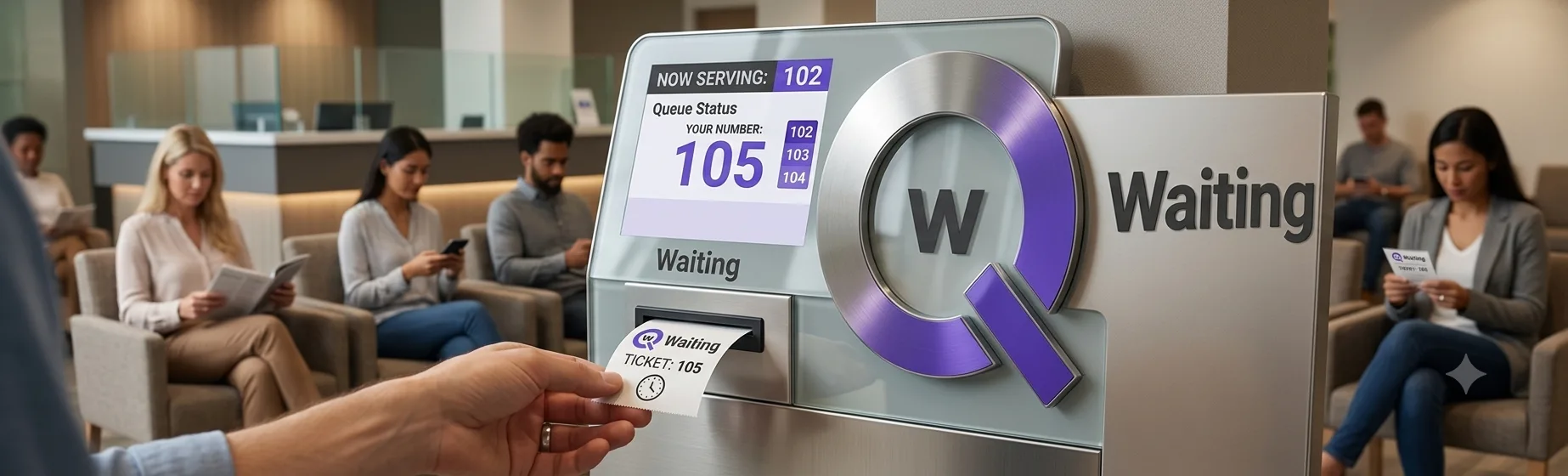
A guest who waits 25 minutes to badge in at a conference doesn't remember the keynote afterward. They remember the wait. That's really the whole argument for treating event queue management as its own discipline instead of borrowing whatever software runs the local bank branch.
Event queuing systems get pushed to their limits in ways retail or healthcare tools rarely see. So this piece is about what actually separates a system built for that pressure from one that just happens to have "events" listed somewhere on its features page.
Why Events Break Generic Queue Software
Retail queues are steady. People trickle in throughout the day, and the system has time to breathe between transactions. Events don't give you that luxury.
Most conferences see 70-80% of attendees show up within the first hour after doors open. There's no "come back tomorrow" option either—the keynote starts at 9am whether your line has cleared or not. And unlike a bank counter, an event venue is usually running badge pickup, VIP check-in, session entry, food service, and merch lines all at the same time, often in a space that had no network infrastructure a week ago.
Generic event queue management tools tend to assume an average daily load. That assumption falls apart the moment 800 people hit the door in the same fifteen minutes.
What to Actually Look For
Pre-registration that turns into a scan, not a search. If your check-in process still involves someone typing a name into a search box, you're capped at a few hundred attendees before lines back up. QR codes generated at registration and scanned on arrival is the baseline now, not a nice-to-have.
One dashboard, multiple queues. Badge pickup, VIP lane, session entry — these need to run in parallel and show up on a single screen. Staff toggling between three separate apps during a rush is how mistakes happen.
Actual tested throughput, not marketing copy. Ask vendors point blank: what's the highest concurrent check-in rate this has handled in production? A tool that's smooth at 50 scans a minute but stutters at 200 was built for retail and rebranded.
Something that survives bad Wi-Fi. Convention centers are notorious for this. If the system needs a live connection to function at all, it will fail exactly when you need it most — during the rush, with three thousand phones competing for the same signal. Local caching with sync-on-reconnect isn't optional.
Live updates on the floor. Digital signage, SMS, app notifications — whatever keeps people informed about their queue position in real time. This is the difference between an orderly line and a crowd forming near the entrance because nobody knows what's happening.
Data you can actually use afterward. Timestamps, dwell time, no-show rates, peak-load windows. Organizers need this to justify budget to sponsors and to plan the next event better, not just to fill out a report nobody reads.
The Main Formats
QR or ticket-based check-in covers most conferences — scan and go. Kiosks work well for on-site badge printing and cut down staffing needs at entry points. Virtual queuing, where someone joins remotely via SMS or an app and gets pinged when it's their turn, tends to show up for popular sessions or high-demand booths rather than the main entrance. Face recognition is creeping into VIP lanes because the throughput is genuinely faster, though it comes with consent and compliance questions worth working through before deployment, not after.
Most large events end up running two or three of these together rather than picking just one.
Vendor Evaluation, in Order of What Matters
Ask for a reference client at your scale — not a feature list, an actual comparable deployment. Check how fast they can stand up a new event; a multi-week onboarding cycle doesn't work for a three-day conference. Find out if it runs on hardware you already own or locks you into proprietary kiosks. Confirm it integrates with your registration platform (Eventbrite, Cvent, whatever you're using) so nobody's manually importing a CSV the morning of the event. And ask what support looks like during your actual event hours, because a standard 9-to-5 SLA is useless if your doors open at 7am on a Saturday.
Where Entry Lines Usually Go Wrong
Under-provisioning stations for the first-hour spike instead of planning around average hourly flow is probably the most common mistake. Close behind it: no fallback when the network drops, VIP and general admission funneled through the same physical lane, and systems that get deployed without ever being load-tested against a simulated rush. There's also a psychology piece people underrate — attendees will tolerate a longer wait far more easily if they can see their position and get an honest estimate, versus standing in an unmarked line with no idea what's going on.
FAQs
What's the difference between event queue management and general queue management software? Event systems are built around short, extreme bursts and temporary setups. General queue software is built for steady, ongoing footfall at a fixed location — different design problem entirely.
Can event queuing systems integrate with platforms like Eventbrite? Most current systems do, either through an API or CSV sync, so registration data flows straight into check-in instead of getting re-entered by hand.
Do these systems work without internet access? The good ones offer offline mode with local caching that syncs once the connection comes back — a real requirement, not a bonus feature, given how unreliable venue Wi-Fi tends to be.
How many check-in stations does a 1,000-person event need? A rough starting point is one station per 75-100 attendees during peak arrival, then adjust depending on how much your check-in process actually involves (a simple scan versus badge printing changes the math quite a bit).
Is face recognition check-in worth the investment for events? It speeds up VIP and expedited lanes noticeably, but only makes sense once you've worked through consent processes and whatever biometric regulations apply in your jurisdiction. Worth evaluating case by case rather than assuming it's always the right call.
Bottom Line
Event queuing lives or dies in the first hour after doors open. Vendors who can prove they've handled burst load, survived a bad network, and deployed on short notice matter more than ones with the longest feature comparison chart. Analytics and integrations are worth having, but only once the core check-in flow actually holds up under real pressure.