
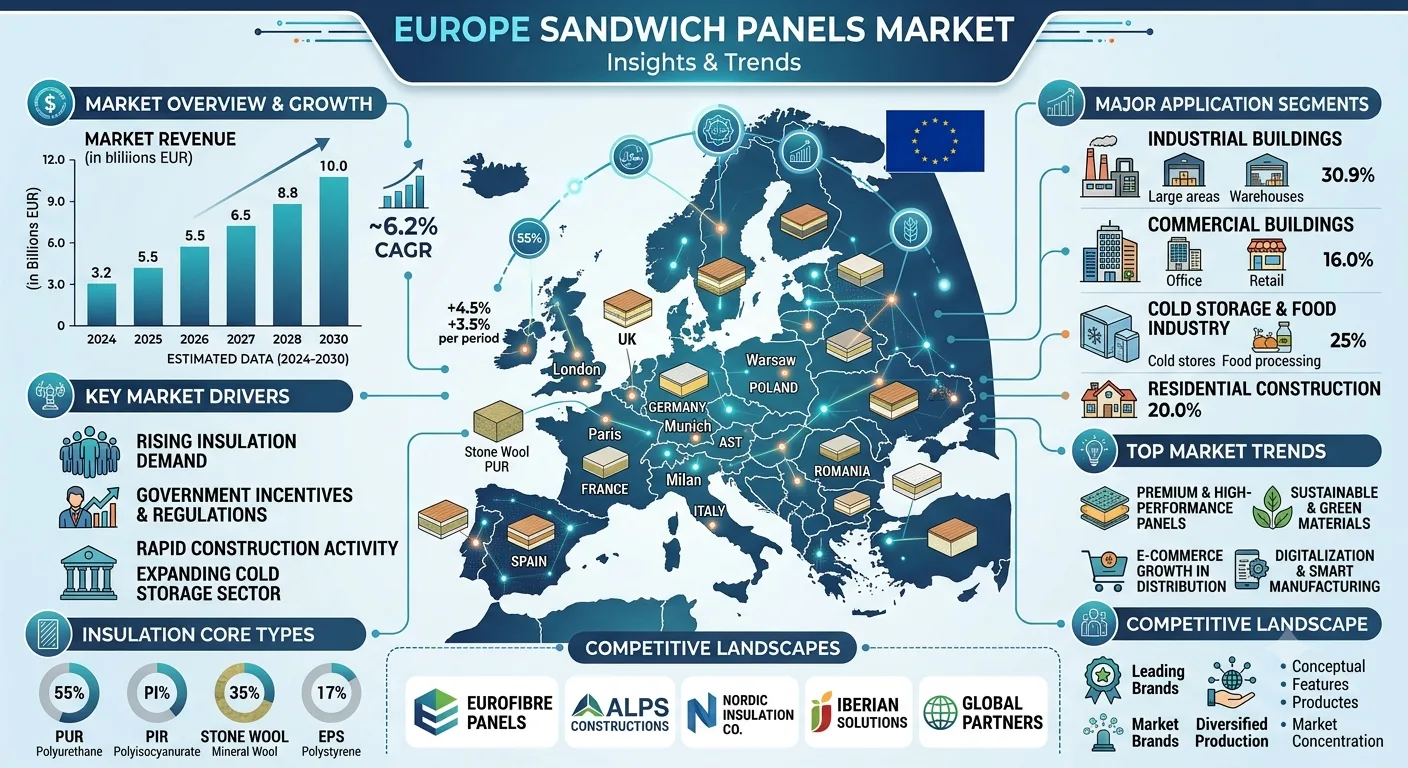
Market Overview
The Europe sandwich panels market size was valued at USD 4.2 Billion in 2025. Looking forward, IMARC Group estimates the market to reach USD 6.3 Billion by 2034, exhibiting a growth rate (CAGR of 4.30%) from 2026-2034. The market is witnessing significant growth due to the escalating demand for energy-efficient buildings and the growing emphasis on sustainability and green construction, alongside the rise of prefabricated and modular construction, technological advancements in insulation, and increasing focus on industrial and commercial applications.
The Europe sandwich panels market encompasses PUR/PIR, mineral wool, expanded polystyrene, and other core types across continuous fibre reinforced thermoplastics, fibreglass reinforced panel, aluminium, steel, and other skin materials, manufactured through continuous and discontinuous technologies for wall panels, roof panels, and other applications across residential, commercial, industrial, institutional, and other end uses in Germany, the United Kingdom, France, Italy, Russia, Spain, the Netherlands, Switzerland, Poland, and other European markets. Sandwich panels are composite building materials consisting of two strong outer layers and a lightweight insulating core, providing excellent thermal and sound insulation, durability, and structural strength, and are commonly employed in industrial, commercial, and residential construction for energy-efficient, cost-effective solutions for walls, roofs, and ceilings. The market is strategically important to Europe's building energy efficiency objectives, green construction transition, and construction productivity, supporting regulatory compliance with increasingly stringent building energy performance standards while enabling faster construction timelines and reduced environmental impact.
Europe's sandwich panels landscape is being shaped by the escalating demand for energy-efficient buildings. There is a high increase in the cost of energy, and this coupled with rising environmental concerns has led to a marked trend towards constructing energy-efficient structures in Europe, with sandwich panels excelling in insulation performance among solutions applied to reduce energy consumption in both residential and commercial buildings. These panels help maintain indoor temperature, cutting down on the needs for heating and cooling and ultimately lowering energy bills, with the trend highly visible in green buildings and retrofitting of existing buildings to respect regulations set for saving energy and meeting efficiency standards. The Ukrainian insulation market saw domestic sales of insulated sandwich panels by construction company Rauta grow 15% in the first half of 2024, demonstrating the strength of demand for energy-efficient building solutions across European markets.
EUROPE SANDWICH PANELS MARKET SUMMARY
The Europe sandwich panels market encompasses the manufacturing, distribution, and installation of composite building panels consisting of two strong outer skins and a lightweight insulating core for wall, roof, and other applications across residential, commercial, industrial, and institutional construction in European markets.
The ecosystem spans panel manufacturers, steel and aluminium skin suppliers, insulation core material providers, construction contractors, prefabrication and modular building companies, architects and specifiers, distributors, and regulatory bodies serving customers across industrial facilities, commercial buildings, cold storage, warehouses, and residential construction.
By Type, the market is segmented into PUR/PIR (dominating), Mineral Wool, Expanded Polystyrene, and Others.
By Skin Material, the market is segmented into Continuous Fibre Reinforced Thermoplastics, Fibreglass Reinforced Panel, Aluminium, Steel (dominating), and Others.
By Technology, the market is segmented into Continuous (dominating) and Discontinuous.
By Application, the market is segmented into Wall Panels (dominating), Roof Panels, and Others.
By End Use, the market is segmented into Residential, Commercial, Industrial (dominating), Institutional and Others. By Country, the market serves Germany (dominating), United Kingdom, France, Italy, Russia, Spain, Netherlands, Switzerland, Poland, and Others.
Key trends shaping the market include rise of prefabricated and modular construction, technological advancements in insulation, increasing focus on industrial and commercial applications, recycled and low-carbon steel adoption, manufacturing capacity expansion, and strategic joint ventures and acquisitions.
PORTER'S FIVE FORCES ANALYSIS – EUROPE SANDWICH PANELS MARKET
Competitive Rivalry: High. The European sandwich panels market is characterized by the presence of both multinational companies and regional players, with the market share of key industry leaders significant mainly because of their extensive product portfolios, strong distribution networks, and advanced technological capabilities. Competition centers on insulation performance and thermal efficiency, fire resistance and safety compliance, sustainability credentials including recycled content and low-carbon production, price competitiveness, installation speed, and customization capability. Companies are focusing on expanding manufacturing capacities and introducing innovative, energy-efficient solutions to meet growing demand, with regional manufacturers increasingly adopting sustainable practices and offering customized solutions to cater to specific construction needs. Intense competition is driving innovation, leading to enhanced product performance and cost efficiency, with consolidation activity including ArcelorMittal's acquisition of Italpannelli and the Marcegaglia-Manni Group joint venture reshaping competitive dynamics. Business implication: Companies must differentiate through insulation performance, fire safety credentials, sustainability certification, manufacturing scale, and application-specific solutions to defend market positions.
Supplier Power (Steel, Aluminium, and Core Material Providers): Moderate to High. Sandwich panel manufacturers rely on suppliers of steel, aluminium, insulation core materials including PIR, mineral wool, and EPS, and adhesives. Critical inputs including high-quality steel coils and specialized insulation materials are concentrated among a limited number of producers, with steel price volatility significantly affecting panel manufacturing costs and margins. Sustainability requirements including recycled steel and low-carbon production increase dependency on qualified suppliers such as ArcelorMittal's XCarb recycled steel, while fire safety regulations for mineral wool and PIR cores limit substitution options. Business implication: Strategic relationships with steel and core material suppliers, long-term supply agreements, and vertical integration can reduce dependency and mitigate price volatility, with recycled content supply partnerships supporting sustainability credentials.
Buyer Power (Construction Contractors, Developers, and Specifiers): High. Construction contractors, property developers, and architects exercise significant purchasing power through large project contracts, specification control, and competitive tendering. Buyers demand verified thermal performance, fire safety certification, compliance with building regulations, installation efficiency, and sustainability credentials including Environmental Product Declarations and recycled content verification. Architects and specifiers influence material selection through design decisions and performance specifications, with building regulations and energy performance standards shaping minimum requirements. Buyers increasingly favor prefabricated and modular solutions that reduce on-site labor and construction time. Business implication: Manufacturers must demonstrate certified thermal and fire performance, building regulation compliance, installation support, and sustainability documentation to win and retain major project contracts, with specification support and technical assistance critical for architect engagement.
Threat of Substitutes: Moderate. Sandwich panels face competition from traditional construction methods including brick and block masonry, concrete panels, timber frame construction, and curtain wall systems. Within specific applications, insulated render systems, structural insulated panels, and alternative cladding materials compete for wall and roof applications, while single-skin metal cladding with separate insulation competes in cost-sensitive industrial applications. However, sandwich panels offer integrated insulation and structural performance with fast installation that traditional methods cannot match for many industrial and commercial applications, with energy efficiency regulations increasingly favoring high-performance insulated solutions. Business implication: Demonstrating superior thermal performance, installation speed, and total cost of ownership relative to traditional and alternative construction methods is essential, while addressing fire safety and acoustic requirements to expand addressable applications.
Threat of New Entrants: Moderate. Barriers to entry include substantial capital requirements for continuous production lines, access to steel and insulation material supply, building certification and fire safety approvals, established relationships with contractors and specifiers, and distribution networks. However, the growth of discontinuous production technology, regional manufacturing, and specialized application segments has enabled new entrants including regional producers and specialists focused on cold storage and niche applications. Manufacturing capacity expansion by existing players including Tenax Panel's EUR 13 million factory investment and ArcelorMittal's 13 million m² capacity addition demonstrates scale requirements but also market attractiveness. Business implication: Incumbents must leverage scale, certification credentials, distribution networks, and specification relationships while monitoring regional and specialized new entrants targeting specific applications and geographic markets.
KEY ASPECTS REQUIRED FOR THE EUROPE SANDWICH PANELS MARKET
Market Performance: USD 4.2 Billion in 2025, projected to reach USD 6.3 Billion by 2034, driven by energy-efficient building demand, green construction emphasis, prefabrication adoption, and industrial and commercial applications.
Market Outlook: A 4.30% CAGR through 2034 reflects steady growth led by PUR/PIR type dominance, steel skin material leadership, continuous technology prevalence, wall panel application dominance, industrial end-use leadership, and Germany's regional leadership.
Growth Drivers: Escalating demand for energy-efficient buildings with rising energy costs and environmental concerns driving trend toward constructing energy-efficient structures; growing emphasis on sustainability and green construction with stringent environmental policies encouraging sustainable materials; rise of prefabricated and modular construction responding to labor shortages and need for quicker construction timelines; technological advancements in insulation including PIR and EPS cores with superior thermal resistance and fire protection; increasing focus on industrial and commercial applications with warehouse, factory, and large commercial building construction surging; stringent building regulations and energy performance standards; cold storage and food plant requirements; building retrofit and energy efficiency upgrades.
Competitive Landscape: A competitive market with multinational companies and regional players including FischerSIPS, HEMSEC, KPS Global, Green Span Profiles, Metecno, ArcelorMittal, Sintex, Tata Steel, Kingspan Group, Areco, and Rautaruukki Corporation. Recent developments include the July 2024 Marcegaglia Steel and Manni Group joint venture creating the second-largest panel producer in Europe with an estimated combined turnover of around 500 million euros, ArcelorMittal's 2024 acquisition of Italpannelli SRL and Italpannelli Iberica adding 13 million m² capacity, Tenax Panel's May 2024 new factory with EUR 13 million investment doubling production capacity, and Kingspan/Invespanel's 2024 adoption of ArcelorMittal's XCarb recycled steel.
Value Chain Analysis: From steel and insulation material sourcing through continuous or discontinuous panel production, cutting and profiling, distribution to contractors and distributors, installation in building envelopes, and building operation with thermal performance benefits, supported by certification and sustainability documentation.
Industry Trends: Rise of prefabricated and modular construction for faster assembly and reduced labor costs; technological advancements in insulation including PIR and EPS cores with superior thermal resistance; increasing focus on industrial and commercial applications including warehouses, factories, and cold storage; recycled and low-carbon steel adoption including ArcelorMittal's XCarb; manufacturing capacity expansion across Europe; strategic joint ventures and acquisitions; prefabricated housing and modular construction adoption; cold storage and food plant applications with PIR FROST panels.
Strategic Recommendations: Invest in high-performance PIR and mineral wool insulation cores meeting stringent fire safety and thermal efficiency standards; develop recycled and low-carbon steel and aluminium skin capabilities aligned with sustainability requirements; expand continuous production capacity for large-scale industrial and commercial projects; develop cold storage and food plant panel solutions meeting hygiene and temperature requirements; pursue prefabricated and modular construction partnerships supporting faster build timelines; develop building retrofit and energy efficiency upgrade solutions; strengthen presence in Germany and high-growth European markets; pursue strategic acquisitions and joint ventures for capacity and geographic expansion; invest in Environmental Product Declarations and sustainability certification; develop specification support and technical assistance capabilities for architects and specifiers.
Request for Sample Report - https://www.imarcgroup.com/europe-sandwich-panels-market/requestsample
MARKET GROWTH DRIVERS
Escalating Demand for Energy-Efficient Buildings
The increasing need for energy-efficient buildings is a key driving force in the Europe sandwich panels market. There is a high increase in the cost of energy, and this coupled with rising environmental concerns has led to a marked trend towards constructing energy-efficient structures in Europe, with sandwich panels among the solutions applied to reduce energy consumption in both residential and commercial buildings excelling in insulation performance. These panels help maintain indoor temperature, cutting down on the needs for heating and cooling and ultimately lowering energy bills, with the trend highly visible in green buildings and retrofitting of existing buildings to respect regulations set for saving energy and meeting efficiency standards. The Ukrainian insulation market saw domestic sales of insulated sandwich panels by construction company Rauta grow 15% in the first half of 2024, demonstrating strong demand for energy-efficient building solutions. As European energy costs remain elevated and building energy performance regulations tighten through frameworks including the Energy Performance of Buildings Directive, demand for high-performance insulated building envelopes grows proportionally, with sandwich panels offering an integrated solution combining structural performance, thermal insulation, and rapid installation that addresses both new construction and retrofit requirements across residential, commercial, and industrial building segments.
Growing Emphasis on Sustainability and Green Construction
The growing emphasis on sustainability and green construction is fueling the market for sandwich panels, with governments and regulatory bodies across Europe implementing stringent environmental policies that encourage the use of sustainable materials in construction. Sandwich panels, which offer reduced environmental impact due to their lightweight nature and ability to be recycled, align with these objectives, with their ease of installation reducing construction time and associated waste and further supporting the sustainability goals of builders and developers in the region. In 2024, Kingspan/Invespanel became the first sandwich panel producer in Spain and Portugal to use ArcelorMittal's XCarb recycled steel, reducing carbon footprint with 100% renewable energy and 75% scrap steel, demonstrating how manufacturers are responding to sustainability requirements through recycled content and renewable energy adoption. This sustainability transition is reinforced by building certification schemes, corporate ESG commitments, and public procurement requirements favoring low-carbon construction materials, with sandwich panel manufacturers increasingly providing Environmental Product Declarations, recycled content verification, and carbon footprint data that enable builders and developers to demonstrate compliance with green building standards and meet client sustainability requirements across increasingly environmentally conscious European construction markets.
Rise of Prefabricated and Modular Construction
Prefabrication and modular construction are becoming increasingly popular across Europe, particularly in response to labor shortages and the need for quicker construction timelines. Sandwich panels are integral to this trend as they allow for faster assembly, reduced on-site construction time, and lower labor costs, with these panels manufactured off-site and quickly transported and installed making them ideal for projects with tight deadlines. The versatility of sandwich panels in prefabricated structures ranging from residential buildings to industrial applications has further contributed to their market growth, with prefabricated housing increasingly using sandwich panels for their lightweight nature and ability to meet building regulations making them ideal for low-rise and mid-rise residential buildings. In October 2024, Balex Metal offered 110mm and 140mm PIR FROST sandwich panels expanding its range, with these panels used in food plants, cold stores, and warehouses meeting load-bearing and insulation requirements for walls and ceilings, demonstrating product innovation responding to specialized prefabricated application requirements. As European construction faces persistent skilled labor shortages and pressure to reduce project timelines, prefabricated and modular construction methods that leverage sandwich panels for rapid envelope completion become increasingly attractive, supporting demand growth across residential, commercial, and industrial building segments.
Technological Advancements in Insulation and Industrial Applications
Technological innovations in insulation materials have enhanced the performance and efficiency of sandwich panels, with manufacturers incorporating advanced insulating cores such as polyisocyanurate and expanded polystyrene that provide superior thermal resistance and fire protection. In 2024, ArcelorMittal Construction expanded its panels portfolio by acquiring Italpannelli SRL in Italy and Italpannelli Iberica in Spain, adding 13 million m² capacity for sandwich panels annually and supporting low-carbon buildings, with these advancements driving adoption particularly in buildings with higher energy performance standards. As demand for high-performance insulation solutions rises, sandwich panels are becoming a preferred choice for architects and builders who require both functionality and compliance with increasingly stringent energy regulations. A significant trend in the European sandwich panels market is the growing demand for these panels in industrial and commercial applications, with Europe continuing to industrialize and with construction of warehouses, factories, and large commercial buildings surging. In May 2024, Tenax Panel's new sandwich panel factory was inaugurated representing a major milestone, with a EUR 13 million investment doubling production capacity for export markets and aiming for 1 million m², with sandwich panels favored in these projects due to their ability to provide fast, cost-effective, and durable solutions, and with their lightweight yet robust structure making them ideal for large-scale commercial and industrial facilities where speed of construction and energy efficiency are essential. Furthermore, the ability of sandwich panels to provide excellent insulation in harsh climates is particularly important in regions with extreme temperatures such as northern Europe, with Russia's enormous size and cold climate driving usage in residential and industrial buildings particularly for insulated buildings such as warehouses, factories, and cold storage, where sandwich panels are seen as energy-saving solutions that save on heating costs and meet modern building standards.
Stringent Building Regulations and Energy Performance Standards
Governments and regulatory bodies across Europe have implemented stringent environmental policies that encourage the use of sustainable materials in construction, with building regulations and energy performance standards shaping minimum requirements for thermal insulation, fire safety, and environmental impact. Germany's demand for high-performance panels is fueled by strict building regulations and an emphasis on sustainability, especially in green buildings, warehouses, and cold storage facilities, while the United Kingdom promotes sustainable building practices with sandwich panels fitting the criteria since they save energy and are installed quickly, and with their demand rising because of regulation and need for green, low-carbon construction solutions. In France, energy-efficient building is a necessary aspect especially within urban areas, with sandwich panels fulfilling standards of environmental requirements, while Switzerland's sandwich panels market is driven by stringent environmental regulations and focus on energy-efficient, sustainable construction, with the Swiss market valuing high-quality, durable panels that meet stringent building codes and contribute to green building initiatives. The Netherlands uses sandwich panels extensively in both commercial and industrial sectors where energy efficiency and sustainability are top priorities, with the country's commitment to reducing carbon emissions aligning with growing demand for high-performance sandwich panels making them an integral part of green construction projects. These regulatory frameworks create mandatory performance requirements that favor high-performance sandwich panels over traditional construction methods, with compliance documentation, certification, and testing requirements creating barriers to entry that favor established manufacturers with validated product ranges.
EUROPE SANDWICH PANELS MARKET SEGMENTATION
Segmentation analysis provides a detailed view of the Europe sandwich panels market by category:
Type Insights: The report has provided a detailed breakup and analysis of the market based on type. This includes PUR/PIR, mineral wool, expanded polystyrene, and others. PUR/PIR is an excellent insulator providing insulation material for sandwich panels with quite high thermal efficiency, suitable for usage in energy-efficient buildings, with usage in industrial, commercial, and cold storage construction where their insulation properties and fire resistance value allow them to comply with stringent environmental standards. PUR/PIR panels represent a leading type segment driven by thermal performance requirements in energy-efficient buildings and specialized applications including cold storage where superior insulation properties are essential, with Balex Metal's October 2024 launch of 110mm and 140mm PIR FROST sandwich panels for food plants, cold stores, and warehouses demonstrating continued product innovation in this segment. Mineral wool sandwich panels are highly resistant to fire and exhibit excellent sound insulation and thermal performance, widely used in construction of industrial and commercial buildings in Europe where these panels are opted for due to their sustainability and safety features, with mineral wool panels forming an integral part of any project requiring fire-rated material and increasingly used in building regulations with higher safety standards. Expanded polystyrene is one of the lightweight and cheap insulating materials applied widely in sandwich panels for most construction applications, with EPS panels very popular in residential and commercial buildings as they provide good thermal performance at lower cost, and with the simplicity of application and affordability keeping EPS dominant especially for less demanding insulation needs. Others include specialized and emerging core materials serving niche applications requiring specific performance characteristics.
Skin Material Insights: The report has also provided a detailed breakup and analysis of the market based on skin material. This includes continuous fibre reinforced thermoplastics, fibreglass reinforced panel, aluminium, steel, and others. Steel is one of the most common skin materials in sandwich panels with advantages including robustness and inexpensive value, with steel-faced sandwich panels employed extensively in industrial, commercial, and agricultural buildings, and with steel imparting structural integrity and protecting against outdoor environmental elements in warehouses, factories, and cold storage, and with its versatility allowing customization in various building designs. Steel represents the dominant skin material segment given its cost-effectiveness, structural performance, and compatibility with continuous production technology, with recycled and low-carbon steel adoption including Kingspan/Invespanel's 2024 use of ArcelorMittal's XCarb recycled steel demonstrating sustainability innovation within the steel skin segment. Continuous fibre reinforced thermoplastics is a high-performance material with applications for sandwich panel skins offering good strength-to-weight ratio, durability, and resistance to environmental factors, with increasing application in automotive and aerospace industries as well as construction providing lightweight solutions high in strength, and with recyclability and superior performance driving demand in sustainable construction applications. Fibreglass reinforced panels are highly valued for strength, durability, and resistance to corrosion, used in the European sandwich panels market for applications in harsh environments such as chemical plants, warehouses, and cold storage facilities, with resistance to moisture, chemicals, and physical wear making them ideal for industrial and commercial buildings requiring long-lasting solutions. Aluminium-faced sandwich panels are popular for being lighter, resistant to corrosion, and aesthetically pleasing, with great demand in European applications of architectural requirements such as façades, roofs, and industrial buildings, with thermal and sound insulation benefits providing excellent advantages from modern construction projects while adding an attractive solution that can last long without significant maintenance.
Technology Insights: The report has also provided a detailed breakup and analysis of the market based on technology. This includes continuous and discontinuous. Continuous technology in sandwich panel manufacturing feeds raw materials continuously into the production line to form panels without interruption, with continuous sandwich panel production in the European market providing consistent quality and efficiency in large-scale construction projects, and with the method primarily used for high-volume production in industrial and commercial buildings with uniform insulation and strength. Continuous represents the dominant technology segment given its efficiency, consistency, and cost advantages for large-scale production, with major capacity additions including ArcelorMittal's 13 million m² annual capacity addition and Tenax Panel's factory expansion relying on continuous production lines. Discontinuous technology involves batch production of panels whereby individual panels are produced one at a time, with this method widely used in Europe to produce customized smaller quantities of sandwich panels, and with niche applications including cold storage and specialized buildings where discontinuous technology offers flexibility in panel design and material combinations and allows more control over panel quality and customization.
Application Insights: The report has also provided a detailed breakup and analysis of the market based on application. This includes wall panels, roof panels, and others. The main use of sandwich panels is in wall panels used primarily for thermal insulation, soundproofing, and structural strength, with wall panels widely utilized in industrial, commercial, and residential construction throughout the European market, and with application in buildings including warehouses, factories, and cold storage facilities due to their satisfaction of strict building regulations and sustainability requirements. Wall panels represent the dominant application segment given their broad applicability across building types and their role in achieving thermal performance and regulatory compliance. Sandwich panel systems feature roof panels that provide excellent thermal insulation and weather resistance, with roofs for industrial and commercial buildings broadly utilized in Europe because of the durability, energy efficiency, and cost-effectiveness provided by roof panels, and with energy consumption decreased through utilization of these panels due to better insulation especially in warehouses, distribution centers, and facilities in agriculture. Others include ceiling panels, partition panels, and specialized applications including cold storage internal walls and clean room enclosures.
End Use Insights: The report has also provided a detailed breakup and analysis of the market based on end use. This includes residential, commercial, industrial, institutional and others. In the industrial sector, sandwich panels are essential for warehouses, factories, and cold storage facilities, with these panels providing superior insulation and durability critical for maintaining temperature control and energy efficiency, and with demand for industrial sandwich panels continuing to grow in Europe as businesses seek cost-effective, high-performance solutions that comply with environmental regulations and improve operational efficiency, making industrial the dominant end-use segment. In the residential sector, sandwich panels provide effective thermal insulation and noise reduction offering energy-efficient solutions for homes, with these panels increasingly used in modular and prefab housing delivering fast construction times and cost savings, and with their lightweight nature and ability to meet building regulations making them ideal for low-rise and mid-rise residential buildings. Commercial buildings in Europe use sandwich panels for their quick installation, energy efficiency, and aesthetic appeal, commonly used for office buildings, retail stores, and showrooms, with sandwich panels helping reduce heating and cooling costs and enhancing sustainability, and with flexibility in design allowing for diverse facades and interior finishes while meeting stringent building codes and safety standards. Sandwich panels are also widely used in institutional applications such as schools, hospitals, and sports facilities where thermal insulation, fire safety, and acoustics are important, with these panels offering fast construction and long-lasting performance meeting rigorous standards for public buildings, and with additional use in specialized sectors including agricultural and temporary structures providing versatility across various applications.
Country Insights: The report has also provided a comprehensive analysis of all the major regional markets, which include Germany, United Kingdom, France, Italy, Russia, Spain, Netherlands, Switzerland, Poland, and Others. Germany is a significant contributor to the European sandwich panels market, with the country boasting a strong industrial base and energy-efficient construction, and with commercial, industrial, and residential sectors using sandwich panels extensively, and with Germany's demand for high-performance panels fueled by strict building regulations and an emphasis on sustainability especially in green buildings, warehouses, and cold storage facilities. The United Kingdom is one of the significant markets for sandwich panels, with these panels widely used in commercial, residential, and industrial building constructions, and with the UK promoting sustainable building practices and sandwich panels fitting the criteria since they save energy and are installed quickly, and with their demand rising because of regulation and need for green, low-carbon construction solutions. In France, sandwich panels are used more extensively in the residential and commercial sectors, with energy-efficient building a necessary aspect especially within urban areas, and with sustainable construction significant for France thus fulfilling standards of environmental requirements, and with cost-effectiveness enhancing popularity across industrial facilities and warehouses for major projects. Italy is a growing market for sandwich panels especially in the industrial and commercial sectors, with the country's emphasis on sustainable energy-efficient buildings fitting well with sandwich panels' properties, and with sandwich panels becoming popular in residential buildings with quick installation and thermal insulation contributing to Italy's green building initiatives. Russia's enormous size and cold climate drive sandwich panels usage in both residential and industrial buildings, particularly for insulated buildings such as warehouses, factories, and cold storage, with rapid development of the construction industry seeing sandwich panels as energy-saving solutions that save on heating costs and meet modern building standards. Spain has seen more demand in commercial and residential construction due to thermal insulation properties important for the hot climate, with sandwich panels used in office buildings, warehouses, and sports facilities providing energy savings and fast construction times, and with popularity fueled by emphasis on sustainable, energy-efficient buildings. The Netherlands uses sandwich panels extensively in both commercial and industrial sectors where energy efficiency and sustainability are top priorities, commonly used for warehouses, cold storage, and manufacturing plants, with the country's commitment to reducing carbon emissions aligning with growing demand for high-performance sandwich panels making them an integral part of green construction projects. Switzerland's sandwich panels market is driven by stringent environmental regulations and focus on energy-efficient, sustainable construction, with these panels used in industrial, commercial, and residential buildings helping reduce energy consumption and construction time, and with the Swiss market valuing high-quality, durable panels that meet stringent building codes and contribute to green building initiatives. The sandwich panels market in Poland is growing, particularly with demand from industrial and commercial segments creating considerable growth opportunities, and with warehouses, factories, and retail buildings constructed more energy efficiently at lower cost due to increased sandwich panel usage, and with increasing modernization of Polish construction industries making sandwich panels popular because they ensure thermal insulation and durability and speedy construction.
COMPETITIVE LANDSCAPE
The market research report has also provided a comprehensive analysis of the competitive landscape. Competitive analysis such as market structure, key player positioning, top winning strategies, competitive dashboard, and company evaluation quadrant has been covered in the report. Also, detailed profiles of all major companies have been provided.
The European sandwich panels market is characterized by the presence of both multinational companies and regional players, with the market share of key industry leaders significant mainly because of their extensive product portfolios, strong distribution networks, and advanced technological capabilities. These companies are focusing on expanding their manufacturing capacities and introducing innovative, energy-efficient solutions to meet growing demand, with regional manufacturers increasingly adopting sustainable practices and offering customized solutions to cater to specific construction needs. Intense competition is driving innovation, leading to enhanced product performance and cost efficiency, with key companies including FischerSIPS, HEMSEC, KPS Global, Green Span Profiles, Metecno, ArcelorMittal, Sintex, Tata Steel, Kingspan Group, Areco, and Rautaruukki Corporation.
Recent Developments:
In July 2024, Marcegaglia Steel and Manni Group formed a joint venture in insulated and sectional door panels, combining their expertise in steel processing. This collaboration creates a major player in the Italian market and the second-largest panel producer in Europe, with an estimated combined turnover of around 500 million euros. In 2024, Ireland's Kingspan launched a joint venture with MV Aceros to produce insulated metal panels and other products for the Paraguayan market, leveraging MV Aceros' local expertise and experience. In 2024, Kingspan/Invespanel became the first sandwich panel producer in Spain and Portugal to use ArcelorMittal's XCarb recycled steel, reducing carbon footprint with 100% renewable energy and 75% scrap steel. In 2024, ArcelorMittal Construction expanded its panels portfolio by acquiring Italpannelli SRL in Italy and Italpannelli Iberica in Spain, adding 13 million m² capacity for sandwich panels annually and supporting low-carbon buildings. In May 2024, Tenax Panel's new sandwich panel factory was inaugurated representing a major milestone, with a EUR 13 million investment doubling production capacity for export markets and aiming for 1 million m². In October 2024, Balex Metal offered 110mm and 140mm PIR FROST sandwich panels, expanding its range, with these panels used in food plants, cold stores, and warehouses meeting load-bearing and insulation requirements for walls and ceilings.
Investment opportunities exist in high-performance PIR and mineral wool insulation cores, recycled and low-carbon steel and aluminium skins, continuous production capacity expansion, cold storage and food plant applications, prefabricated and modular construction systems, and building retrofit and energy efficiency upgrades.
REGIONAL ANALYSIS
Germany is a significant contributor to the European sandwich panels market, with the country boasting a strong industrial base and energy-efficient construction, and with the commercial, industrial, and residential sectors using sandwich panels extensively. Germany's demand for high-performance panels is fueled by strict building regulations and an emphasis on sustainability especially in green buildings, warehouses, and cold storage facilities, with Germany's position as Europe's largest construction market and industrial base supporting substantial demand across all application segments. Germany's strong engineering and manufacturing tradition supports domestic panel production and innovation, while the country's Energiewende energy transition and stringent building energy performance standards create mandatory requirements for high-performance insulated building envelopes. Germany's central European location supports distribution to neighboring markets, with the country serving as a key manufacturing and logistics hub for sandwich panel producers serving broader European construction markets.
United Kingdom is one of the significant markets for sandwich panels, with these panels widely used in commercial, residential, and industrial building constructions. The UK promotes sustainable building practices, and sandwich panels fit the criteria since they save energy and are installed quickly, with their demand rising because of regulation and need for green, low-carbon construction solutions. The UK's strong industrial and logistics sector, including warehouse and distribution center construction driven by e-commerce growth, supports substantial sandwich panel demand, while the country's commitment to net zero and building energy performance standards including Future Homes Standard and Part L regulations create mandatory requirements for high-performance building envelopes. The UK's established construction industry and specifier community support product innovation and certification development.
France represents a significant market, with sandwich panels used more extensively in the residential and commercial sectors, and with energy-efficient building a necessary aspect especially within urban areas. Sandwich panels come into play owing to the significance of sustainable construction for France, thus fulfilling the standards of environmental requirements, with the cost-effectiveness feature of sandwich panels enhancing popularity across industrial facilities and warehouses for major projects. France's strong regulatory framework including RE2020 environmental regulations for new buildings creates mandatory requirements for low-carbon construction materials and high-performance building envelopes, supporting demand for sandwich panels with recycled content and verified environmental performance. France's established construction sector and large-scale infrastructure and commercial projects support sustained panel demand.
Italy is a growing market for sandwich panels especially in the industrial and commercial sectors, with the country's emphasis on sustainable energy-efficient buildings fitting well with sandwich panels' properties. Besides industrial applications, sandwich panels are becoming popular in construction of residential buildings with quick installation and thermal insulation contributing to Italy's green building initiatives, with the July 2024 Marcegaglia Steel and Manni Group joint venture creating a major player in the Italian market and the second-largest panel producer in Europe with an estimated combined turnover of around 500 million euros demonstrating the Italian market's strategic importance.
RECENT INDUSTRY DEVELOPMENTS
2026 Activity: The Europe sandwich panels market continued its growth trajectory from USD 4.2 Billion in 2025 toward USD 6.3 Billion by 2034 at a CAGR of 4.30%.
October 2024: Balex Metal offered 110mm and 140mm PIR FROST sandwich panels, expanding its range. These panels, used in food plants, cold stores, and warehouses, meet load-bearing and insulation requirements for walls and ceilings.
July 2024: Marcegaglia Steel and Manni Group formed a joint venture in insulated and sectional door panels, combining their expertise in steel processing. This collaboration creates a major player in the Italian market and the second-largest panel producer in Europe, with an estimated combined turnover of around 500 million euros.
May 2024: Tenax Panel's new sandwich panel factory was inaugurated, representing a major milestone. With a EUR 13 million investment, it doubles production capacity for export markets, aiming for 1 million m².
2024: ArcelorMittal Construction expanded its panels portfolio by acquiring Italpannelli SRL in Italy and Italpannelli Iberica in Spain, adding 13 million m² capacity for sandwich panels annually, supporting low-carbon buildings.
2024: Kingspan/Invespanel became the first sandwich panel producer in Spain and Portugal to use ArcelorMittal's XCarb recycled steel, reducing carbon footprint with 100% renewable energy and 75% scrap steel.
2024: Ireland's Kingspan launched a joint venture with MV Aceros to produce insulated metal panels and other products for the Paraguayan market, leveraging MV Aceros' local expertise and experience.
First half of 2024: The Ukrainian insulation market saw domestic sales of insulated sandwich panels by construction company Rauta grow 15%, demonstrating strong demand for energy-efficient building solutions.
FREQUENTLY ASKED QUESTIONS
Q1: What is the current size of the Europe sandwich panels market?
A: The Europe sandwich panels market was valued at USD 4.2 Billion in 2025 and is projected to reach USD 6.3 Billion by 2034, exhibiting a CAGR of 4.30% from 2026-2034.
Q2: What are the key drivers of the Europe sandwich panels market?
A: The market is driven by: (i) escalating demand for energy-efficient buildings with rising energy costs and environmental concerns; (ii) growing emphasis on sustainability and green construction with stringent environmental policies; (iii) rise of prefabricated and modular construction responding to labor shortages and need for quicker timelines; (iv) technological advancements in insulation including PIR and EPS cores with superior thermal resistance and fire protection; (v) increasing focus on industrial and commercial applications with warehouse, factory, and commercial building construction surging; (vi) stringent building regulations and energy performance standards; (vii) cold storage and food plant requirements; and (viii) building retrofit and energy efficiency upgrades.
Q3: What are the major segments in the Europe sandwich panels market?
A: Major segments include Type (PUR/PIR, Mineral Wool, Expanded Polystyrene, Others), Skin Material (Continuous Fibre Reinforced Thermoplastics, Fibreglass Reinforced Panel, Aluminium, Steel, Others), Technology (Continuous, Discontinuous), Application (Wall Panels, Roof Panels, Others), End Use (Residential, Commercial, Industrial, Institutional and Others), and Country (Germany, United Kingdom, France, Italy, Russia, Spain, Netherlands, Switzerland, Poland, Others). PUR/PIR represents a significant type segment with high thermal efficiency, steel is one of the most common skin materials, continuous technology dominates high-volume production, wall panels represent the main application, and industrial represents the dominant end-use segment.
Q4: Which country leads the Europe sandwich panels market?
A: Germany is a significant contributor to the European sandwich panels market, with the country boasting a strong industrial base and energy-efficient construction, and with the commercial, industrial, and residential sectors using sandwich panels extensively. Germany's demand for high-performance panels is fueled by strict building regulations and an emphasis on sustainability especially in green buildings, warehouses, and cold storage facilities. The United Kingdom, France, Italy, Russia, Spain, the Netherlands, Switzerland, and Poland represent significant markets with distinct demand profiles driven by building regulations, climate conditions, and construction activity, with the UK promoting sustainable building practices and sandwich panels fitting the criteria since they save energy and are installed quickly, while Russia's enormous size and cold climate drive usage in residential and industrial buildings for insulated structures.
Note: If you need any specific information that is not covered currently within the scope of the report, we will provide the same as a part of customization.
Report Format, Delivery, and Customization Details
Report Format Mode: PPT, PDF, and Excel
Report Delivery Mode: Online Delivery, Physical Delivery
Report Delivery Time: Report Delivered Over Email within 24 to 48 hours. If requested by the client, a physical copy will be delivered within three to ten days.
Report Confirmation Mode: Yes via Email
Report Customization Mode: Yes via Email / Call
Report Table of Content: Yes
Report List of Figures: Yes
Report Methodology Mode: Yes
Request For Sample Report: Yes