Construction businesses operate in a highly dynamic environment where project costs, timelines, and resource requirements can change rapidly. Maintaining financial stability in such conditions requires accurate financial tracking and structured control systems.
Bookkeeping for the construction industry plays a crucial role in maintaining accurate financial records and ensuring that projects remain profitable. Reliable bookkeeping helps track expenses, manage cash flow, and monitor project budgets effectively.
In this blog, we explore how proper bookkeeping strengthens financial controls, improves financial visibility, and supports better decision-making for construction businesses. We also examine how outsourced bookkeeping solutions help companies maintain accuracy and reduce financial risks.
Understanding Financial Controls in Construction AccountingFinancial controls are structured policies and procedures designed to ensure accurate recording and monitoring of financial transactions. These controls help businesses maintain transparency, prevent fraud, and minimize accounting errors.
In the construction sector, financial controls help businesses track project expenses, manage cash flow, and ensure that budgets are followed. Since construction companies often manage multiple projects simultaneously, clear financial controls are essential for effective resource allocation.
Strong financial controls also improve accountability across teams. With proper systems in place—such as project budgets, cost tracking tools, invoice management, and internal audits—construction companies can maintain accurate records and monitor financial performance consistently.
Ultimately, well-structured financial controls allow businesses to manage projects efficiently and make informed financial decisions.
Why Bookkeeping for the Construction Industry Requires Strong Financial ControlsComplexity of Construction Projects
Construction projects involve numerous tasks, subcontractors, and materials. Bookkeeping ensures each project’s financial data is tracked accurately and organized properly.
High Risk of Cost Overruns
Without accurate bookkeeping, construction projects may experience cost overruns due to untracked expenses or poor budgeting. Financial controls help prevent such issues.
Regulatory Compliance
Construction companies must comply with tax regulations, labor laws, and contractual obligations. Proper bookkeeping ensures that financial records meet regulatory requirements.
Managing Cash Flow
Bookkeeping for the construction industry helps businesses monitor cash inflows and outflows, ensuring that payments to suppliers, subcontractors, and employees are managed effectively.
Better Decision-Making
Accurate financial records allow managers to make informed decisions regarding project planning, procurement, and bidding strategies.
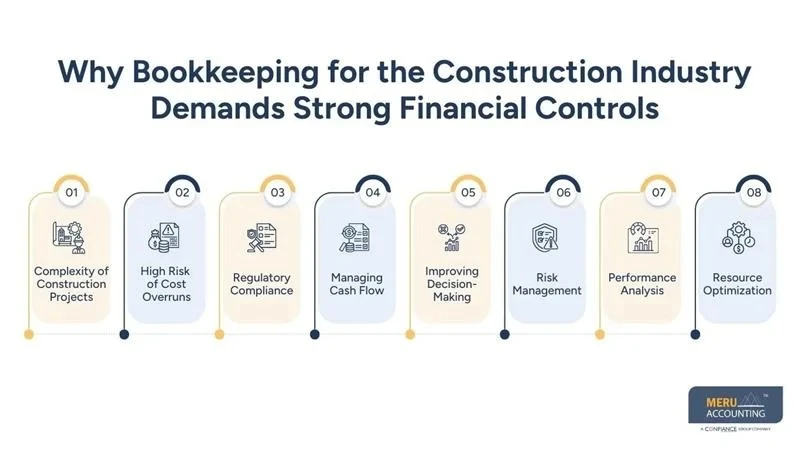
Risk Management
Financial tracking helps identify risks early, such as delayed payments or unexpected cost increases.
Performance Evaluation
Bookkeeping enables companies to measure project performance by comparing actual costs with planned budgets.
Resource Optimization
Accurate financial data helps businesses determine whether labor, equipment, or materials are being used efficiently.
The Role of Bookkeeping for the Construction Industry in Financial AccuracyAccurate Record-Keeping
Bookkeeping ensures that every financial transaction is recorded and categorized properly, reducing errors and discrepancies.
Real-Time Financial Insights
With proper bookkeeping systems, construction managers can access up-to-date financial information about project expenses and revenue.
Budget Monitoring
Tracking actual costs against project budgets allows businesses to identify variances early and take corrective action.
Profitability Analysis
Construction businesses can analyze which projects generate the highest profits and focus on similar opportunities in the future.
Audit Preparation
Well-organized financial records simplify the audit process and reduce stress during compliance reviews.
Key Financial Controls Every Construction Business Should ImplementProject Budgeting
Creating detailed project budgets ensures that funds are allocated properly and spending remains under control.
Cost Tracking
Regular monitoring of labor, material, and overhead costs helps identify inefficiencies and improve profitability.
Invoice Management
Efficient invoicing systems ensure timely billing and faster payment collection from clients.
Payroll Controls
Tracking employee hours, wages, and subcontractor payments ensures payroll accuracy and compliance with labor regulations.
Internal Audit Procedures
Regular financial reviews help detect errors, inconsistencies, and potential fraud.
How Bookkeeping for the Construction Industry Improves Financial VisibilityTransparent Financial Reporting
Clear financial reports provide stakeholders with a complete overview of project finances and company performance.
Monitoring Key Financial Metrics
Construction businesses can track metrics such as job cost variance, gross profit margins, and project performance.
Early Issue Identification
Financial visibility helps contractors identify cost overruns, delays, or payment issues early.
Strategic Planning Support
Accurate bookkeeping ensures that long-term financial decisions are based on reliable data.
Improved Team Communication
Transparent financial data allows project managers, finance teams, and executives to collaborate effectively.
Challenges of In-House Construction BookkeepingHigh Workload
Managing financial records for multiple projects can overwhelm internal accounting teams.
Limited Industry Expertise
In-house accountants may lack specialized knowledge of construction accounting methods.
Higher Risk of Errors
Manual data entry increases the likelihood of accounting mistakes.
Delayed Financial Reports
Busy internal teams may struggle to produce timely financial reports.
Resource Limitations
Maintaining accounting software, training staff, and ensuring compliance can strain internal resources.
Why Outsourced Construction Bookkeeping Improves Financial ControlsIndustry Expertise
Outsourced bookkeeping providers have specialized knowledge in construction accounting and project cost tracking.
Cost Efficiency
Outsourcing reduces the cost of maintaining a full-time internal accounting department.
Timely Financial Reporting
Professional bookkeeping services provide accurate financial reports on time.
Greater Accuracy
Systematic processes and reconciliations reduce errors and ensure reliable records.
Focus on Core Operations
Construction companies can focus on project execution while experts handle financial management.
Meru Accounting’s Bookkeeping Services for ConstructionAt Meru Accounting, we provide specialized bookkeeping for the construction industry designed to meet the unique needs of contractors and construction firms.
Our services include:
- Customized bookkeeping solutions for construction projects
- Detailed cost tracking for labor, materials, and overhead
- Outsourced bookkeeping support from experienced professionals
- Compliance and tax assistance for construction businesses
- Real-time financial insights and reporting
By partnering with Meru Accounting, construction companies can improve financial visibility, maintain accurate records, and make better strategic decisions.
Key Takeaways- Bookkeeping for the construction industry is essential for maintaining financial accuracy and transparency.
- Strong financial controls help prevent cost overruns, fraud, and accounting errors.
- Accurate bookkeeping improves project budgeting, cost tracking, and cash flow management.
- Outsourced construction bookkeeping offers expertise, efficiency, and reliable financial reporting.
- Businesses with structured financial controls can manage projects more effectively and achieve long-term growth.