Every growing business hits the same wall. Orders live in one sheet, stock in another, and accounts in a third. Someone always has the wrong version, and month-end turns into a week-long scramble. ERPNext fixes a lot of this, but only if it is set up around how you work.
That is where ERPNext development services come in. Rather than forcing your team to adapt to generic software, a good development partner adapts ERPNext to your business. The difference shows up in daily work: fewer clicks, fewer errors, and reports you can trust.
In this post, I’ll explain what these services cover, when they are worth the money, and how to avoid the mistakes that make ERP projects drag on. If you are still early in your research, our ERPNext implementation guide is a useful companion read.
What is Included in ERPNext Development?
We can think of ERPNext as a high quality shop, we can help you with filling the shelves with the right products. This often includes:
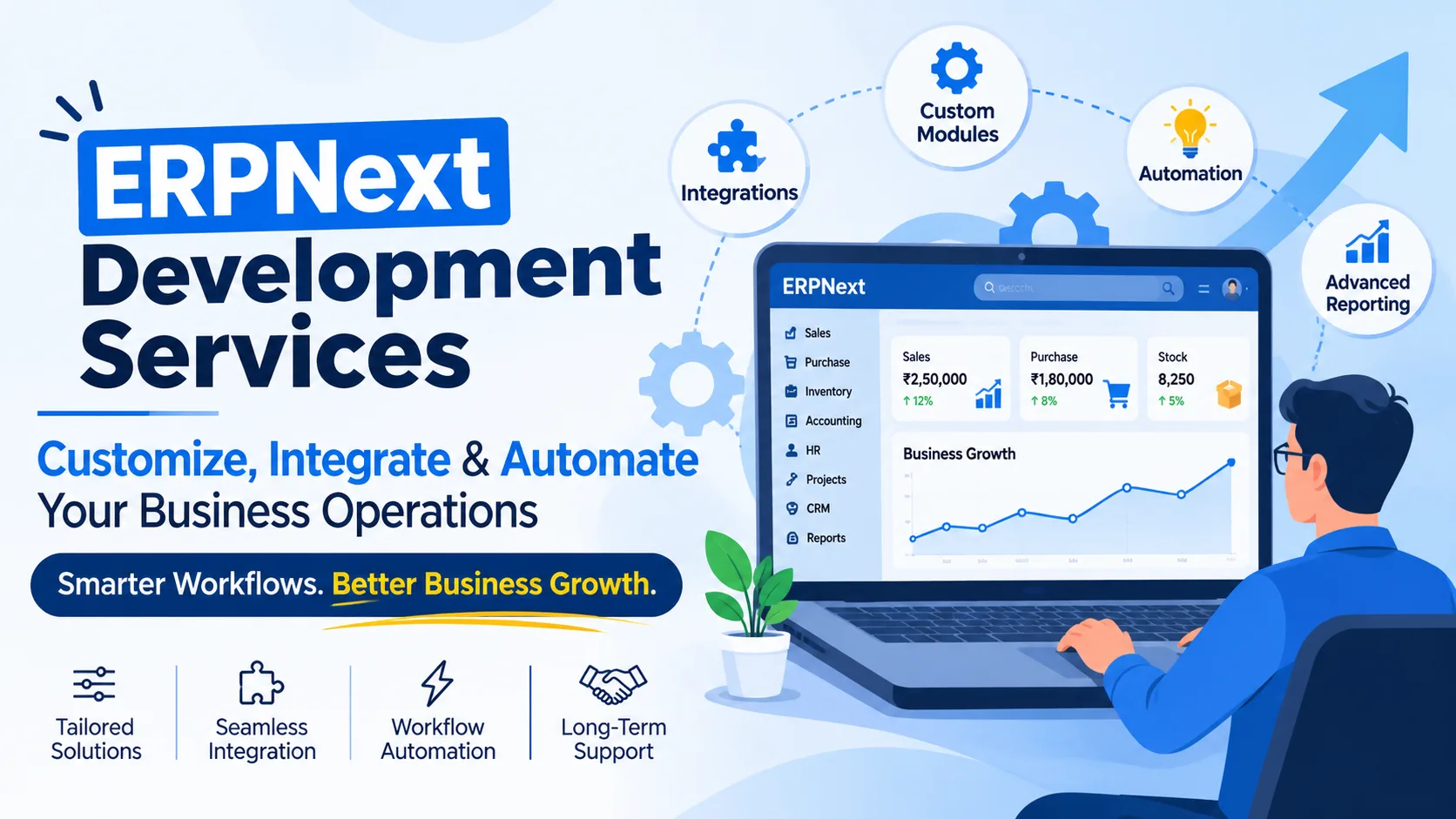
- Custom Apps/Modules (Built with the Frappe Framework)
- Custom Forms/Fields and Approval Processes
- Payment gateway integration and e-commerce, courier API and WhatsApp integration
- Custom Print Formats and Reports (GST Invoices, Sales Dashboard)
- Migration from Tally/Excel/Old ERP
- Upgrades, Hosting & Support.
Depending on your business you may not require all of the above. If you are a trading company you may just require clean data migration and some reports. If you are a logistics company you may need a fully custom module. You will only be paying for the parts of ERPNext that will affect your daily operations.
Why ERPNext is a popular option for Custom Developments
There are many reasons why ERPNext is a good option to choose when looking at ERP’s that can be customised.
- No Licencing Costs – You won’t incur any additional costs when adding additional sales people.
- Open Source – You can view and amend how things work within the code.
- Single Database – All information relating to your sales, purchase, stock, accounts, HR and Projects can be found in one place. This means your custom developments will streamline your workflow.
- Fantastic Support for India – Features like GST, E-Invoicing and E-Way Bill are included. This saves you hours of work. We have a blog explaining how to set up GST within ERPNext.
Most Impactful Services
- Workflow Automations
Slow approvals can have an impact on your profitability. When you have a purchase order or discount sitting in someone’s inbox you cannot move forward. Using custom workflows you can automate your requests and see where the issue is happening.
2. Industry Specific Modules
If you are a courier company you will need to be able to book, pickup, track and proof delivery. If you are a school you will need to be able to collect fees and track attendances. These modules are not included in the standard ERPNext so your developers will create them. This can be seen in our Courier Management Module.
Integrations
If you cannot integrate your ERP then you will waste a lot of time. Integrating your online store, payment gateway and shipping partner can allow you to automate your order processing, stock and reduce duplication.
3. Custom Reports & Dashboards
As the months go by, owners will start to ask more complicated questions. E.g. What product is the most profitable? Who do we owe money too? This can be easily found using custom reporting.
4. Training & Support
Even if you have a great piece of software, if no one is using it then it will not help. A good provider will offer training to your team and post live support. There will be smaller issues to manage.
How To Find The Right Development Partner
Not necessarily the cheapest but ask:
Have they done anything like it previously? Can they provide examples of past projects they have completed for clients in your industry?
Will they ask questions about your business? A good development team will ask you questions about how you invoice, approve and where your pain points are.
How will they ensure things are safe to change? As you will be using a custom app you will be able to upgrade your system. You will however not be able to upgrade the core files.
What support will they provide? How fast will they be? What contact details do they have?
Clear scope? If it is unclear then this could cause issues.
Timelines
Every project will be different however you can expect to spend:
1-2 weeks on Discovery and Planning
2-4 weeks on Configuration
3-8 weeks on Custom Development
2-3 weeks on Testing and Data Migration
1-2 weeks on Training and Go Live.
Simple projects will often only take around 6 weeks but if your project is complex around manufacturing and multi branch then it can take 4 months+. Be wary of people who can promise you a fully bespoke ERP in 10 days.
Over customisation. It can sometimes be cheaper to change your processes rather than your software.
Not involving your users. The users of the system should be involved with trialling the system.
Poor data. If you are inputting messy data then your reports will be messy.
No post go live plan. Your ERP should grow with your business.
Frequently Asked Questions:
1. What are ERPNext development services?
ERPNext development services are used to tailor ERPNext to your business. You can have custom modules, workflows, integrations, reports, data migrations and support.
2. How much do ERPNext development services cost?
This will depend on how complicated your project is. Simple projects will be much cheaper than those requiring multiple modules. You should always ask for a detailed breakdown.
3. How long will ERPNext customisation take?
This can vary. Simple projects can be completed within 4-6 weeks. Larger projects that require custom modules and data migrations can take 3-4 months.
4. Will ERPNext customisations affect my ability to upgrade?
No. As long as it has been done properly your developers creating custom apps will ensure your upgrades are safe.
5. Can ERPNext be integrated with my existing systems?
Yes! ERPNext can be integrated with e-commerce stores, payment gateways, CRMs, courier services and messaging apps using APIs.
6. Is ERPNext good for small businesses?
Yes! As there isn’t a licensing fee per user it can often be cheaper than paid options. You can get a basic setup and add new modules as you go along.
7. Do I need any support after going live?
We would definitely recommend it. New users will always have questions and your requirements will evolve. Having a support plan will save you time.
Final Thoughts
ERPNext is a great platform but when it is tailored to your business is when it really comes into its own. Finding the right ERPNext development services partner will save you months of frustration, provide your team with a system they will use everyday and allow you to scale.
Before speaking to any providers make a list of your top 3 operational issues you face everyday. How they respond to this list will tell you more than any sales pitch.