ERP Software for Oman E-Invoicing Compliance: A Complete Guide
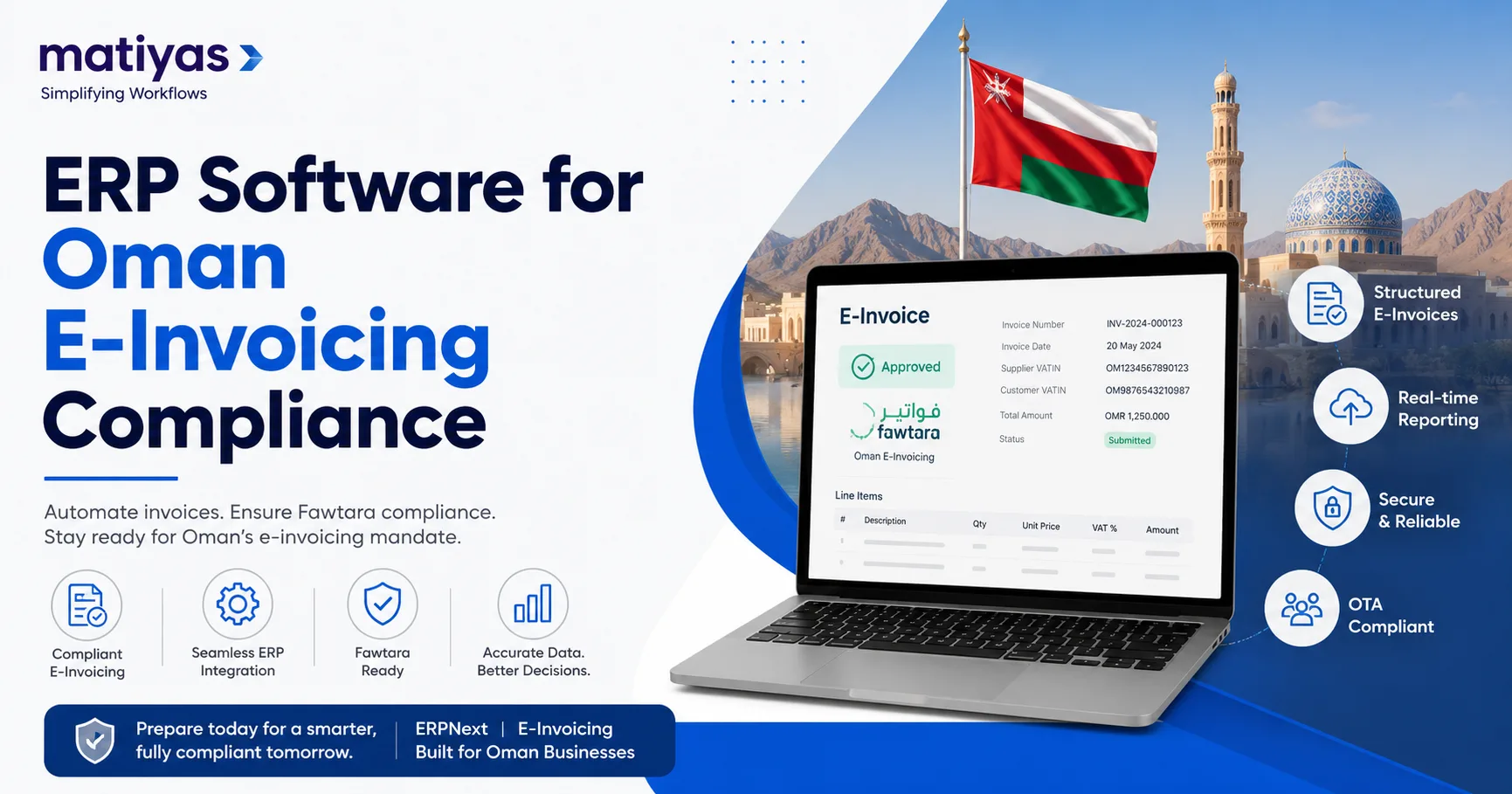
Oman is changing the way businesses create, exchange, and report invoices. With the introduction of Fawtara, the Sultanate's electronic invoicing initiative, VAT-registered businesses are moving toward a more structured and automated invoicing environment.
This transition involves more than replacing a printed invoice with a digital document. Businesses need to consider how invoice information is generated, validated, exchanged, recorded, and connected with their existing financial processes.
For companies already managing accounting, sales, purchasing, and customer transactions digitally, ERP can play an important role in this transition.
ERP software for Oman e-invoicing compliance can help businesses connect invoice creation with accounting and operational data while preparing their systems to work with Oman's evolving e-invoicing framework.
What Is Oman E-Invoicing?
Electronic invoicing is a structured method of generating and exchanging invoice information digitally.
A PDF invoice sent through email may be electronic in a general sense, but it is not necessarily a compliant e-invoice. Under Oman's framework, e-invoices use standardized digital information that can move electronically between the seller, buyer, service providers, and the Oman Tax Authority (OTA).
Oman's e-invoicing initiative is known as Fawtara.
According to the Oman Tax Authority, the system uses a 5-Corner Model designed to enable standardized and secure invoice exchange. The model connects suppliers and buyers through their respective service providers while also communicating invoice data to the Tax Authority.
The objective is to improve tax compliance and transparency while reducing manual invoicing processes and supporting greater automation.
How Does the Fawtara Model Work?
Understanding the basic transaction flow makes it easier to see where ERP fits into e-invoicing.
Imagine an Oman-based company sells goods or services to another business.
The supplier first creates the invoice. Instead of simply printing it or emailing a PDF, invoice information moves through the supplier's service provider.
The information is then exchanged through the e-invoicing network and reaches the customer's service provider before being delivered to the customer. At the same time, relevant invoice data is communicated to the Oman Tax Authority.
This creates an interconnected invoicing environment involving five participants:
- Supplier
- Supplier's service provider
- Customer's service provider
- Customer
- Oman Tax Authority
For businesses processing a significant number of invoices, manually moving information between accounting software, ERP systems, and an e-invoicing platform can create unnecessary work.
Integration therefore becomes an important part of e-invoicing readiness.
Oman E-Invoicing Implementation Timeline
Oman is introducing Fawtara gradually rather than requiring every VAT-registered business to adopt it on the same date. Businesses can review the complete Oman e-invoicing timeline to understand the rollout phases and prepare for their applicable compliance period.
Based on the Oman Tax Authority's current published FAQ, implementation is planned in phases:
Phase 1 – August 2026:
Implementation begins for 100 selected large VAT-registered companies.
Phase 2 – February 2027:
The rollout expands to all large VAT-registered companies.
Phase 3 – August 2027:
Remaining VAT-registered taxpayers are brought into the system, including SMEs.
Phase 4 – Government entities:
Government institutions and entities will be included in a later phase, with the year currently to be announced.
Businesses should verify their own applicable requirements and implementation dates directly with the Oman Tax Authority because regulatory and technical information can be updated during the rollout.
Where Does ERP Fit Into Oman E-Invoicing?
An invoice is usually the result of several earlier business activities.
A company receives a customer order. Products or services are confirmed. Pricing and taxes are calculated. Goods may be delivered. An invoice is then generated, followed eventually by payment and accounting entries.
When these activities take place in different systems, e-invoicing can introduce another layer of data transfer.
An integrated ERP environment takes a different approach.
Customer details, item information, tax data, sales transactions, invoices, accounting records, and payments can originate from connected business processes.
This means the ERP can become an important source of structured transaction information required for electronic invoicing.
With appropriate configuration and integration, ERP software for Oman e-invoicing compliance can help businesses prepare invoice data and connect their internal processes with the required e-invoicing ecosystem.
Why Invoice Data Quality Matters
E-invoicing puts greater importance on the information behind an invoice.
In a manual environment, an employee may notice incomplete information and correct it before sending a document. Automated electronic exchange is less forgiving of inconsistent data.
Businesses therefore need to examine the quality of information stored within their systems.
This may include customer records, VAT information, product or service descriptions, tax treatment, invoice references, transaction dates, quantities, prices, and other required invoice fields.
Preparing for Fawtara should therefore not begin only with software integration.
It should also involve reviewing the data that will eventually flow through that integration.
ERP provides an opportunity to maintain this information centrally and apply consistent rules when transactions are created.
Automating the Invoice-to-Accounting Workflow
Consider a business processing hundreds of customer invoices every month.
If employees have to create a sales invoice in one application, manually enter the same information into another platform for e-invoicing, and then update accounting records separately, the business has created three opportunities for inconsistency.
ERP integration can reduce this duplication.
A properly designed workflow can connect the original sales transaction with invoice generation, accounting, payment tracking, and the external e-invoicing process.
The goal is not simply to issue electronic invoices.
It is to make e-invoicing part of the company's normal business workflow rather than an additional administrative task performed after every sale.
How ERPNext Can Support E-Invoicing Readiness
ERPNext is an open-source ERP platform that integrates accounting with sales, purchasing, inventory, CRM, and other business functions.
For businesses preparing for Oman e-invoicing, ERPNext can provide the operational foundation from which invoice information is generated.
For example, businesses can manage:
- Customer and supplier records
- Sales invoices
- Purchase invoices
- Tax configurations
- Items and services
- Sales and purchase transactions
- Credit and debit-related workflows
- Payment records
- Accounting entries
- Financial reports
Where required, ERPNext can also be customized and integrated with external systems or service providers.
However, using ERPNext alone should not automatically be interpreted as Fawtara compliance. Compliance depends on the actual configuration, required technical integration, service-provider arrangements, current OTA specifications, and the business's applicable obligations.
That distinction is important when evaluating any e-invoicing ERP in Oman.
Preparing Your ERP for Fawtara
Businesses do not need to wait until their applicable rollout date to examine their readiness.
Preparation can begin with existing processes.
First, identify how invoices are currently generated. Determine which system holds customer information, VAT details, product data, pricing, and accounting records.
Next, review data accuracy. Duplicate customer records, incomplete tax information, inconsistent item descriptions, and manual adjustments can create difficulties when transactions become more automated.
Businesses should then evaluate whether their current accounting or ERP software can support the integrations required for Fawtara.
The Oman Tax Authority states that companies need to issue invoices electronically using approved formats and use a certified service provider or compatible ERP solution while ensuring timely invoice reporting.
The technical and regulatory requirements applicable to a particular company should therefore be confirmed before implementation.
Benefits Beyond Regulatory Compliance
Fawtara is primarily a tax and invoicing initiative, but preparing for it can also encourage businesses to improve their internal processes.
When invoicing becomes connected with ERP, companies may reduce repeated data entry and gain more consistent financial records.
Finance teams can access transactions without waiting for information to be transferred manually. Sales invoices can remain connected to customer records and related business activities. Management can gain better visibility into receivables, revenue, taxes, and transaction history.
Electronic records can also simplify invoice retrieval and create a clearer audit trail.
Therefore, the business case for ERP integration should not be viewed exclusively through the lens of regulatory compliance.
It can also be an opportunity to modernize the complete invoice-to-accounting process.
Start Preparing for Oman E-Invoicing
Oman's transition to Fawtara represents a significant change in how businesses will exchange invoice information.
For VAT-registered companies, preparation should involve more than waiting for a compliance deadline. Businesses need to understand their rollout phase, examine invoice data, review existing accounting processes, and determine how their software will connect with the new e-invoicing environment.
Implementing ERP software for Oman e-invoicing compliance can provide a stronger foundation by bringing invoicing, accounting, customer data, tax information, and operational transactions into a connected system.
ERPNext can be configured and integrated according to a company's business requirements, while an experienced implementation partner can help evaluate existing workflows and identify the technical changes required for e-invoicing readiness.
Matiyas Solutions provides ERPNext implementation, customization, integration, and support services for businesses in Oman. Companies preparing for Fawtara can begin by assessing their current ERP environment, invoice data, and integration requirements before their applicable e-invoicing phase begins.