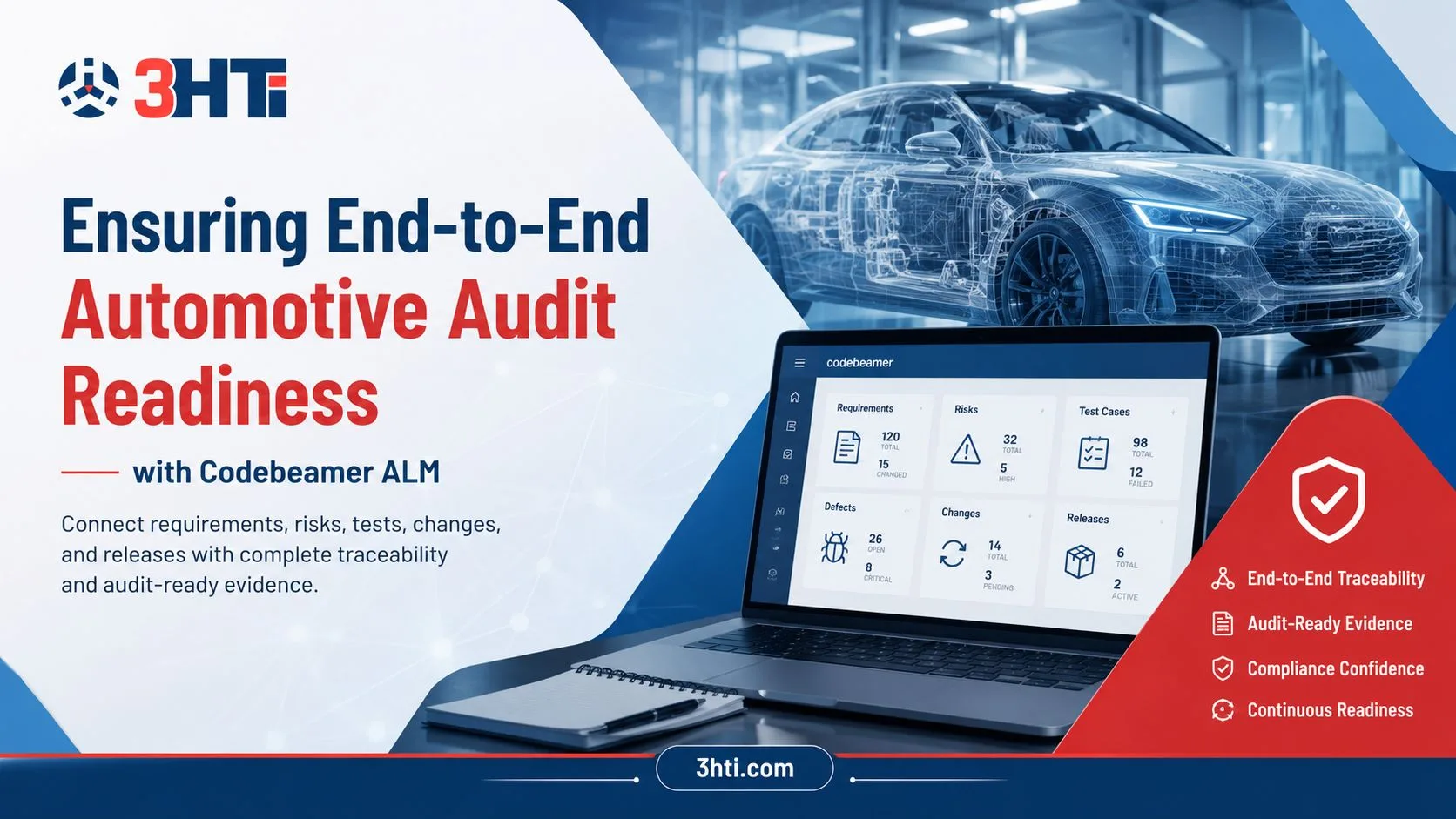
Automotive audit readiness increasingly depends on whether an engineering organization can prove the relationship between requirements, risks, design decisions, software, tests, defects, changes, and releases. Codebeamer ALM provides a structured environment for connecting these artifacts and maintaining traceability across complex product-development workflows. PTC identifies Codebeamer as an ALM platform for requirements, risks, tests, variants, compliance artifacts, and end-to-end traceability, with support for standards including ISO 26262 and Automotive SPICE.
For automotive manufacturers and suppliers, the goal is not merely to pass an audit. It is to maintain an engineering record that can demonstrate what was required, why it was required, how risk was assessed, how the requirement was implemented, how it was tested, and what changed before release.
Key Takeaways
- Automotive audit readiness depends heavily on traceability, controlled processes, evidence, and change management.
- Codebeamer connects requirements, risks, tests, defects, releases, and other lifecycle artifacts into a traceable digital thread.
- ISO 26262 addresses functional safety throughout the automotive safety lifecycle, including management, system, hardware, software, and supporting processes.
- Automotive SPICE evaluates process capability across defined process areas and includes bilateral traceability among its work-product concepts.
- UN Regulations 155 and 156 add cybersecurity and software-update management considerations for applicable vehicle programs.
- Codebeamer 3.3, released by PTC in August 2026, adds capabilities focused on traceability, change management, product variants, AI-assisted search, and governance.
What Does Automotive Audit Readiness Actually Mean?
Automotive audit readiness means an organization can produce credible, controlled evidence that its development processes are being followed and that product requirements and risks remain traceable through verification and validation.
This is broader than storing documents.
For example, an auditor may need to understand the relationship between:
Stakeholder Requirement → System Requirement → Software Requirement → Risk → Design/Implementation → Test Case → Test Result → Defect → Change → Release
If those relationships exist only across spreadsheets, emails, documents, source-control systems, and disconnected test tools, assembling evidence can become a manual reconciliation exercise.
Codebeamer is designed to centralize these relationships and provide traceability across requirements, risks, tests, defects, variants, and releases.
Why Traceability Matters for ISO 26262
ISO 26262 provides a functional-safety framework for safety-related electrical and electronic systems in road vehicles. Its lifecycle encompasses management activities as well as product development at the system, hardware, and software levels.
That makes traceability a practical engineering requirement, not merely an administrative exercise.
A safety-related requirement should be connected to the evidence showing how it was addressed and verified. When a requirement changes, teams should also be able to determine what downstream artifacts may be affected.
Codebeamer supports this model through linked requirements, risks, tests, reviews, changes, and releases. PTC specifically describes the platform as providing a digital thread from concept to release and supporting compliance through traceability, baselines, reviews, and audit-ready documentation.
How Codebeamer Supports Automotive SPICE Readiness
Automotive SPICE focuses on assessing the capability of development processes. Its current Process Assessment Model includes capability levels from performed through optimizing processes and explicitly addresses work-product characteristics and bilateral traceability.
Codebeamer can support the evidence-management side of this environment by connecting:
- Requirements
- Development activities
- Reviews
- Test cases
- Test results
- Defects
- Changes
- Releases
- Baselines
- Approvals
The important distinction is that ALM software does not make an organization Automotive SPICE compliant by itself. The organization still needs defined processes, competent teams, appropriate governance, and evidence that those processes are actually followed.
Codebeamer provides infrastructure for making that evidence structured, connected, and easier to retrieve.
Building an End-to-End Automotive Audit Trail
A practical audit-ready workflow can be built around five connected layers.
1. Requirements
Capture stakeholder, system, hardware, and software requirements in a controlled environment.
Each requirement should have an identifiable owner, status, version, rationale where applicable, and relationship to relevant downstream artifacts.
2. Risk and Safety Analysis
Connect hazards, risks, safety goals, and mitigation requirements to the development lifecycle.
This is particularly important for functional-safety programs where changes to safety-related requirements can have consequences across multiple engineering artifacts.
3. Verification and Validation
Requirements should connect to appropriate verification methods, test cases, execution results, and defects.
This gives engineering leaders a much clearer answer to a fundamental audit question:
Can you demonstrate that the requirement was actually verified?
4. Change and Configuration Management
Every significant change should have a controlled reason, approval path, impact assessment, and relationship to affected artifacts.
This becomes increasingly important as automotive products evolve through software releases and product variants.
5. Release Evidence
At release time, teams should be able to establish which requirements, tests, risks, defects, and approvals applied to that specific configuration.
This creates a reproducible evidence trail instead of requiring engineers to reconstruct project history manually.
Why Automotive Cybersecurity and Software Updates Matter
Modern vehicle programs increasingly require evidence beyond traditional functional-safety processes.
UN Regulation No. 155 establishes a framework for cybersecurity management, while UN Regulation No. 156 addresses software-update management. UNECE materials describe requirements around risk assessment, mitigation, monitoring, software identification, update documentation, and evidence that may be reviewed by authorities.
For software-defined vehicles, this means lifecycle traceability must extend into cybersecurity and software-update processes.
Codebeamer's value is therefore broader than requirements management: it can provide a structured environment for connecting engineering evidence across increasingly software-intensive product lifecycles.
Where ALM Integration Becomes Critical
Automotive engineering rarely happens inside one application.
Organizations may use requirements tools, PLM, CAD, source-control platforms, CI/CD pipelines, testing tools, and enterprise systems simultaneously.
PTC documents Codebeamer integrations with tools including IBM DOORS, Jira, Jenkins, Git, PLM systems, and testing platforms such as VectorCAST. These integrations are designed to maintain synchronized information and traceability across the lifecycle.
This is where ALM integration solutions become strategically important.
For example, connecting Codebeamer with Windchill can help establish relationships between software/system development and broader product lifecycle information rather than leaving those environments as isolated silos.
How Should Organizations Prepare for an Automotive Audit?
A practical readiness assessment should examine six areas:
- Traceability: Can requirements be traced to verification evidence?
- Risk management: Are safety and product risks connected to mitigations and requirements?
- Change control: Can the organization demonstrate who approved significant changes and why?
- Configuration: Can teams reproduce the state of a product or release at a defined point in time?
- Evidence: Can required records be retrieved without manually searching disconnected systems?
- Process adherence: Does actual engineering behavior match the organization's documented process?
Organizations that identify gaps should address process weaknesses before attempting to solve everything through tooling.
3HTi provides compliance audit services and business-process audit support for regulated engineering organizations, including assistance with preparing processes for external audits.
For organizations implementing or optimizing Codebeamer, 3HTi's ALM services include implementation, process consulting, data management and migration, template setup, integration, and ongoing services.
How PLM and ALM Complete the Digital Thread
Automotive products combine mechanical, electrical, electronic, and software components. Keeping these disciplines connected is therefore essential for modern product development.
PLM managed services can support product structures, engineering data, lifecycle processes, and enterprise product information, while Codebeamer manages requirements, risks, testing, software lifecycle artifacts, and related traceability.
The result is a broader engineering Digital Thread rather than an isolated ALM repository.
The strongest audit-readiness strategy is consequently not "install Codebeamer and become compliant." It is to establish a controlled development process, connect the right engineering systems, define traceability relationships, and continuously maintain the evidence required by the organization's applicable standards and regulations.
For automotive organizations, that combination turns audit preparation from a last-minute documentation exercise into a continuous engineering discipline.
FAQs
Can Codebeamer make an automotive company ISO 26262 compliant?No. Codebeamer is a tool that can support requirements management, traceability, risk management, testing, reviews, and compliance workflows. ISO 26262 compliance depends on the organization's complete safety lifecycle, processes, responsibilities, engineering activities, and evidence, not on software alone.
Does Codebeamer support Automotive SPICE?Codebeamer can support Automotive SPICE-related process evidence through structured requirements, workflows, traceability, reviews, testing, and controlled work products. However, Automotive SPICE process capability is assessed against the organization's actual processes and work products, not simply the tool being used.
How does Codebeamer improve audit readiness?Codebeamer centralizes and links requirements, risks, tests, defects, changes, variants, and releases. This makes relationships between development artifacts easier to demonstrate and reduces dependence on manually reconciling disconnected spreadsheets and documents.
Can Codebeamer integrate with PLM systems?Yes. PTC documents Codebeamer integrations with PLM tools and other engineering applications. These integrations can help organizations connect ALM information with broader product lifecycle processes and establish a more complete engineering Digital Thread.
Why are UN Regulations 155 and 156 relevant to automotive ALM?UN Regulation 155 addresses vehicle cybersecurity management, while UN Regulation 156 addresses software-update management. Both require structured processes and evidence around areas such as risk management, software identification, updates, and cybersecurity activities.
Can an operational audit process replace continuous audit readiness?No. An operational audit process can identify weaknesses at a specific point in time, but continuous readiness requires organizations to maintain controlled processes, traceability, configuration information, approvals, and evidence throughout development. Regular audits should therefore complement, not replace ongoing governance.