Email marketing continues to evolve as businesses look for smarter ways to engage audiences without overwhelming them. Two terms that often get used interchangeably are drip campaigns and automation campaigns. While both rely on automated systems, they serve different strategic purposes. Understanding the distinction between an Email Drip Campaign vs Email Automation Campaign can help marketers build more effective communication strategies.
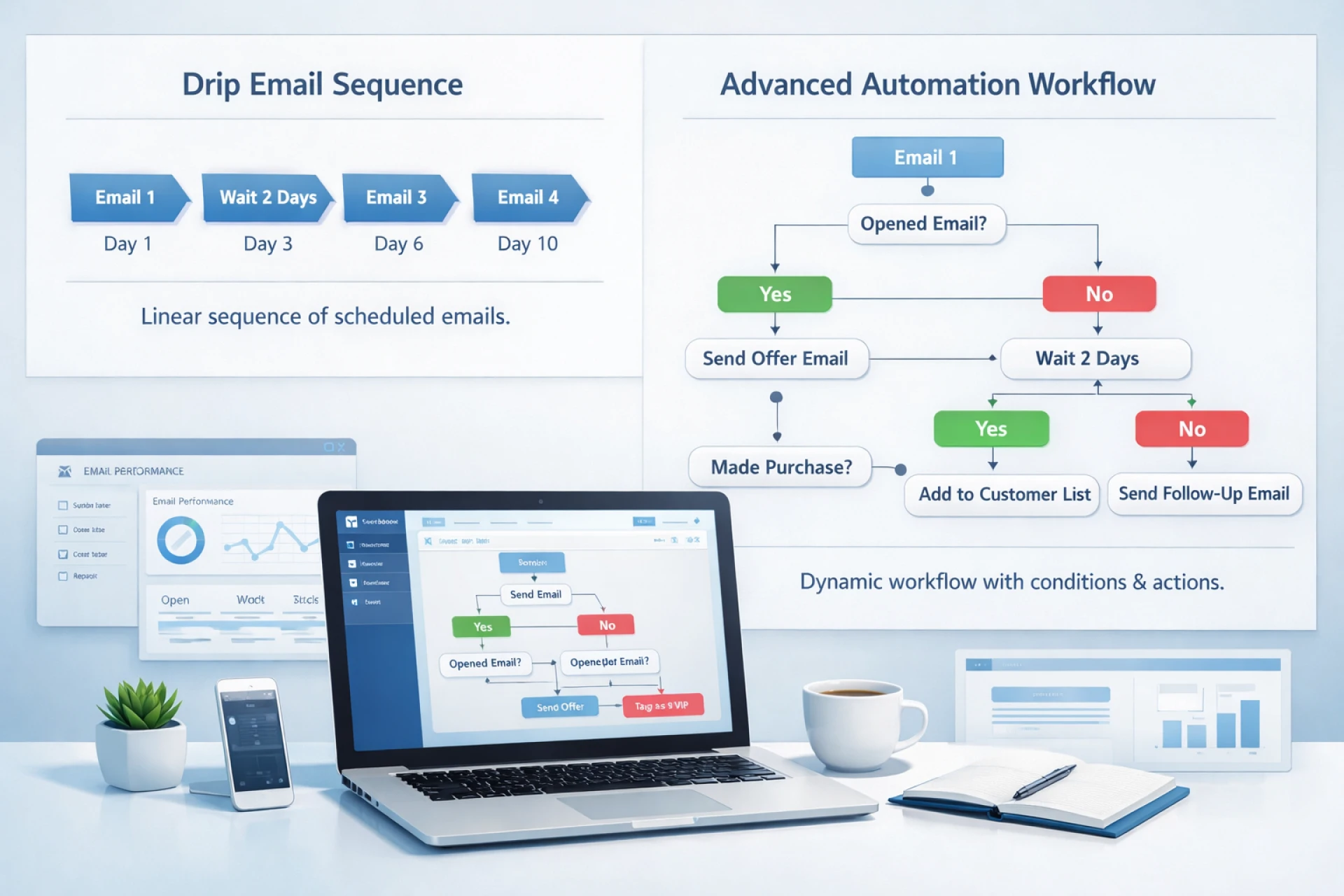
A drip campaign is typically a pre-written sequence of emails sent at predetermined intervals. The sequence is triggered by a specific action such as signing up for a newsletter, downloading a guide, or registering for a webinar. Once the trigger occurs, the system automatically sends emails according to a fixed timeline. For example, a new subscriber might receive a welcome email immediately, a product overview two days later, and a testimonial email after five days.
Drip campaigns are structured and predictable. They are especially useful for onboarding sequences, educational series, and lead nurturing flows where the journey is consistent for every subscriber. Because the sequence does not change based on behavior, drip campaigns are relatively simple to set up and manage.
On the other hand, automation campaigns are more dynamic and responsive. Instead of following a strict timeline, they adapt to subscriber behavior and engagement. These campaigns can change based on actions such as opening an email, clicking a link, visiting a pricing page, abandoning a cart, or completing a purchase.
For example, if a subscriber clicks on a link related to a specific service, the automation workflow can send more targeted content related to that interest. If they ignore multiple emails, the system might pause communication or shift messaging strategies. This level of responsiveness allows marketers to personalize communication at scale.
The difference becomes clearer when looking at complexity. Drip campaigns operate on a linear structure. Automation campaigns operate within conditional logic frameworks. Automation workflows often use if/then rules, segmentation triggers, scoring models, and behavioral tracking.
That does not mean one is better than the other. Each has its place depending on business objectives.
Drip campaigns work well when:
- The customer journey is predictable
- Education or onboarding is required
- Every subscriber should receive the same foundational information
- Simplicity and consistency are priorities
Automation campaigns work well when:
- Personalization is critical
- The audience has diverse interests
- Behavioral data is available
- Conversion optimization is a priority
Many modern marketing strategies combine both. For example, a company might use a drip sequence for new subscribers while simultaneously running behavioral automation workflows that respond to website activity.
Another key difference lies in data usage. Drip campaigns require minimal ongoing data input once set up. Automation campaigns require continuous monitoring and optimization. Metrics such as open rates, click-through rates, conversion rates, and engagement scoring influence how workflows perform over time.
From a technical standpoint, automation campaigns often require more advanced marketing platforms. They may integrate with CRM systems, analytics tools, and behavioral tracking software. Drip campaigns can typically be handled by most standard email service providers.
When comparing Email Drip Campaign vs Email Automation Campaign, it’s helpful to think in terms of structure versus intelligence. Drip campaigns provide structured communication. Automation campaigns introduce intelligence based on real-time data.
Businesses that rely heavily on lifecycle marketing, customer segmentation, and conversion optimization often lean toward automation. Smaller teams or businesses just beginning their email strategy may start with drip campaigns before expanding into more advanced automation.
It is also worth considering user experience. Over-automation without thoughtful planning can feel intrusive. Sending too many behavior-triggered emails can overwhelm subscribers. Balance remains important regardless of the method used.
Ultimately, the decision depends on marketing maturity, available data, and campaign goals. A startup educating new users about its product may benefit more from a clear onboarding drip sequence. An established ecommerce brand tracking browsing behavior may gain more from dynamic automation.
Both approaches support long-term relationship building when executed thoughtfully. The key is aligning the strategy with customer expectations and business objectives.
As email marketing becomes more competitive, understanding the differences between drip and automation strategies allows marketers to design smarter workflows that improve engagement without sacrificing relevance.