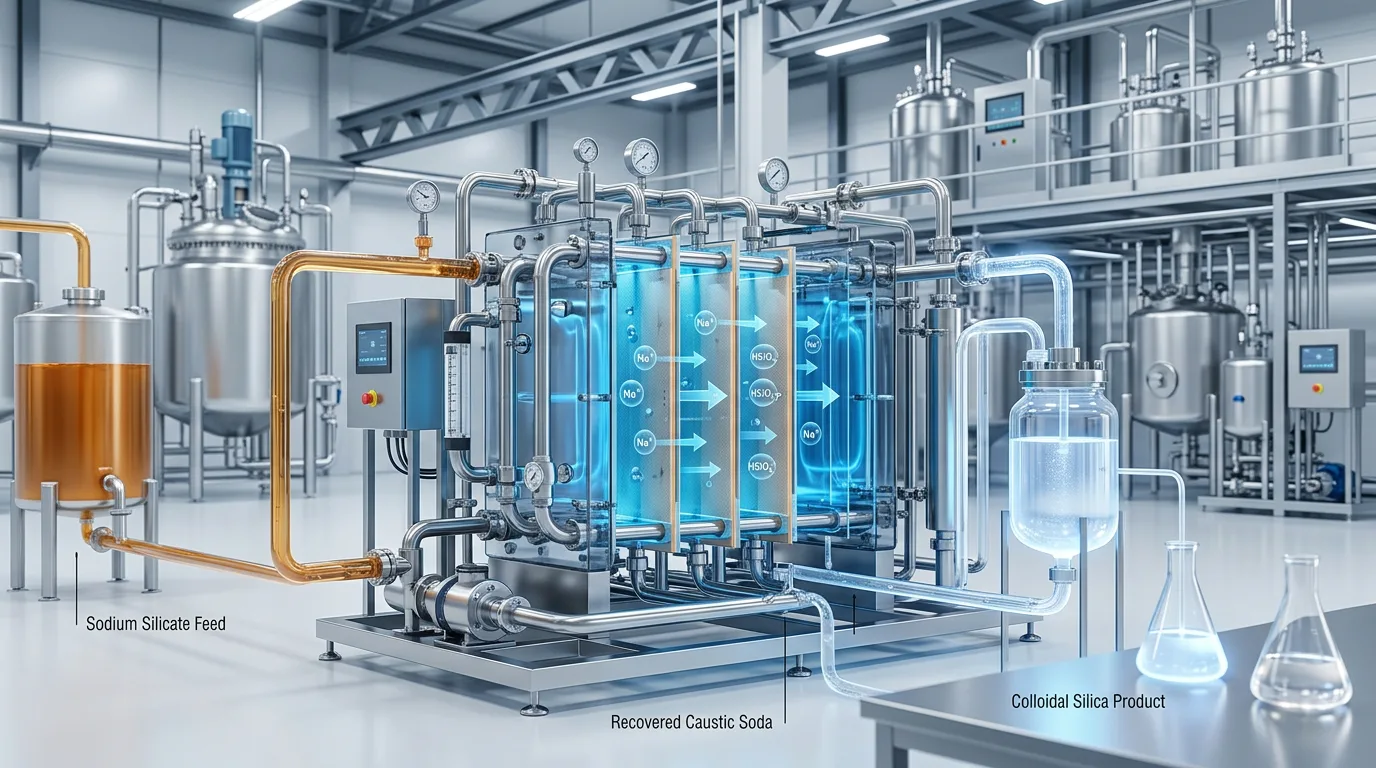
We design modular, fully automated electrodialysis plants for colloidal silica production that control ionic strength and pH, reduce chemical dosing, and stabilise particle charge so your spray-dryer or downstream reactor behaves predictably pilot to commercial scales, touch-operated and application-tailored.
Introduction
Three things decide whether colloidal silica runs clean or sloppy: ionic strength, pH, and salt carryover. As an electrodialysis plant manufacturer, Laxminarayan Technologies builds ED and EDBM systems for colloidal silica workflows so those variables stay under control. You give us the feed data; we give you a skid that desalts, concentrates, or generates acid and alkali on-site with recipe-driven automation, so the process feels less like guesswork and more like engineering.
What is electrodialysis / EDBM?
Electrodialysis moves ions through alternating cation and anion exchange membranes under DC to separate a feed into diluate and concentrate streams. Electrodialysis with bipolar membranes (EDBM) adds bipolar elements that split water into H+ and OH–, converting salts into acid and base without external reagents. This lets you control ionic strength and make dilute acid/alkali for washes or surface treatment.
Use Cases / Applications
- Desalting before spray drying to avoid sintering and bridging during powder formation.
- On-site alkali production (EDBM) for silanol activation and surface functionalisation.
- Acid recovery from wash streams to reduce hazardous chemical handling.
- Brine concentration and ZLD preparation to cut hauling costs.
For a process note and pilot options see our application page on colloidal silica manufacturing. Electrodialysis plant for colloidal silica manufacturing process.
Design and process choices
- Feed characterisation: measure TDS, silica ppm, particle size, organics, and hardness before design.
- Membrane selection: pick chemistry and thickness suited for silica-laden feeds and your CIP detergents.
- Stack layout: choose cell count and bipolar placement according to recovery and acid/base needs.
- Controls: recipe-based PLC/HMI with conductivity, pH, current and voltage interlocks prevents membrane damage.
We deliver modular racks so you scale by adding trains rather than re-engineering the whole plant.
Challenges & Solutions
- Membrane fouling: silica and organics foul like a clogged filter; our spec calls for cartridge prefiltration (1–5 µm), staged CIP (alkaline then acid), and periodic polarity reversal where beneficial.
- Scaling from hardness: hardness precipitates when pH swings; we recommend softening ahead of the stack or targeted acid pulses, and anti-scalant cycles in CIP.
- Current efficiency loss: stacks polarise and efficiency drops as voltage creeps like a stressed pump; our controllers run stepped or pulsed current and monitor stack voltage to stay in the efficient window.
- Maintenance downtime: we design quick-swap stacks and keep spare membrane cassettes in the spare-parts kit so you schedule swaps, not emergency repairs.
How an EDBM stack splits salt step-by-step
- Feed flows through diluate chambers between cation and anion membranes.
- DC field moves cations and anions into concentrate channels.
- Bipolar membranes split water into H+ and OH– under field stress.
- H+ and OH– collect into separate streams, producing acid and alkali from the original salt.
Performance anchors (quotable)
According to membrane industry sources, typical cell-pair voltages are about 1–3 V and current densities range commonly from 50–500 A/m2; energy for desalting duties commonly falls roughly between 0.5–3 kWh/m3 depending on feed and recovery targets.
Pilot-to-commercial path (numbered)
- Bench ED cell screening with your feed.
- 1–5 m2 pilot stack with filtration and CIP loop.
- 10–50 m2 modular pilot rack to validate recipes.
- Multi-rack commercial trains with redundant capacity.
Conclusion
We build modular, fully automated, touch-operated ED and EDBM plants that let you control ionic strength and pH for consistent colloidal silica quality, from pilot runs to production trains. Laxminarayan Technologies pairs field commissioning experience, pilot scale validation, and recipe-based automation so your runs stop being guesswork and start being reproducible. Tell us your feed spec and we’ll propose a pilot configuration.
FAQs
Q: What is the best electrodialysis plant manufacturer for colloidal silica production?
A: The best manufacturer combines pilot capability, modular design, automation, and experience with silica feeds including filtration and CIP match. Laxminarayan Technologies provides those services and pilot-to-commercial scaling.
Q: How often will membranes need CIP or replacement?
A: CIP frequency depends on organics and silica load from weekly to monthly; membrane replacement typically ranges 3-7 years with good prefiltration and CIP practice.
Q: Can EDBM replace chemical dosing for pH adjustments?
A: Yes. EDBM can generate dilute acid and alkali on-site from salts, reducing external reagent handling, but it adds system complexity and requires an energy bud